
Chirality
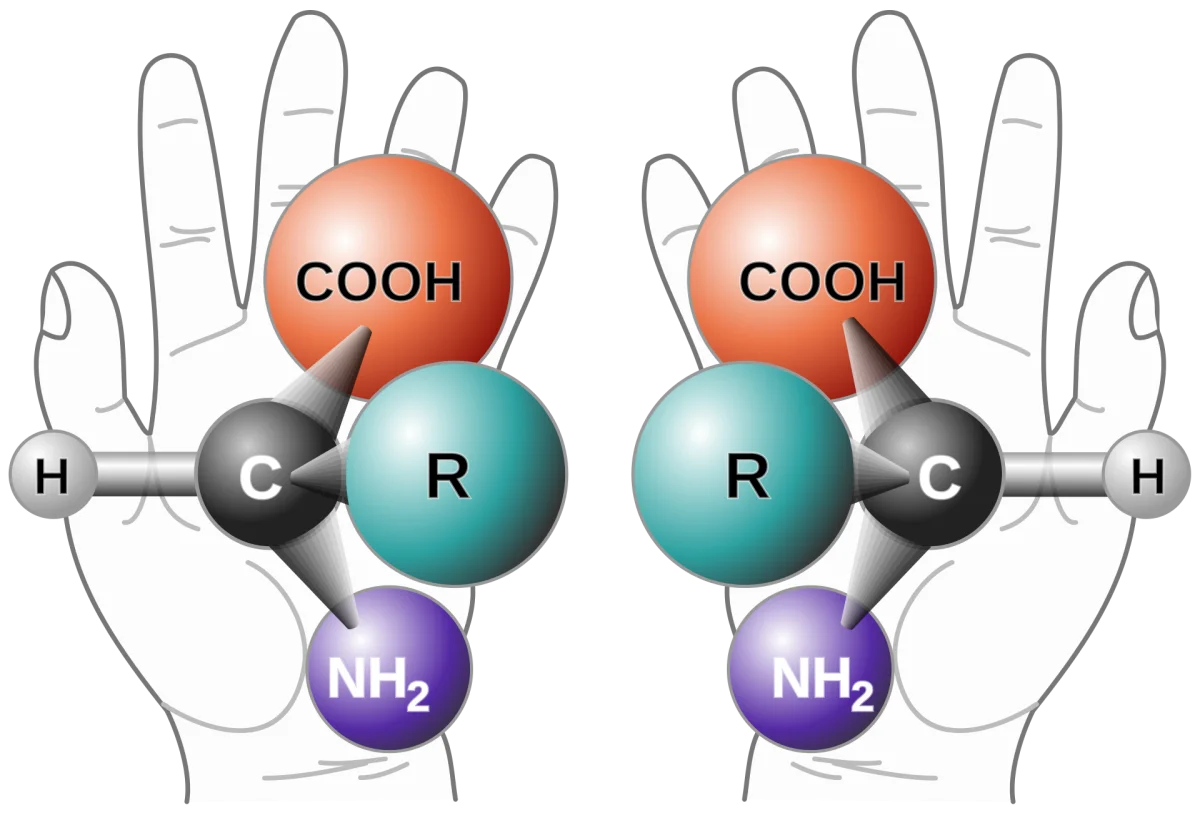
Look at your hands. They are mirror images of each other. But no matter how you rotate your left hand, you cannot make it look identical to your right hand. If you place your left hand flat on a table, palm down, your thumb points right. If you place your right hand palm down, your thumb points left. Same fingers, same connections, but not stackable. This property - being non-superimposable on your mirror image - is called chirality.
A molecule is chiral if it cannot be superimposed on its mirror image. A molecule is achiral if it CAN be superimposed on its mirror image.
The Requirements for Chirality
The most common cause of chirality is a chiral center (stereocenter) - a carbon atom bonded to four different substituents. But chirality is actually a property of the whole molecule, not just individual atoms. Here is the complete picture:
A molecule is chiral if:
- It has no internal plane of symmetry (no mirror plane that divides the molecule into two identical halves)
- It is non-superimposable on its mirror image
A molecule is achiral if:
- It has an internal plane of symmetry, OR
- It is superimposable on its mirror image
The plane of symmetry test is usually the fastest way to determine chirality on the MCAT.
Identifying Chiral Centers Step by Step
To find chiral centers in a molecule, examine each carbon and check whether it is bonded to four different groups:
Step 1: Look at a carbon atom.
Step 2: Identify the four groups attached to it. Trace each group outward from the carbon - you need to follow the entire chain, not just the immediately attached atom.
Step 3: Compare all four groups. If all four are different, the carbon is a chiral center. If any two are identical, it is not.
Example: 2-bromobutane (CH3CHBrCH2CH3)
Carbon 2 is bonded to: H, Br, CH3 (going one direction), and CH2CH3 (going the other direction). All four groups are different, so carbon 2 is a chiral center.
Example: 2-propanol (CH3CHOHCH3)
Carbon 2 is bonded to: H, OH, CH3 (going left), and CH3 (going right). Two of the groups are identical (both CH3), so carbon 2 is NOT a chiral center. This molecule is achiral.
Superimposability - The Definitive Test
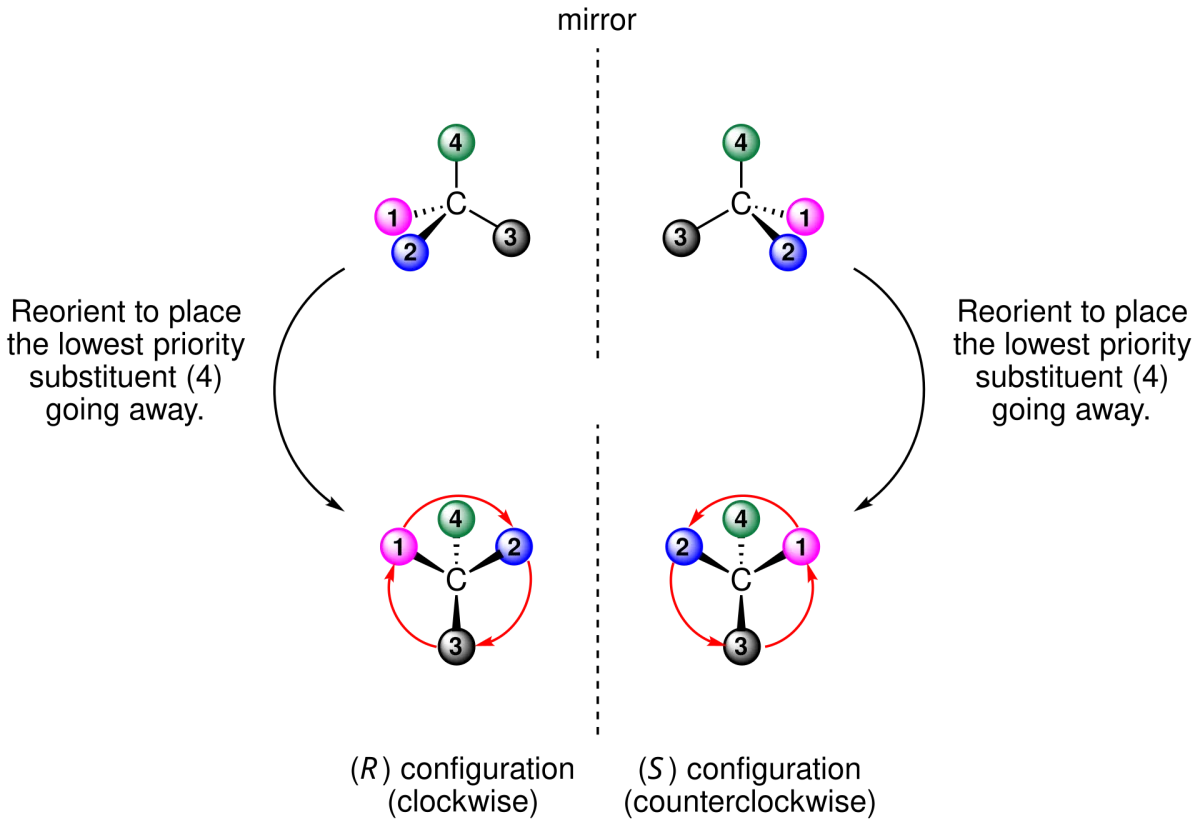
The word “superimposable” means you can place one molecule on top of the other so that every atom in molecule A lines up perfectly with the corresponding atom in molecule B. If you can do this (even after rotating the molecule), the two are identical - the same compound. If you cannot, they are different compounds (enantiomers).
Think of it this way: take a transparency of molecule A and lay it on top of molecule B. Can you rotate and flip the transparency until every atom matches? If yes, they are superimposable (identical). If no amount of rotation works, they are non-superimposable (enantiomers).
Chirality Without a Stereocenter
While a chiral center is the most common source of chirality on the MCAT, molecules can be chiral without having a traditional four-different-groups carbon. Two less common examples:
Allenes: Molecules with cumulated double bonds (C=C=C) can be chiral if the two ends have different substituents. The two pi bonds are perpendicular, creating a 3D arrangement that can be non-superimposable on its mirror image.
Atropisomers: Molecules where rotation around a single bond is restricted by steric hindrance (bulky groups blocking rotation). Substituted biphenyls are the classic example.
These are rare on the MCAT, but you should know they exist so you don’t assume that “no stereocenter = not chiral.”
Planes of Symmetry and Chirality
The fastest way to determine chirality on an exam is the plane of symmetry test:
If you can draw a plane through the molecule that divides it into two halves that are exact mirror reflections of each other, the molecule is achiral (even if it has stereocenters - this is the meso situation, covered in Section 2.8).
If no such plane exists, the molecule is chiral.
Examples of achiral molecules with symmetry planes:
- Methane (CH4) - multiple planes of symmetry
- 2-propanol - the plane through the OH, H, and the central C divides the two CH3 groups symmetrically
- cis-1,2-dimethylcyclohexane (in certain conformations)
Chirality in Biological Systems
Life on Earth is homochiral - it uses almost exclusively L-amino acids and D-sugars. This means your enzymes, receptors, and transport proteins are all built from chiral building blocks with a specific handedness.
When a chiral molecule enters your body, it interacts with chiral biological machinery. The two enantiomers of a drug will interact differently with the same receptor, just as your left hand interacts differently with a right-handed glove versus a left-handed glove.
This is why the pharmaceutical industry cares deeply about chirality. A racemic mixture (50:50 mix of both enantiomers) means half your drug dose could be inactive or even harmful.