
R and S Configuration
You have identified a chiral center. Now what? You need a way to name which specific arrangement is present - to distinguish the “left hand” from the “right hand.” The Cahn-Ingold-Prelog (CIP) system assigns each chiral center a label: R (rectus, Latin for “right”) or S (sinister, Latin for “left”). This is called the absolute configuration.
Think of it like giving directions. You are standing at an intersection (the chiral center) with four roads going in different directions (the four substituents). The CIP rules tell you to rank the roads by importance, point the least important road away from you, and then look at which direction the other three roads circle - clockwise or counterclockwise.
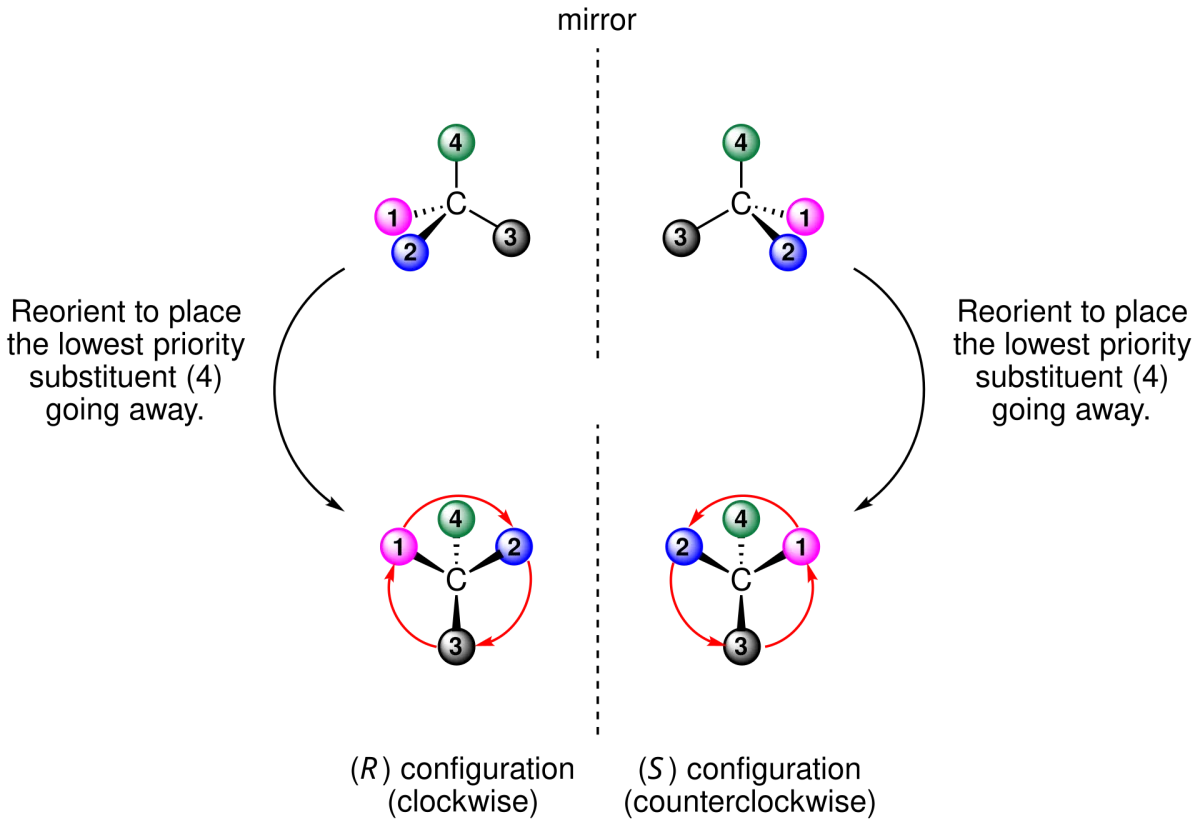
Step-by-Step: Assigning R or S
Step 1: Assign priorities (1 through 4) to the four substituents.
Look at the atom directly attached to the chiral center. Higher atomic number = higher priority.
- Priority 1: highest atomic number
- Priority 4: lowest atomic number (usually hydrogen)
If two atoms directly attached to the chiral center are the same element, move outward along each chain until you find a difference. The first point of difference determines priority.
Step 2: Orient the molecule so that priority 4 points away from you.
Imagine holding the molecule like a steering wheel, with the lowest-priority group (usually H) pointing straight back, behind the carbon.
Step 3: Trace a path from priority 1 to 2 to 3.
- If the path goes clockwise (like turning a steering wheel to the right): the configuration is R
- If the path goes counterclockwise (like turning left): the configuration is S
CIP Priority Rules in Detail
Rule 1: Atomic number wins.
Compare the atoms directly bonded to the chiral center. Higher atomic number gets higher priority.
| Atom | Atomic Number | Priority Rank (if all four present) |
|---|---|---|
| I (iodine) | 53 | Highest |
| Br (bromine) | 35 | High |
| Cl (chlorine) | 17 | Medium-high |
| O (oxygen) | 8 | Medium |
| N (nitrogen) | 7 | Medium-low |
| C (carbon) | 6 | Low |
| H (hydrogen) | 1 | Lowest (almost always priority 4) |
Rule 2: If the first atoms are the same, keep going outward.
When two substituents start with the same atom (e.g., both start with carbon), move to the next atom in each chain. Compare the sets of atoms at the next level. The first point of difference determines the winner.
Example: -CH2CH3 vs. -CH3
Both start with C. Move outward: -CH2CH3 has (C, H, H) at the next level. -CH3 has (H, H, H). C > H, so -CH2CH3 gets higher priority.
Rule 3: Double and triple bonds are “expanded.”
A double bond to an atom counts as two single bonds to that atom. A triple bond counts as three.
- C=O is treated as if carbon is bonded to two O atoms (and each O is bonded back to a “phantom” C)
- C=C is treated as if each carbon is bonded to two C atoms
This means an aldehyde group (-CHO) outranks a simple alcohol (-CH2OH) because the carbonyl carbon appears to have two bonds to oxygen.
The “Priority 4 Is Toward You” Shortcut
On the MCAT, the lowest-priority group is not always drawn pointing away from you. When priority 4 faces toward you (represented by a wedge in a dash-wedge drawing), use this shortcut:
- Assign priorities 1-4 as normal.
- Trace 1 to 2 to 3 as if priority 4 were pointing away.
- The direction you see (clockwise or counterclockwise) gives you the opposite configuration.
Why? Because you are looking at the molecule from the wrong side. If you see clockwise with priority 4 coming toward you, the actual configuration is S (counterclockwise from the correct viewing angle), and vice versa.
Common MCAT Pitfalls
Pitfall 1: Confusing R/S with (+)/(-).
R and S describe the arrangement of groups around a chiral center. (+) and (-) describe the direction a compound rotates plane-polarized light. There is NO predictable relationship between them. R does not mean (+), and S does not mean (-). An R compound can be (+) or (-), and you can only determine the sign experimentally with a polarimeter.
Pitfall 2: Forgetting to expand double bonds.
Students often rank -CH2OH above -CHO because they see “more atoms.” But -CHO has a C=O double bond, which expands to two C-O bonds, giving it higher priority than -CH2OH at the first point of difference.
Pitfall 3: Not going far enough outward.
When two substituents start with the same atom, you must keep tracing outward until you find a difference. Sometimes the difference is three or four atoms away from the chiral center.
Worked Example
Assign R or S to (S)-alanine:
Alanine’s chiral center (the alpha carbon) is bonded to: -NH2, -COOH, -CH3, and -H.
Step 1 - Assign priorities:
- Priority 1: N (atomic number 7) from -NH2
- Priority 2: C from -COOH. This C has a double bond to O, expanded to two C-O bonds. Higher than the C in -CH3.
- Priority 3: C from -CH3 (only bonded to H atoms beyond the first C)
- Priority 4: H
Step 2 - Orient with #4 away from you.
Step 3 - Trace 1 to 2 to 3. If the path is counterclockwise, the assignment is S.
Practice: Quick Priority Ranking
Rank these substituents from highest to lowest CIP priority:
-OH, -CH3, -NH2, -H
Answer: -OH (O, atomic number 8) > -NH2 (N, atomic number 7) > -CH3 (C, atomic number 6) > -H (H, atomic number 1)
Rank these: -CH2Cl, -CH2OH, -CH2CH3, -CH3
Answer: -CH2Cl (Cl at second position, atomic number 17) > -CH2OH (O at second position, atomic number 8) > -CH2CH3 (C at second position, atomic number 6) > -CH3 (H at second position, atomic number 1)