
Optical Activity
Normal light vibrates in every direction at once - up-down, left-right, and every angle in between. Now pass that light through a special filter (called a polarizer) that blocks everything except one plane of vibration. You are left with plane-polarized light - light waves that all vibrate in a single direction, like a jump rope shaking only side to side.
When plane-polarized light passes through a solution of a chiral compound, something remarkable happens: the plane of polarization rotates. The light comes out vibrating at a different angle than it went in. This is called optical activity, and it is the one physical property that distinguishes enantiomers in the lab.
The Polarimeter
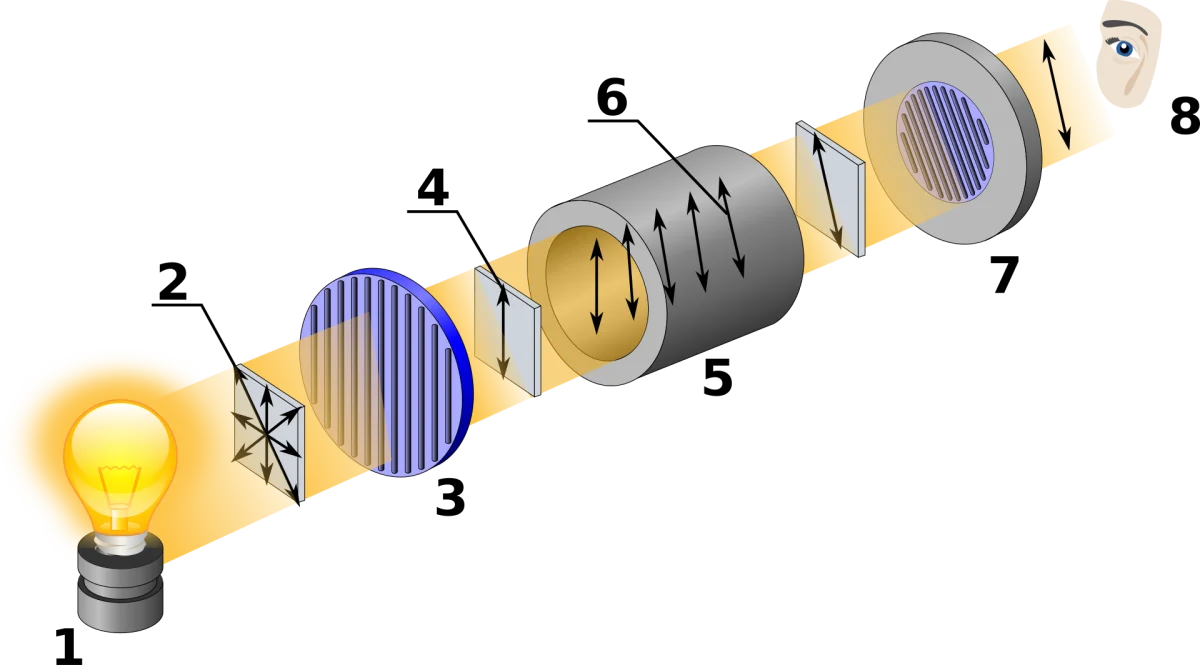
A polarimeter is the instrument that measures optical rotation. Here is how it works:
- A light source produces ordinary (unpolarized) light.
- The light passes through a polarizer, creating plane-polarized light.
- The polarized light passes through a tube containing a solution of the compound being tested.
- A second polarizer (the analyzer) at the other end is rotated until maximum light intensity passes through.
- The angle between the initial polarization direction and the analyzer position is the observed rotation (alpha).
Dextrorotatory vs. Levorotatory
- (+) or d (dextrorotatory): rotates plane-polarized light clockwise (to the right as you face the light)
- (-) or l (levorotatory): rotates plane-polarized light counterclockwise (to the left)
These labels come from experimental measurement only. You cannot predict the sign from the structure.
Specific Rotation
The observed rotation depends on several factors: the concentration of the solution, the length of the sample tube, the temperature, and the wavelength of light used. To standardize measurements, chemists report specific rotation, which accounts for these variables:
Key point: Specific rotation is an intrinsic property of a compound, like melting point or boiling point. It does not change with concentration or tube length. The observed rotation changes with these variables, but specific rotation is constant for a given compound under standard conditions.
Enantiomers have equal but opposite specific rotations. If (R)-2-bromobutane has a specific rotation of +23.1 degrees, then (S)-2-bromobutane has a specific rotation of -23.1 degrees. Same magnitude, opposite sign. Always.
Racemic Mixtures
A racemic mixture (also called a racemate) is a 50:50 mixture of both enantiomers. Because the two enantiomers rotate light by equal amounts in opposite directions, their rotations cancel perfectly. A racemic mixture has an observed rotation of zero - it is optically inactive.
Racemic mixtures are denoted with the prefix (+/-) or (d,l) or (rac).
Important: A racemic mixture is optically inactive, but it is NOT the same as a meso compound. A racemic mixture is a mixture of two different compounds. A meso compound is a single compound that is intrinsically achiral.
Enantiomeric Excess (ee)
When a mixture is not exactly 50:50, it will be optically active. The enantiomeric excess (ee) tells you how much of the mixture is “excess” of one enantiomer over the other:
Example calculation:
Pure (S)-2-bromobutane has [alpha] = -23.1 degrees. A sample has an observed specific rotation of -11.55 degrees. What is the enantiomeric excess?
ee = (11.55 / 23.1) x 100% = 50%
This means 50% of the mixture is excess (S) enantiomer. The remaining 50% is a racemic pair (25% S + 25% R). Total composition: 75% S, 25% R.
Working backward from ee to composition:
If ee = 50% and the major enantiomer is S:
- % S = (100 + ee) / 2 = (100 + 50) / 2 = 75%
- % R = (100 - ee) / 2 = (100 - 50) / 2 = 25%
Optically Active vs. Optically Inactive
| Condition | Optically Active? |
|---|---|
| Pure (R) enantiomer | Yes (+) |
| Pure (S) enantiomer | Yes (-) |
| Racemic mixture (50:50 R and S) | No (rotations cancel) |
| Meso compound | No (internal symmetry) |
| Non-chiral compound (no stereocenters) | No |
| Unequal mixture of enantiomers | Yes (net rotation from excess) |
D/L vs. d/l vs. R/S - Clearing Up the Confusion
Students often mix up these labeling systems. Here is the distinction:
| Label | System | What It Describes |
|---|---|---|
| R, S | CIP (Cahn-Ingold-Prelog) | Absolute configuration at a stereocenter (assigned by priority rules) |
| +, - (or d, l) | Optical rotation | Direction of rotation of plane-polarized light (measured experimentally) |
| D, L | Fischer convention | Configuration relative to D-glyceraldehyde (used mainly for amino acids and sugars) |
Critical: D/L (capital letters, Fischer convention) is NOT the same as d/l (lowercase, optical rotation). D-glucose happens to be dextrorotatory (+), but D-fructose is levorotatory (-). The D/L system is based on structural comparison to glyceraldehyde, not optical rotation.