
Fischer Projections
Trying to draw a three-dimensional molecule on a two-dimensional page is like trying to describe a sculpture with a flat photograph - you lose information. Fischer projections are a clever shortcut that lets you represent 3D stereochemistry on a flat page using a simple cross pattern. The convention was invented by Emil Fischer in the 1890s for carbohydrate chemistry, and it remains essential for sugars and amino acids on the MCAT.
The key rule is this: imagine pressing a 3D molecular model flat against a wall, like squashing a spider. The horizontal lines come toward you (out of the page), and the vertical lines go away from you (into the page). That single convention encodes all the 3D information.
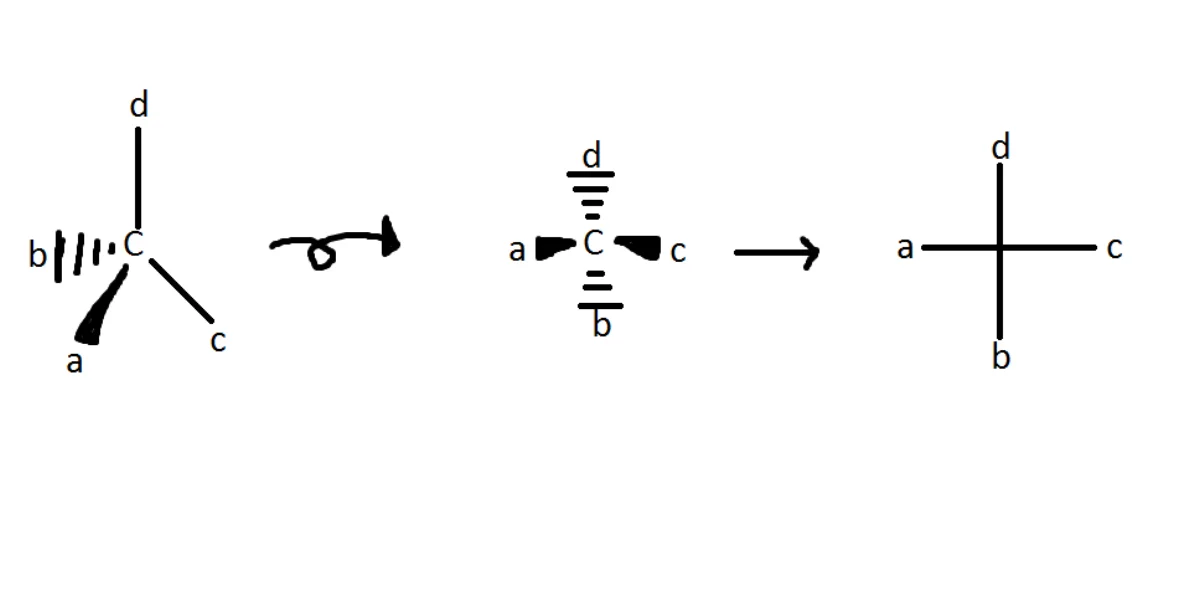
The Fischer Projection Convention
Every cross (+) in a Fischer projection represents a tetrahedral carbon:
- Horizontal lines point toward the viewer (equivalent to wedge bonds)
- Vertical lines point away from the viewer (equivalent to dash bonds)
- The carbon itself sits at the intersection
For a standard Fischer projection of a sugar or amino acid:
- The most oxidized carbon (aldehyde, ketone, or carboxyl group) goes at the top
- The carbon chain runs vertically
- Each horizontal position shows the substituents that point toward you
Drawing a Fischer Projection from a 3D Structure
- Orient the molecule so the carbon chain is vertical, with the most oxidized end at the top.
- For each chiral center, arrange substituents so that the chain continues vertically (going into the page) and the other two groups point horizontally (coming toward you).
- Draw each chiral center as a cross: the vertical line continues the chain, and the horizontal line shows the groups projecting toward you.
Manipulation Rules
Fischer projections follow strict rules about what you can and cannot do:
Allowed:
- Rotate the entire projection 180 degrees in the plane of the paper (this keeps all relationships intact)
- Make an even number of pairwise swaps of substituents on a single carbon (this preserves configuration)
NOT allowed:
- Rotate 90 degrees (this inverts all stereocenters - turns R into S and vice versa)
- Lift the projection off the page and flip it over (this also inverts configuration)
- Make an odd number of swaps (this inverts configuration)
Assigning R/S from Fischer Projections
You can assign R/S directly from a Fischer projection without converting to a 3D drawing. Here is the shortcut:
Step 1: Assign CIP priorities (1-4) to the four substituents on the stereocenter, just as you normally would.
Step 2: Check where priority 4 (the lowest-priority group, usually H) is located.
If priority 4 is on the vertical (going away from you):
- Trace 1 to 2 to 3 directly.
- Clockwise = R, Counterclockwise = S.
- This is the standard assignment because #4 is already pointing away from you.
If priority 4 is on the horizontal (coming toward you):
- Trace 1 to 2 to 3.
- The answer you get is REVERSED: Clockwise = S, Counterclockwise = R.
- This is because #4 is toward you instead of away, so you are looking from the wrong side (the same flip rule from Section 2.5).
The D/L System
The D/L system is an older naming convention that is still used extensively for amino acids and sugars. It is based on comparison to the reference compound glyceraldehyde.
D-glyceraldehyde has the OH group on the RIGHT side of the Fischer projection (at the bottom-most stereocenter). L-glyceraldehyde has the OH on the LEFT.
For sugars:
- Look at the highest-numbered stereocenter (the bottom-most chiral center in the Fischer projection).
- If the OH on that carbon is on the RIGHT, the sugar is D.
- If the OH is on the LEFT, the sugar is L.
For amino acids:
- Look at the alpha carbon in the Fischer projection (with the carboxyl group at the top and the R group at the bottom).
- If the NH2 group is on the LEFT, the amino acid is L.
- If the NH2 is on the RIGHT, the amino acid is D.
Critical: Almost all naturally occurring amino acids are L, and almost all naturally occurring sugars are D. This is one of the most commonly tested facts in MCAT biochemistry.
D/L vs. R/S vs. (+)/(-)
These three systems are completely independent. There is no consistent relationship between them:
| System | What It Describes | How It Is Assigned |
|---|---|---|
| R/S | Absolute configuration at a stereocenter | CIP priority rules |
| D/L | Configuration relative to glyceraldehyde | Position of OH or NH2 in Fischer projection |
| (+)/(-) | Direction of optical rotation | Experimental measurement with a polarimeter |
Examples that prove they are independent:
- D-glucose is dextrorotatory (+). D-fructose is levorotatory (-). Both are D-sugars.
- L-alanine has the (S) configuration. L-cysteine has the (R) configuration. Both are L-amino acids. (Cysteine is R because the sulfur-containing side chain has higher CIP priority than the carboxyl group, rearranging the priority order.)
Fischer Projections and Enantiomers/Meso Compounds
To find the enantiomer from a Fischer projection: swap left and right on every stereocenter (mirror the entire projection along the vertical axis).
To identify a meso compound from a Fischer projection: look for an internal horizontal line of symmetry. If the top half of the Fischer projection is the mirror image of the bottom half, the compound is meso.
Example: For tartaric acid in a Fischer projection:
- If the OH groups are both on the right (or both on the left), it is one of the optically active enantiomers.
- If one OH is on the right and one is on the left, with the molecule symmetric about a horizontal midline, it is the meso form.
Common MCAT Applications
Sugars: Fischer projections are the standard way to draw monosaccharides. D-glucose, D-galactose, D-mannose, and D-fructose are drawn as Fischer projections to show the configuration at each stereocenter. Epimers (sugars differing at one stereocenter) are easily compared by looking at which OH groups point left vs. right.
Amino acids: The alpha carbon of amino acids is commonly shown in a Fischer projection. L-amino acids have NH2 on the left, COOH at the top, R group at the bottom, and H on the right.
Converting Between Representations
You should be comfortable converting between three representations:
- 3D perspective drawing (wedge-dash) - shows bonds coming toward and away from you explicitly
- Fischer projection - uses the horizontal/vertical cross convention
- Newman projection - views down a specific bond axis
The MCAT may give you a molecule in one representation and ask you to identify it in another. Practice converting between all three formats. The key is always knowing which bonds point toward you and which point away.