
Types of Isomers
Imagine you have a box of LEGO bricks - say, four red bricks, ten blue bricks, and one yellow brick. You could build a house with those exact bricks. Or you could tear it apart and build a car using the same pieces. Same bricks, completely different structure. That is what isomers are: molecules that share the same molecular formula but differ in how those atoms are arranged.
The MCAT will hand you two molecules, and you need to classify their relationship instantly. Are they constitutional isomers? Enantiomers? Diastereomers? Conformational isomers? This section gives you the decision tree.
The Isomer Family Tree
Every pair of isomers falls into one of two major branches:
-
Constitutional (structural) isomers - same molecular formula, different connectivity. The atoms are bonded to different partners. Think of “listen” and “silent” - same letters, completely rearranged.
-
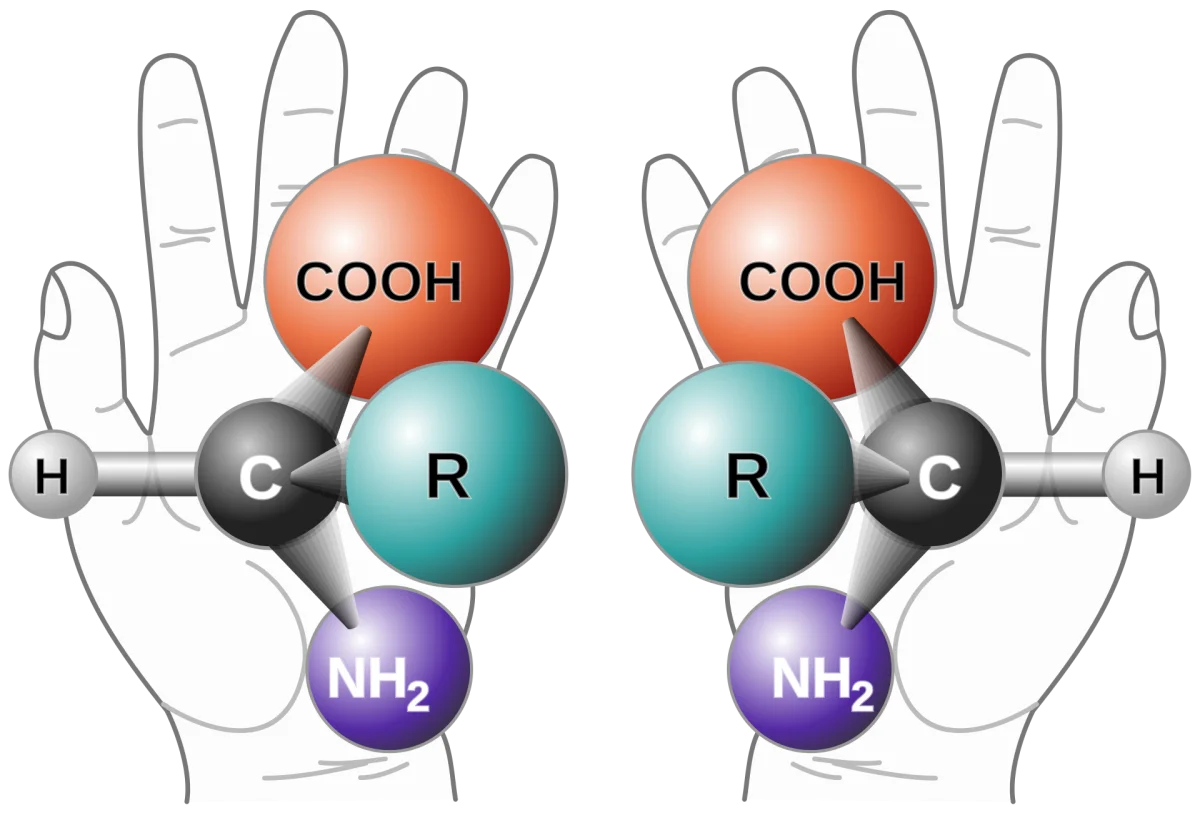
Stereoisomers - same molecular formula AND same connectivity, but different spatial arrangement. The atoms are bonded to the same partners, but the 3D layout differs. Think of your left and right hands - same fingers connected the same way, but arranged differently in space.
Constitutional Isomers
Constitutional isomers have different bonding patterns. Given the molecular formula C4H10, you could draw butane (a straight chain of four carbons) or isobutane (a three-carbon chain with a methyl branch). Same formula, different connectivity. These molecules have different physical properties - different boiling points, different melting points, different reactivities.
The key test: if you need to break and re-form covalent bonds to convert one molecule into the other, they are constitutional isomers.
Stereoisomers
Stereoisomers have identical connectivity - every atom is bonded to the same partners. The only difference is how those bonds are oriented in three-dimensional space. Stereoisomers break down into further subcategories:
- Enantiomers - non-superimposable mirror images (like left and right hands)
- Diastereomers - stereoisomers that are NOT mirror images of each other
- Meso compounds - molecules with stereocenters but an internal mirror plane that makes them achiral
- Geometric (cis/trans or E/Z) isomers - differ in arrangement around a double bond or ring
- Conformational isomers - differ by rotation around a single bond (same molecule, different rotational snapshot)
The Decision Flowchart
When the MCAT shows you two molecules with the same molecular formula, run through this checklist:
| Question | If YES | If NO |
|---|---|---|
| Same molecular formula? | Could be isomers - continue | Not isomers at all |
| Same connectivity (same bonding partners)? | Stereoisomers | Constitutional isomers |
| Non-superimposable mirror images? | Enantiomers | Diastereomers (or other subtype) |
| Internal mirror plane despite having stereocenters? | Meso compound (achiral) | Chiral molecule |
| Differ only by rotation around a single bond? | Conformational isomers | Configurational isomers |
Configurational vs. Conformational Isomers
One distinction that trips up students: configurational isomers require bond breaking to interconvert, while conformational isomers interconvert by simple rotation around single bonds without breaking anything.
Enantiomers, diastereomers, and geometric isomers are all configurational - you cannot convert one into the other without breaking bonds. Conformational isomers (like anti-butane and gauche-butane) are really just different rotational snapshots of the same molecule. They interconvert freely at room temperature.
Why Isomers Matter in Biology
Your body is a chiral environment. Enzymes are chiral. Receptors are chiral. When a molecule interacts with a biological target, shape determines everything. This is why:
- (S)-Ibuprofen is the active pain reliever; (R)-ibuprofen is inactive.
- (S)-Thalidomide treats morning sickness; (R)-thalidomide causes severe birth defects.
- D-glucose is the fuel your cells burn; L-glucose passes through your body unmetabolized.
The MCAT loves these examples because they show that isomer classification is not an abstract exercise - it has real consequences.
Quick Reference: Isomer Types at a Glance
| Isomer Type | Same Formula? | Same Connectivity? | Mirror Images? | Interconvert Freely? |
|---|---|---|---|---|
| Constitutional | Yes | No | N/A | No (bond breaking needed) |
| Enantiomers | Yes | Yes | Yes (non-superimposable) | No (bond breaking needed) |
| Diastereomers | Yes | Yes | No | No (bond breaking needed) |
| Meso | Yes | Yes | Has internal mirror plane | No (single compound, achiral) |
| Geometric (E/Z) | Yes | Yes | No | No (double bond restricts rotation) |
| Conformational | Yes | Yes | Varies | Yes (free rotation) |