When you heat a substance, the temperature rises steadily - until you hit a phase change. Then something strange happens: you keep adding heat, but the temperature stops rising. All that energy goes into breaking intermolecular forces rather than speeding up molecules. Understanding this behavior is essential for interpreting heating curves on the MCAT.
Phase Change Terminology
Phase Change
Name
Direction
ΔH Sign
Solid → Liquid
Melting (fusion)
Endothermic
+
Liquid → Gas
Vaporization (boiling)
Endothermic
+
Solid → Gas
Sublimation
Endothermic
+
Gas → Liquid
Condensation
Exothermic
-
Liquid → Solid
Freezing
Exothermic
-
Gas → Solid
Deposition
Exothermic
-
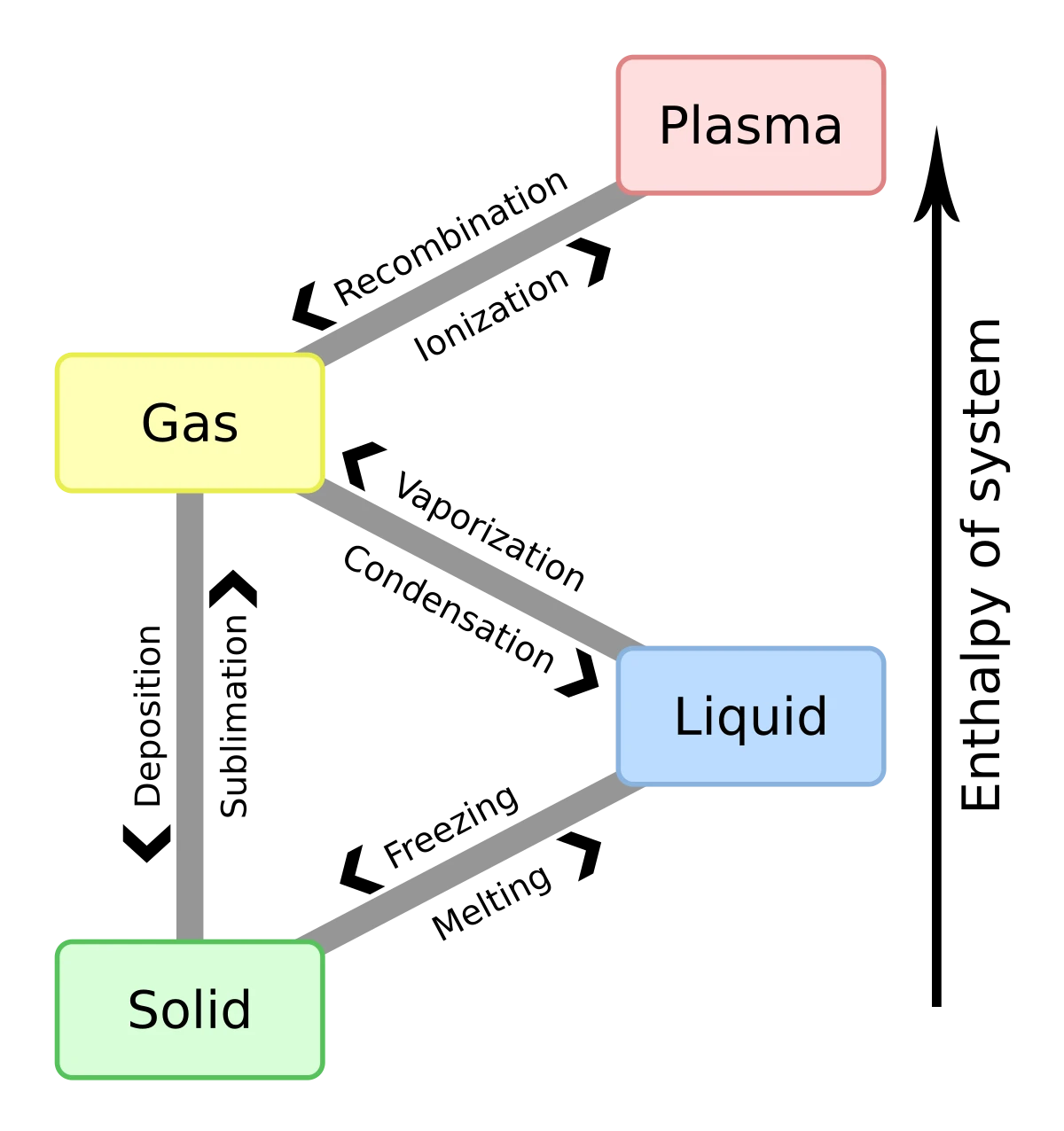
Key rule: Breaking intermolecular forces requires energy (endothermic). Forming intermolecular forces releases energy (exothermic). Going from more ordered → less ordered absorbs heat.
All phase transitions and their names. Upward arrows (increasing enthalpy) represent endothermic changes; downward arrows represent exothermic changes. Credit: Wikimedia Commons, CC BY-SA 4.0
The Heating Curve
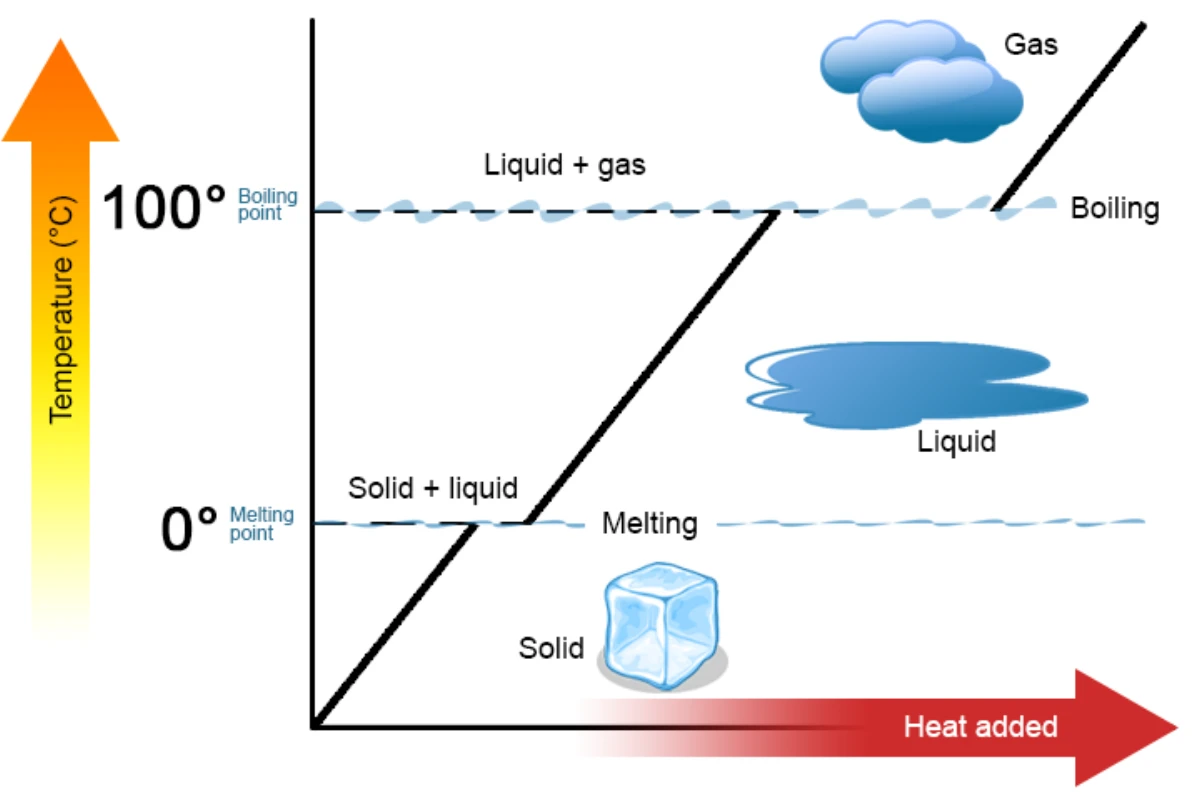
Heating curve for water. Sloped regions represent temperature changes within a single phase (q = mcΔT). Flat plateaus at 0 C and 100 C represent phase transitions where all added energy goes into breaking intermolecular forces (q = nΔH). Credit: Wikimedia Commons, CC BY-SA 3.0
A heating curve plots temperature (y-axis) vs. heat added (x-axis) for a substance being heated from solid to gas at constant pressure. It has five distinct regions:
Solid warming (sloped line): Temperature rises as heat increases the kinetic energy of molecules in the solid. q = mcΔT using c(solid).
Melting plateau (flat line at melting point): Temperature stays constant while the solid melts. All added heat goes into breaking intermolecular forces. q = n × ΔH(fus).
Liquid warming (sloped line): Temperature rises again. q = mcΔT using c(liquid).
Boiling plateau (flat line at boiling point): Temperature stays constant while the liquid vaporizes. q = n × ΔH(vap).
Gas warming (sloped line): Temperature rises. q = mcΔT using c(gas).
Key Formulas for Heating Curves
ΔH(vap) >> ΔH(fus)
The enthalpy of vaporization is always much larger than the enthalpy of fusion for the same substance. This is because vaporization completely separates molecules from each other (overcoming all remaining intermolecular forces), while melting only loosens the rigid crystal structure.
For water:
ΔH(fus) = 6.01 kJ/mol (melting ice)
ΔH(vap) = 40.7 kJ/mol (boiling water)
The boiling plateau on a heating curve is much wider than the melting plateau because more energy is needed.
Why the Boiling Plateau Matters
Calculating Total Heat for a Complete Heating Process
To find the total heat needed to convert ice at -20 C to steam at 120 C, you must add five separate terms:
Heat the ice from -20 C to 0 C: q₁ = mc(ice)ΔT
Melt the ice at 0 C: q₂ = nΔH(fus)
Heat the water from 0 C to 100 C: q₃ = mc(water)ΔT
Boil the water at 100 C: q₄ = nΔH(vap)
Heat the steam from 100 C to 120 C: q₅ = mc(steam)ΔT
q(total) = q₁ + q₂ + q₃ + q₄ + q₅
Entropy and Phase Changes
Phase changes also involve entropy changes:
Melting: ΔS = ΔH(fus) / T(melting) > 0
Boiling: ΔS = ΔH(vap) / T(boiling) > 0
At the phase transition temperature, ΔG = 0 (the two phases are in equilibrium). This is consistent with ΔG = ΔH - TΔS = 0, so T = ΔH/ΔS at the phase boundary.
On a heating curve, you are at a flat region at 100 C. What phases are present, and what is happening to the added heat energy?
Click to reveal answer
Liquid water and water vapor (steam) coexist. The flat region at 100 C is the boiling plateau. The added heat is being used entirely to overcome intermolecular forces (hydrogen bonds) and convert liquid water to gas. Temperature remains constant because the energy increases potential energy (separating molecules), not kinetic energy (molecular speed).
Why is ΔH(vap) always much larger than ΔH(fus) for the same substance?
Click to reveal answer
Because vaporization completely separates molecules. Melting only disrupts the rigid crystal lattice while keeping molecules close together (liquid state). Vaporization must completely overcome the remaining intermolecular forces to send molecules into the gas phase, where they are far apart and essentially independent. This requires much more energy.