In everyday English, “work” means effort. You worked hard at the gym. You pulled an all-nighter. You worked all summer at a coffee shop.
Physics is much more particular. To a physicist, you only do work if you push or pull something and it actually moves and the force has at least some component in the direction of motion. Stand still holding a 50 lb weight overhead for an hour and your muscles will be on fire — but in physics terms, you’ve done zero work on that weight, because nothing moved.
This is one of those sections where intuition will betray you. The MCAT writes great trap questions around it. Lock in the formula, learn the three cases (positive, negative, zero), and the rest is plug-and-chug.
The Work Equation
Work is a scalar, not a vector — it can be positive, negative, or zero, but it has no direction.
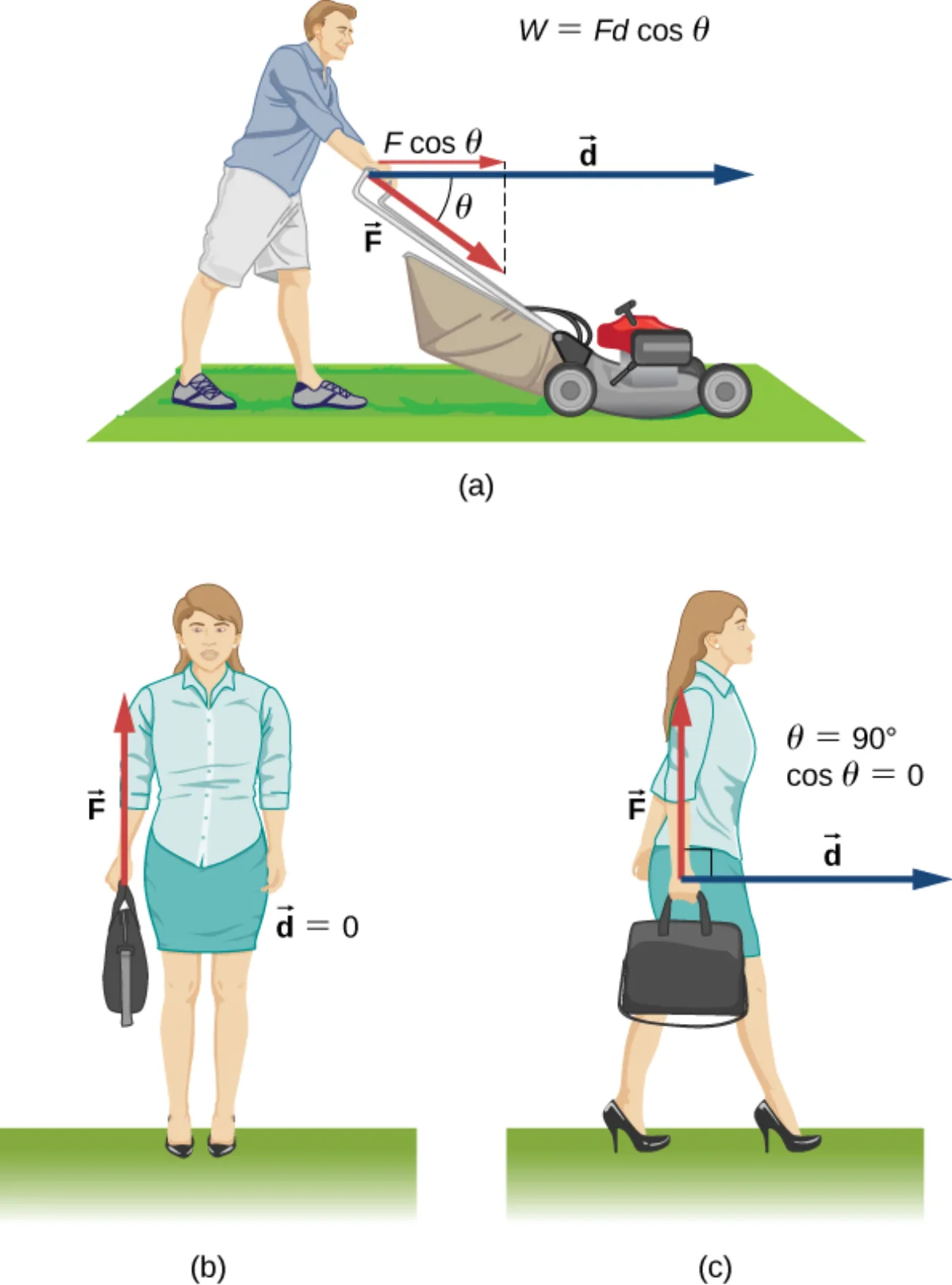
The whole reason this equation is more nuanced than “force times distance” is the cosθ term. That cosine picks out only the part of the force that lines up with the motion. A force perpendicular to motion does zero work; a force directly opposite to motion does negative work.
Only the component of force parallel to displacement (Fcosθ) contributes to work. The perpendicular component does no work. Credit: OpenStax, CC BY 4.0
The Three Cases: Positive, Negative, Zero
The sign of work tells you whether energy is flowing into or out of the object.
Case
Angle θ
cosθ
What happens
Example
Positive work
0° to 89°
Positive
Force adds energy to the object
Pushing a box in the direction it slides
Negative work
91° to 180°
Negative
Force removes energy from the object
Friction slowing a sliding box
Zero work
90°
0
Force transfers no energy
Carrying a box horizontally (gravity is perpendicular to motion)
Special Cases Worth Memorizing
θ=0° (force in same direction as motion):cos0°=1, so W=Fd. Maximum work for a given force and distance. Example: pushing a crate in a straight line behind it.
θ=180° (force opposite to motion):cos180°=−1, so W=−Fd. Negative work. Example: kinetic friction always opposes motion, so friction always does negative work on a sliding object.
θ=90° (force perpendicular to motion):cos90°=0, so W=0. Examples: the normal force on a box sliding across the floor; the centripetal force on an object in circular motion.
Work Done by Multiple Forces
When several forces act on an object at once, you have two equally valid options:
Calculate work for each force separately, then add them: Wnet=W1+W2+W3+…
Find the net force first, then compute: Wnet=Fnet⋅d⋅cosθ.
Both give the same answer. Pick whichever is faster for the question in front of you.
Gravity’s Work
Gravity deserves special attention because it shows up in nearly every energy problem. The work done by gravity on an object that moves vertically by height h is:
Wgravity=−mgh if the object moves up (gravity opposes the motion).
Wgravity=+mgh if the object moves down (gravity helps the motion).
If the object moves along a diagonal path (like up a ramp), only the vertical component of displacement matters for gravity’s work. Horizontal motion is perpendicular to gravity, so it contributes nothing. This is why a 10 m walk across a flat floor and a 10 m walk across a higher floor both involve zero gravitational work — but climbing stairs to that higher floor does involve work.
Worked Example
You push a 20 kg box across a frictionless floor with a 30 N force at 60° below horizontal (you’re pushing down on a handle), moving it 5 m. How much work do you do?
Use W=Fdcosθ with θ=60°.
W=30×5×cos60°=30×5×0.5=75 J.
Your full 30 N push covered 5 m, but only 30cos60°=15 N of it actually pointed forward. The other 30sin60°≈26 N pressed straight down into the floor and did nothing useful. That’s why the work is 75 J, not 150 J.
A 50 N force is applied at a 60° angle to the horizontal as a box is dragged 4 m across the floor. How much work is done by the applied force?
Click to reveal answer
W=Fdcosθ=(50)(4)(cos60°)=(50)(4)(0.5)=100 J. Only the horizontal component of the force (Fcos60°=25 N) does work on the box.
A satellite orbits Earth in a perfect circle. How much work does gravity do on the satellite per orbit?
Click to reveal answer
Zero. In a circular orbit, gravity always points toward the center while the satellite's displacement at any instant is tangent to the circle. The angle between force and displacement is always 90°, cos90°=0, so gravity does no work. The satellite's speed stays constant — which is exactly why circular orbits are stable.
You hold a 10 kg dumbbell perfectly still at shoulder height for 30 seconds. How much work do you do on the dumbbell?
Click to reveal answer
Zero. Work requires displacement. The dumbbell didn't move (d=0), so W=Fdcosθ=0 regardless of the force or the angle. Your muscles still burn — that's biology (sustained muscle contraction uses ATP) — but in physics terms, no work is done on the dumbbell.
The equation W=Fdcosθ works perfectly when the force is constant. But what if the force changes as the object moves?
Stretch a rubber band. The first centimeter is easy. The next centimeter is harder. By the time you’ve pulled it 10 cm, you’re really straining. The force isn’t a single number — it’s a different value at every position. You can’t just multiply “the force” by “the distance,” because there’s no single “the force.”
This is where the graphical method comes in. It works for any force — constant, increasing, decreasing, weird-shaped — and the math never goes beyond basic geometry.
The Graphical Method
When force changes with position, work equals the area under the force-vs-displacement (F vs. x) graph.
This is the MCAT-level approach: no calculus required. The MCAT picks problems where the graph is made of straight lines, so the area is always a combination of rectangles, triangles, and trapezoids — shapes you’ve known the area formulas for since middle school.
Common Graph Shapes and Their Areas
Shape
Area formula
When you’ll see it
Rectangle
base × height
Constant force over a distance
Triangle
21 × base × height
Force that grows linearly from zero (like a spring)
Trapezoid
21(b1+b2) × height
Force that grows linearly but doesn’t start at zero
Spring Work: The Most Important Triangle
A spring exerts a force proportional to how far it’s stretched or compressed: F=kx (we’ll cover the negative sign and Hooke’s law in §2.5). The force starts at zero when the spring is at its natural length and grows linearly with displacement, so the F vs. x graph is a straight line through the origin.
The area under that line is a triangle:
Notice the x2. Stretching a spring twice as far takes four times as much work, not twice as much. That’s why pulling back a bow string the last few inches is so much harder than the first few.
Reading Complex Graphs
Some MCAT problems give you a piecewise graph — force constant for a while, then changing in a straight line, then maybe constant again. The recipe: break the graph into simple shapes, find each area, and add them up.
For example, if a graph shows a constant 10 N for the first 3 m (rectangle), then a force linearly decreasing from 10 N to 0 N over the next 2 m (triangle):
Rectangle: 10 N×3 m=30 J.
Triangle: 21×2 m×10 N=10 J.
Total: 30+10=40 J.
That’s the entire technique. Identify shapes, sum areas, done.
Positive and Negative Areas
If the force dips below the x-axis (negative force) over some interval, that region contributes negative work — the force was opposing motion in that stretch.
A common scenario: a spring being released from compression. While you compress it, you do positive work on the spring. When you let go and the spring pushes your hand back, the spring does positive work on your hand, and your hand (now resisting) does negative work on the spring (because hand and spring move in the same direction but the spring’s force on the hand is opposite to the hand’s force on the spring — third law again).
When in doubt, always specify which force you’re calculating work for, and on which object.
Worked Example
A bow archer draws back a bowstring that requires linearly increasing force, from 0 N at rest to 200 N at full draw (a draw distance of 0.5 m). How much work does the archer do on the string?
F vs. x graph: triangle, base = 0.5 m, height = 200 N.
W=21(0.5)(200)=50 J.
So 50 J of energy is now stored in the bent bow, ready to fly into the arrow when released. (Roughly the same energy as a small car moving at 1 m/s — modest, but enough to send a light arrow at 60+ m/s.)
A spring with k=200 N/m is compressed by 0.3 m from its natural length. How much work was done to compress the spring?
Click to reveal answer
W=21kx2=21(200)(0.3)2=21(200)(0.09)=9 J. The force grows linearly from 0 to kx=60 N over 0.3 m, forming a triangle of area 21(0.3)(60)=9 J.
An F vs. x graph shows a constant 20 N force from x=0 to x=5 m, then a straight-line drop to 0 N at x=8 m. What is the total work done?
Click to reveal answer
130 J. Two shapes. Rectangle (0 to 5 m): 20×5=100 J. Triangle (5 to 8 m): 21(3)(20)=30 J. Total: 100+30=130 J.
A spring is stretched 5 cm and stores some amount of energy E. To store 4E instead, how far must it be stretched?
Click to reveal answer
10 cm (double the distance). Spring energy is 21kx2, so it scales with x2. To get 4× the energy, you need 4=2× the distance. This is why drawing a bow back twice as far quadruples the arrow's launch energy.
A bowling ball rolling at 5 m/s and a tennis ball rolling at 5 m/s have wildly different abilities to knock things over. A car at 60 mph isn’t twice as dangerous as the same car at 30 mph — it’s four times as dangerous. A pitched 90 mph fastball carries enough energy to break a bone; a 30 mph toss doesn’t.
What captures these differences is kinetic energy — the energy something has because it’s moving. The amount depends on mass and speed, but speed matters a lot more than you might guess.
The Kinetic Energy Equation
Two things to internalize:
KE depends on v2, not v. Doubling the speed quadruples KE. Tripling speed makes KE 9× bigger. This is the single most important fact in this section.
KE depends on mass linearly. A 2,000 kg truck at 10 m/s has 2× the KE of a 1,000 kg car at 10 m/s. But the same truck at 20 m/s has 4× the KE of itself at 10 m/s. Speed wins by a wide margin.
This is why highway accidents are catastrophically worse than parking-lot fender-benders. A 40 mph crash isn’t twice as bad as a 20 mph crash — it’s four times as bad. Energy scales with the square of speed.
The Work-Energy Theorem
There’s a direct, beautiful connection between work and kinetic energy: the net work done on an object equals its change in kinetic energy.
Applying the Work-Energy Theorem
The theorem is powerful because it bypasses acceleration and time entirely. If you know the forces and the distance, you can find the final speed without ever computing a or t.
Worked example. A 1500 kg car traveling at 20 m/s brakes to a stop over 50 m. What is the average braking force?
KEi=21(1500)(20)2=300,000 J.
KEf=0 (the car stops).
Wnet=KEf−KEi=−300,000 J.
Net work also equals F⋅d⋅cos180°=−F⋅50 (force opposes motion).
So −F⋅50=−300,000 → F=6000 N.
That’s it — no kinematic equations, no need for time. We jumped straight from energy in to force out.
When Net Work is Zero
If the net work on an object is zero, its speed doesn’t change. This doesn’t mean no forces are acting — it means the positive and negative work cancel exactly.
A car cruising at constant 70 mph on a flat highway is the textbook case. The engine pushes forward (positive work). Air resistance and rolling friction push backward (negative work). They cancel. Net work = 0, KE constant, speed steady. Lots of forces, no change in motion.
Similarly, an object in a circular orbit has gravity acting on it constantly — but gravity does zero work because it’s always perpendicular to motion. KE is constant; speed is constant; orbit radius is constant.
Kinetic Energy is a Scalar
Unlike momentum (which is a vector), kinetic energy has no direction. Two cars moving in opposite directions at the same speed have the same KE — even though their momenta cancel out. This is why head-on collisions can completely stop both cars (momenta cancel) while still releasing the combined KE of both into deformation, heat, and sound.
This scalar nature also makes energy easier to work with than momentum in many problems. You don’t need to break it into x and y components.
A 0.5 kg ball is thrown at 10 m/s. If its speed doubles to 20 m/s, by what factor does its kinetic energy increase?
Click to reveal answer
4×.KE=21mv2. Doubling v quadruples v2. KEi=21(0.5)(102)=25 J. KEf=21(0.5)(202)=100 J. Ratio: 4.
A 2 kg block at rest is pushed across a frictionless surface by a constant 10 N force over 5 m. What is the block's final speed?
If a car going 30 mph needs 30 ft to stop, approximately how far does the same car need to stop from 60 mph (same braking force)?
Click to reveal answer
About 120 ft (4×). Stopping distance scales with v2 when the braking force is constant. Doubling the speed quadruples the kinetic energy that must be removed; same braking force times longer distance gives 4× the work, so 4× the distance. This is why highway speed limits exist — the energy involved is not just "a bit more."
Hold a phone above your kitchen counter and let go. It accelerates downward, picks up speed, and lands with a thud. Where did that kinetic energy come from?
It was stored in the phone the moment you lifted it off the counter. Lifting takes effort — your arm muscles do work against gravity. That work doesn’t disappear; it gets stored as gravitational potential energy (gravitational PE). The higher you raise something, the bigger the deposit, and the more kinetic energy it’ll have when it falls.
The same idea explains roller coasters (lift to the top, then convert to speed on the way down), water in a dam (high water = stored energy, released as the water falls through a turbine), and why falling from 30 feet is much more dangerous than falling from 5.
The Equation
This formula applies near Earth’s surface, where g is approximately constant. For objects far from Earth (satellites, spacecraft), gravity weakens with altitude and the MCAT uses a different formula. But for ~95% of MCAT problems, PE=mgh is all you need.
The Reference Point is Arbitrary
This is the part that confuses students most: the value of PE depends on where you set h=0 (your reference point). And that’s fine — because only changes in PE matter, and the changes come out the same no matter where you put zero.
Consider a ball on the edge of a 10 m cliff above a 5 m deep valley:
Reference = valley floor: PE at cliff edge = mg(15).
Reference = base of cliff: PE at cliff edge = mg(10).
Reference = cliff edge: PE at cliff edge = mg(0)=0.
The PE numbers are different. But if the ball falls from cliff edge to cliff base, every reference choice gives the same ΔPE=−mg(10), and the same final speed at the cliff base.
PE-KE Conversion
When an object falls freely (no friction, no air resistance), gravitational PE converts directly into KE:
At the top: maximum PE, minimum KE (object is momentarily at rest, KE = 0).
At the bottom: minimum PE (zero, if you set the reference there), maximum KE.
In between: PE shrinking, KE growing, total stays constant.
This is the foundation of energy conservation, which we’ll formalize in §2.6.
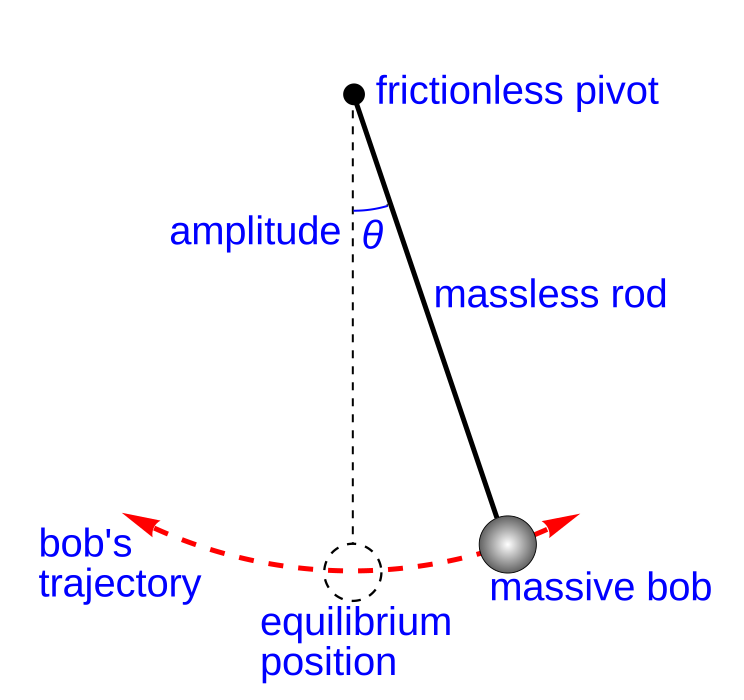
A pendulum demonstrates PE-KE conversion. At the highest points (ends of the swing), energy is all PE. At the lowest point, energy is all KE. Total mechanical energy stays constant throughout. Credit: Wikimedia Commons, CC BY-SA
Negative Heights
If an object is below your reference point, h is negative, and PE is negative. This is mathematically fine. A ball at the bottom of a well, with the reference set at ground level, has negative PE relative to ground level. As it falls deeper, PE becomes more negative (decreases), and KE increases.
The MCAT occasionally tests this. Don’t be thrown by a negative PE value — it just means the object is below the reference you chose.
Quick Calculation Tip
On the MCAT, g≈10 m/s² makes PE math fast. A 2 kg object at 5 m above the reference: PE=2×10×5=100 J. No calculator, no fuss.
To find the speed of a falling object from height h (starting from rest, no friction): set PE = KE, so mgh=21mv2. Mass cancels (everything falls the same), giving:
v=2gh
This shortcut shows up constantly. A 5 m drop: v=2(10)(5)=100=10 m/s. A 20 m drop: v=2(10)(20)=400=20 m/s. (Notice that quadrupling the height only doubles the impact speed — because of that .)
Worked Example
A 2 kg ball is dropped from a 5 m balcony onto a soft mat. What’s its speed just before hitting the mat? How much KE does it have at impact?
v=2gh=2(10)(5)=100=10 m/s.
KE=21mv2=21(2)(100)=100 J.
Sanity check: PEtop=mgh=2(10)(5)=100 J. The ball started with 100 J of PE and ended with 100 J of KE — exactly what energy conservation predicts. ✓
A 3 kg ball is dropped from 20 m. What is its speed just before hitting the ground? (Use g=10 m/s², no air resistance.)
Click to reveal answer
v=20 m/s. Use the shortcut: v=2gh=2(10)(20)=400=20 m/s. Or do it the long way: PEtop=mgh=600 J = KEbottom=21mv2 → v2=400 → v=20 m/s. Mass cancels.
Two students calculate the PE of a book on a table. Student A uses the floor as the reference and gets 30 J. Student B uses the tabletop as the reference and gets 0 J. Who's correct?
Click to reveal answer
Both are correct. The reference point is arbitrary, so both PE values are valid. What matters physically is the *change* in PE. If the book falls from the table to the floor, both students compute the same ΔPE and the same final speed. Absolute PE depends on the reference; the physics doesn't.
A roller coaster of mass 500 kg is released from rest at the top of a 30 m hill. Ignoring friction, what is its speed at the bottom?
Click to reveal answer
About 24.5 m/s.v=2gh=2(9.8)(30)=588≈24.2 m/s (using g=10: 600≈24.5 m/s). Mass doesn't appear — a 1500 kg coaster reaches the same speed. The coaster's mass cancels in the energy equation just like in free-fall problems.
Press a Slinky against the floor and let go — it bounces back. Stretch a rubber band, then release — it snaps back hard enough to sting your fingers. Squish the bumper of a car against a wall and it pops back to shape (within reason).
These are all elastic systems. They share a beautifully simple rule, discovered by Robert Hooke in the 1600s: the more you deform an elastic object, the more strongly it pushes back — and that “push-back” force is exactly proportional to how far you’ve deformed it.
That single rule lets you predict spring forces, calculate stored energy, and analyze everything from car suspensions to pole vaulters to the elasticity of human tendons.
Hooke’s Law
The Spring Constant (k)
The spring constant tells you how stiff the spring is. Big k = stiff spring (a car suspension); small k = soft spring (a Slinky).
Property
High k (stiff)
Low k (soft)
Force for the same displacement
Large
Small
Hard to stretch/compress?
Yes
No
Example
Truck shock absorber
Slinky, soft pillow spring
Units of k: N/m. If k=500 N/m, the spring exerts 500 N of restoring force for every meter of displacement (or 5 N for every centimeter).
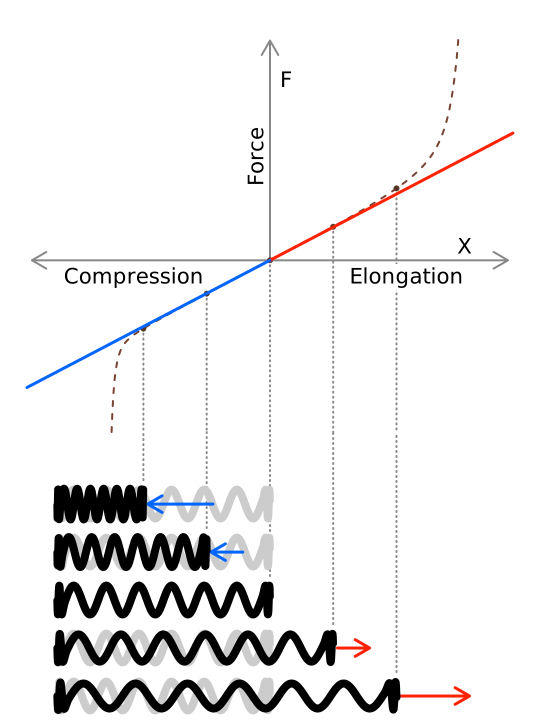
Hooke's law gives a linear F vs. x graph. The slope equals the spring constant k. Force is negative when displacement is positive (and vice versa) because it's a restoring force. Credit: Wikimedia Commons, CC BY-SA
The Negative Sign
The minus sign in F=−kx is the single most important detail of the equation. It’s what makes the spring force a restoring force — always directed back toward the equilibrium position.
Stretch the spring (x>0) → force is negative (pulls back toward center).
Compress the spring (x<0) → force is positive (pushes back toward center).
Elastic Potential Energy
A compressed or stretched spring stores energy. That stored energy is elastic potential energy.
This is the same formula we derived graphically in §2.2 (the area of the triangle under F vs. x).
Notice the x2. Just like KE depends on v2, elastic PE depends on x2 — doubling the displacement quadruples the stored energy. This is why pulling a bowstring back the last few inches takes so much more effort than the first few.
Symmetry of Elastic PE
Because x is squared, a spring compressed by 3 cm stores exactly the same energy as the same spring stretched by 3 cm. The direction of displacement doesn’t matter — only the magnitude.
This symmetry is also why a spring oscillates back and forth between equal stretch and compression. The energy at the two extremes is identical, so the motion is symmetric.
Springs and Simple Harmonic Motion
When a mass attached to a spring is pulled and released, it oscillates back and forth. Energy continuously trades between KE and elastic PE:
At maximum stretch (or compression): all PE, zero KE, mass momentarily at rest.
At equilibrium position (natural length): all KE, zero PE, maximum speed.
In between: a mix of both, total mechanical energy stays constant.
That oscillation is simple harmonic motion (SHM), covered in detail in the waves and sound chapter. For now: a spring-mass system is the prototype example.
When Hooke’s Law Breaks Down
Hooke’s law only holds within the elastic limit — the range where the material returns to its original shape after you release it. Stretch a spring (or a tendon, or any elastic material) too far and it deforms permanently. Beyond the elastic limit, the F vs. x graph stops being a straight line, and F=−kx no longer applies.
That’s why a Slinky stretched all the way down a flight of stairs never quite returns to its original shape — you exceeded its elastic limit. Same idea for a paper clip you’ve bent too far, or a rubber band that’s been stretched until it goes slack.
Worked Example
A spring with k=400 N/m is compressed 0.1 m and used to launch a 2 kg block on a frictionless surface. What’s the block’s speed when the spring returns to its natural length?
Stored PE in spring: PE=21kx2=21(400)(0.01)=2 J.
All converts to KE: 21mv2=2 → v2=2 → v=2≈1.41 m/s.
The 2 J of stored energy fully transferred into the block’s KE the moment the spring reached its natural length. After that, the spring has no more energy to give and the block coasts away at 1.41 m/s.
A spring with k=400 N/m is stretched 0.1 m from equilibrium. What force does the spring exert, and how much energy is stored?
Click to reveal answer
Force: F=kx=(400)(0.1)=40 N back toward equilibrium. Energy: PE=21kx2=21(400)(0.01)=2 J.
A spring is compressed by 2 cm and stores 0.1 J of energy. What is the spring constant k?
Click to reveal answer
k=500 N/m.PE=21kx2⇒k=2PE/x2=2(0.1)/(0.02)2=0.2/0.0004=500 N/m. Remember to convert cm → m before plugging in.
A spring stretched 5 cm stores some amount of energy. To store *9 times* as much energy, how far must it be stretched?
Click to reveal answer
15 cm (3× the original stretch). Elastic PE scales as x2. To get 9× the energy, you need 9=3× the displacement. So 5 cm × 3 = 15 cm.
A roller coaster grinds slowly up its first hill, pauses for a breathless second at the top, then plunges down — every joule of stored gravitational PE converting into screaming kinetic energy. If you could somehow eliminate friction and air resistance, the coaster could climb back up to exactly the same height on the next hill, without an engine, without any extra push. That’s conservation of energy in action.
This idea — energy doesn’t disappear, it just changes form — is one of the most powerful tools in physics. It lets you skip past acceleration, time, and force-balancing and jump straight from “starting condition” to “ending condition” using a single equation.
🎯 Predict First
A 50 kg child and a 100 kg adult start from rest at the top of identical frictionless slides. Who is moving faster at the bottom?
Test your prediction below. Set a start height, press Release, and watch the stacked energy bar: blue PE trades for green KE while the total stays pinned. With friction at zero the ball climbs back to its start height on every pass; add friction and the orange heat band grows until the oscillation dies out, or raise the start height above the 5 m hill and watch the ball escape over the top.
Height: 4.0 mSpeed: 0.0 m/sPE: 40 JKE: 0 JHeat: 0 JMass cancels: v = √(2gΔh), the same speed for any mass.
Conservative vs. Non-Conservative Forces
The key to applying conservation of energy is knowing which forces play nice with it.
Conservative forces have two defining properties:
The work they do is path-independent (only the start and end positions matter, not the route taken).
The work done over a closed loop (back to the same starting point) is zero.
| Conservative forces | Non-conservative forces |
|--------------------|------------------------|
| Gravity | Friction |
| Spring (elastic) force | Air resistance |
| Electrostatic force | Tension (in many setups) |
| | Applied push/pull |
Path Independence: What It Really Means
Carry a 1 kg ball from the floor up to a shelf 2 m high. You could:
Lift it straight up.
Carry it up a spiral staircase.
Hike it up a winding mountain trail until you reach 2 m above the floor.
In every case, gravity does the same amount of work: Wgravity=−mgh=−2(10)(2)=−40 J. The path is irrelevant — only the height difference matters. That’s path independence.
Now slide a box across the floor. A short straight path produces less friction work than a long zigzag path covering more ground. Friction’s work depends entirely on the path length, so friction is non-conservative.
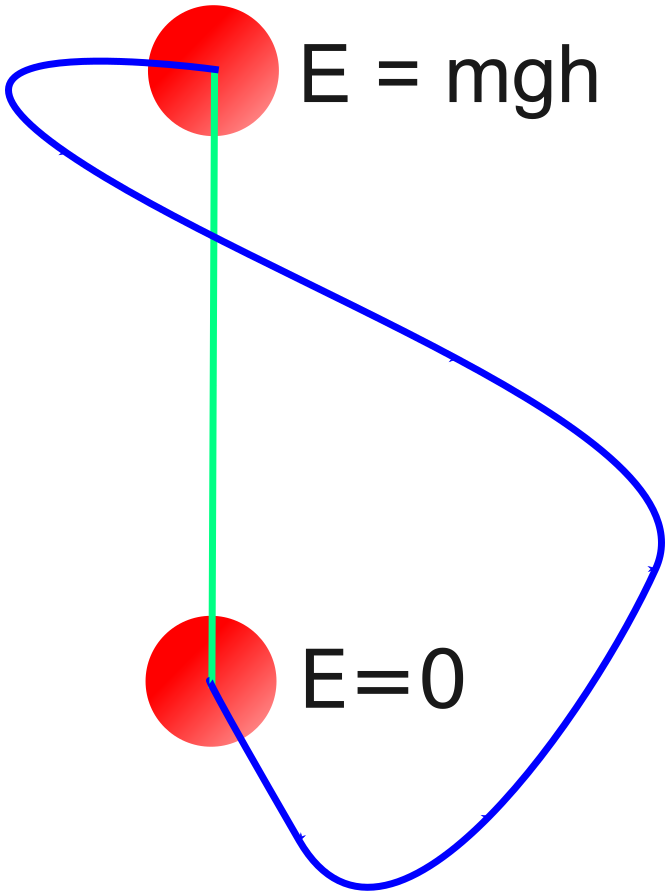
Conservative forces (like gravity) do the same work regardless of path. Non-conservative forces (like friction) do more work over longer paths. Credit: Wikimedia Commons, CC BY-SA
Applying Conservation of Energy
When only conservative forces act, the recipe is short and reliable:
Choose the system and identify the initial and final states.
Set a reference point for PE (usually the lowest point in the problem = 0).
WriteKEi+PEi=KEf+PEf.
Plug in knowns and solve.
Worked example. A 2 kg ball is dropped from 5 m. What’s its speed just before hitting the ground?
KEi+PEi=KEf+PEf
0+mgh=21mv2+0
(2)(10)(5)=21(2)v2
100=v2 → v=10 m/s.
Notice mass cancels when the only energies are gravitational PE and KE. That’s exactly why all objects fall at the same rate in a vacuum.
When Non-Conservative Forces Are Present
When friction (or air resistance, or any non-conservative force) does work, mechanical energy is not conserved. Some KE/PE gets siphoned off into heat, sound, or deformation. The equation becomes:
A frictionless roller coaster converts PE to KE and back. Each hill’s max height is capped by the total mechanical energy set at the first hill. Credit: Wikimedia Commons, CC BY-SA
The Round-Trip Test
A quick way to check whether a force is conservative: imagine moving an object in a complete loop back to its starting point. If the force does zero net work over that round trip, it’s conservative.
Gravity: lift a ball 5 m, then lower it 5 m. Gravity does −mgh on the way up and +mgh on the way down. Net = 0. ✓ Conservative.
Friction: slide a box 5 m right, then 5 m left back to start. Friction opposes motion both ways, so it does negative work in both directions. Net is not zero — energy was bled into heat in both legs. Non-conservative.
This test instantly classifies any force you encounter.
A pendulum is released from a height of 0.8 m above its lowest point. What is its speed at the bottom of the swing? (Ignore air resistance, g=10 m/s².)
Click to reveal answer
v=4 m/s. Conservation of energy: mgh=21mv2. Mass cancels: v=2gh=2(10)(0.8)=16=4 m/s. All gravitational PE converted to KE at the bottom of the swing.
A 5 kg block slides down a 3 m high frictionless ramp, then across a rough horizontal surface where friction does −50 J of work. What is the block’s final speed?
Click to reveal answer
v≈6.3 m/s.KEi+PEi+Wnc=KEf+PEf. Starting from rest at the top: 0+(5)(10)(3)+(−50)=21(5)v2+0 → 100=2.5v2 → v2=40 → v≈6.3 m/s.
You drop a ball from a 4 m height. It bounces back to 3 m. How much mechanical energy was “lost”? Where did it go?
Click to reveal answer
25% of the original PE was converted to other forms. Initial PE = mg(4). PE after bounce = mg(3) = 75% of original. The missing 25% went into heat (slight warming of ball and floor), sound (the thud you hear), and a tiny bit of permanent deformation. Total energy is still conserved — it just left mechanical form.
Two people each carry a 20 kg box up the same flight of stairs. One sprints up in 5 seconds; the other plods up in 30 seconds. They both did the same work — same mass, same height — but most people would agree the sprinter “worked harder” in some sense.
That intuition is what physics calls power: the rate at which work is done. Power isn’t about how much total energy you transfer — it’s about how quickly. The sprinter delivered the same energy in 61 the time, so their power output was 6× higher.
Once you separate “energy” from “energy per second,” a lot of everyday things click. A 100 W bulb and a 60 W bulb both convert electrical energy into light, but the 100 W bulb does it faster — that’s why it’s brighter. A small car engine and a sports car engine can both move the cars forward, but the sports car engine can deliver that energy faster — so it accelerates harder.
The Power Equations
The second formula isn’t a new concept — it’s just an algebraic shortcut. Combine P=W/t with W=Fd: P=Fd/t=F(d/t)=Fv. Same physics, different inputs. Use whichever the problem makes easy.
Units of Power
Unit
Definition
When you’ll see it
Watt (W)
1 J/s
SI unit; standard in physics problems
Kilowatt (kW)
1000 W
Electrical appliances, motors, electricity bills
Horsepower (hp)
~746 W
Engines, occasionally in MCAT passages
For quick estimation: 1 hp ≈ 750 W, so 60 hp ≈ 45 kW. A typical microwave is ~1000 W = 1 kW. A typical car engine peaks at ~150 hp ≈ 110 kW. A fit human can sustain ~200–400 W indefinitely (and briefly hit much higher peaks).
Power and Energy Over Time
Since P=W/t, you can rearrange to W=Pt — the energy transferred over a time interval equals power times time. This is exactly how electricity bills are calculated: you pay for energy in kilowatt-hours (kWh), not in watts.
1 kWh=(1000 W)(3600 s)=3,600,000 J=3.6 MJ
Run a 100 W bulb for 10 hours = 1 kWh of energy. At ~$0.15 per kWh (US average), that’s about 15 cents.
Applying P=Fv
A car engine has to push hard enough to overcome friction and air resistance. At a constant highway speed (no acceleration), the engine’s forward push must exactly cancel the backward resistive forces. The power the engine has to deliver is P=Fv, where F is the resistive force and v is the cruising speed.
This means a higher cruising speed needs more power, even if you assume the resistive forces stay the same. And since air resistance actually grows quickly with speed (roughly with v2), the power needed to cruise at 80 mph is several times the power needed at 40 mph. That’s the main reason highway driving uses way more gas than city driving (per mile of distance).
Average vs. Instantaneous Power
P=W/t gives the average power over a time interval. P=Fv (with instantaneous v) gives the instantaneous power at one specific moment.
On the MCAT, most problems are about average power, but read the question carefully — “the engine’s peak power” or “the power at the moment v = 30 m/s” both ask for instantaneous values.
Worked Example
A 70 kg person runs up a 5 m staircase in 4 seconds. What’s their average power output?
Work against gravity: W=mgh=(70)(10)(5)=3500 J.
Power: P=W/t=3500/4=875 W.
That’s about 1.2 hp — a serious sustained burst, but typical for a fit person sprinting upstairs. The body can briefly exceed this, but most adults can only sustain a few hundred watts for any extended period.
A 60 kg person climbs a 4 m staircase in 5 seconds. What is their average power output? (Use g=10 m/s².)
Click to reveal answer
P=480 W. Work: mgh=(60)(10)(4)=2400 J. Power: W/t=2400/5=480 W (about 0.64 hp).
A car engine provides 3000 N of force while the car travels at constant 20 m/s. What power does the engine deliver?
Click to reveal answer
P=60,000 W = 60 kW. Use P=Fv=(3000)(20)=60,000 W. At constant velocity, all of this goes into overcoming friction and air resistance (no acceleration, no KE change).
A 1500 W microwave is run for 3 minutes. How much energy does it use? Express in joules and in kWh.
Click to reveal answer
270,000 J = 0.075 kWh.W=Pt=1500 W×180 s=270,000 J. In kWh: 1500 W×(3/60) h=0.075 kWh — about 1 cent of electricity. (Or use 270,000 J/3,600,000 J/kWh=0.075 kWh.)
You can’t open a door by pushing on the hinge. You push near the handle — as far from the hinge as possible — because that’s where your push has the most rotational effect. Try pushing 1 cm from the hinge and you’ll be amazed at how stiff the door feels. Push at the handle (~80 cm out) and it swings easily. Same door, same hinge, same push — totally different result.
That “rotational effect of a force” is torque. It’s the rotational version of force: where ordinary force makes things accelerate in a straight line, torque makes things spin around a pivot. The MCAT uses torque in seesaws, beams, levers, the human body (every joint!), and any time a problem mentions a hinge, a pivot, or a fulcrum.
The Torque Equation
The product rsinθ — or equivalently Fsinθ times r — is called the lever arm (the perpendicular distance from the pivot to the line of action of the force). You can read the formula two equivalent ways:
τ=(rsinθ)×F = lever arm × full force.
τ=r×(Fsinθ) = full distance × perpendicular component of force.
Both give the same answer. Use whichever matches your mental picture of the problem.
Sign Convention for Torque
Torque has a sign that tells you which way it’s spinning:
The MCAT may use either convention — what matters is consistency. Pick one for a given problem and stick with it.
Maximizing Torque
Since τ=rFsinθ, you maximize torque by making each factor as big as possible:
r as large as possible (push far from the pivot).
F as large as possible (push harder).
θ=90° (push perpendicular to the lever arm, since sin90°=1).
This is why door handles are placed far from hinges, why long wrenches loosen stubborn bolts, and why a bicycle pedal arm is a foot long, not an inch. All of them are torque-maximizing geometry.
Static Equilibrium
An object is in static equilibrium when it’s not moving and not rotating. That requires two conditions, not one:
The “two conditions, not one” point is what makes equilibrium problems trickier than basic Newton’s-law problems. You can balance forces perfectly and still get rotation; you can balance torques perfectly and still get sliding. You need both.
Interactive Seesaw Simulator
🎯 Predict First
A 10 kg mass sits 1 m to the left of a seesaw's fulcrum. A 5 kg mass is placed on the right side. Can the lighter mass balance the seesaw?
Place two weights on opposite sides of a fulcrum and watch the beam respond. Drag the weights directly on the beam or use the sliders below to adjust masses and distances. Notice how a heavy mass close to the fulcrum can perfectly balance a lighter mass farther away — that’s torque, where the product of mass and distance determines the rotational effect, not mass alone. Hit “Balance It!” to let the math find equilibrium for you.
Solving Equilibrium Problems
Same recipe every time:
Draw a free-body diagram showing all forces and where they act on the object.
Choose a pivot point. (Any point works — the math is the same. Smart choice = easier math.)
Apply ΣF=0 (usually as separate x and y component equations).
Apply Στ=0 about your chosen pivot.
Solve the equations simultaneously.
Choosing the Pivot Point Strategically
You can calculate torques about any point — the answer comes out the same. But a smart choice eliminates unknown forces from the torque equation by putting the pivot right where one of those unknowns acts.
If you don’t know the force at a support, make that support your pivot. The torque from that force is automatically zero (because r=0 for any force at the pivot itself), and you never have to solve for it.
Torque in Biological Systems
The human body is full of torque problems. Every joint is a pivot point. Every muscle attaches to a bone at some distance from that joint. Bones act as lever arms.
Take your bicep. The bicep muscle attaches to the forearm only a few cm past the elbow joint, while the weight you’re holding might be 30+ cm out at your hand. That gives the bicep a short lever arm and the weight a long lever arm — so the bicep has to pull with a force several times bigger than the weight, just to hold things steady. (For a 5 kg dumbbell at the hand, the bicep typically pulls with ~15× that — like 750 N or so.)
This is why even moderately heavy gym weights can feel surprisingly hard: the muscle is at a mechanical disadvantage. It’s also why most muscle attachments throughout the body sacrifice mechanical advantage for speed — a small muscle contraction near the joint produces a large, fast motion at the end of the limb.
A 40 kg child sits 2 m from the pivot of a seesaw. Where must a 60 kg child sit to balance it? (Use g=10 m/s².)
Click to reveal answer
1.33 m from the pivot. For equilibrium: τ1=τ2 → m1gr1=m2gr2. g cancels: (40)(2)=(60)(r2) → r2=80/60=1.33 m. The heavier kid sits closer to the pivot.
A 500 N force is applied at the end of a 0.3 m wrench at a 60° angle to the wrench. What is the torque?
Click to reveal answer
τ≈130 N·m.τ=rFsinθ=(0.3)(500)(sin60°)=(0.3)(500)(0.866)≈130 N·m. If the force were perpendicular (90°), torque would be the maximum: (0.3)(500)(1)=150 N·m.
A horizontal 4 m beam of negligible mass rests on a pivot 1 m from one end. A 10 kg mass hangs from the long end (3 m from the pivot). What mass must be hung from the short end to balance the beam? (g=10 m/s²)
Click to reveal answer
30 kg. Equilibrium of torques: m1gr1=m2gr2⇒m1(1)=(10)(3)⇒m1=30 kg. The shorter lever arm needs proportionally more mass to balance.
You need to lift a 200 kg crate onto a 1.5 m high truck bed. You could deadlift it straight up — a couple thousand newtons of force, briefly. Or you could roll it up a 6 m ramp, using only one-quarter the force, but pushing it four times as far.
You do the same total work either way (about 3000 J in both cases). What changes is how that work is split between force and distance. The ramp lets a single human do what would otherwise require a forklift. That trade — give up distance to save force — is the magic of every simple machine, from the inclined plane the Egyptians used to build pyramids to the gear ratios in a modern bicycle.
The Core Principle: Energy Conservation
Every simple machine obeys the same rule: Win=Wout (in an ideal, frictionless machine). Since W=Fd:
Fin×din=Fout×dout
If the machine reduces the force you need (Fin<Fout), it must increase the distance you move (din>dout). The ratio is fixed by conservation of energy. There’s no free lunch.
Ideal Mechanical Advantage (IMA)
Levers
A lever is a rigid bar that pivots around a fixed point called the fulcrum. There are three classes, distinguished by which of three things — fulcrum, load, effort — sits in the middle.
Class
Fulcrum position
Example
IMA
1st class
Between effort and load
Seesaw, crowbar, scissors
Can be > 1, = 1, or < 1
2nd class
Load between fulcrum and effort
Wheelbarrow, nutcracker, bottle opener
Always > 1 (force multiplier)
3rd class
Effort between fulcrum and load
Tweezers, fishing rod, your bicep-forearm
Always < 1 (speed/distance multiplier)
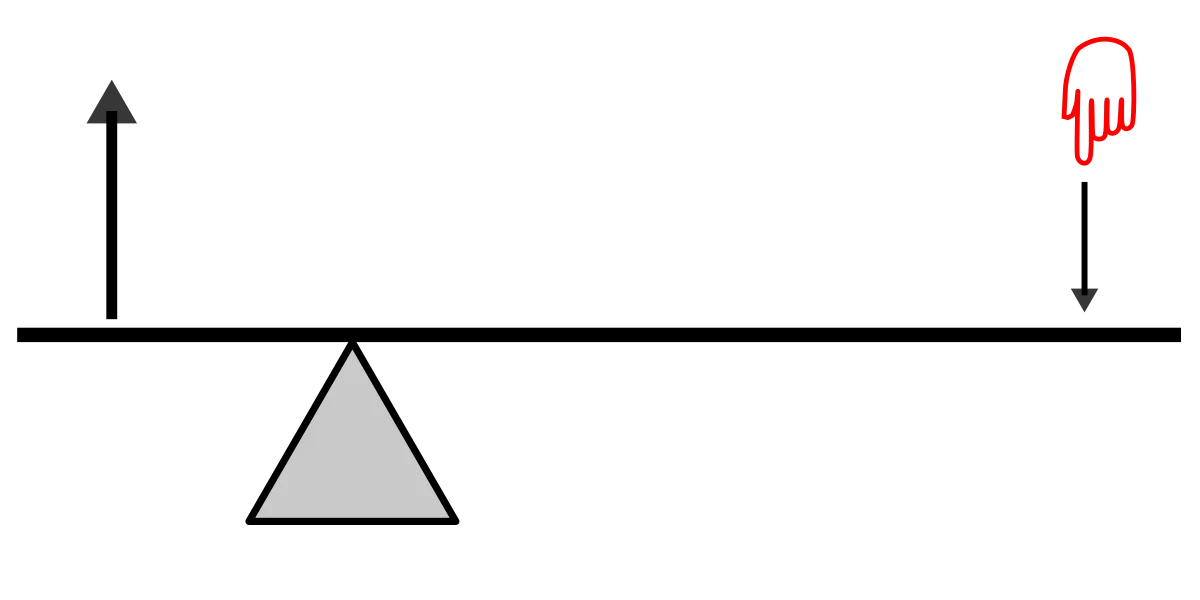
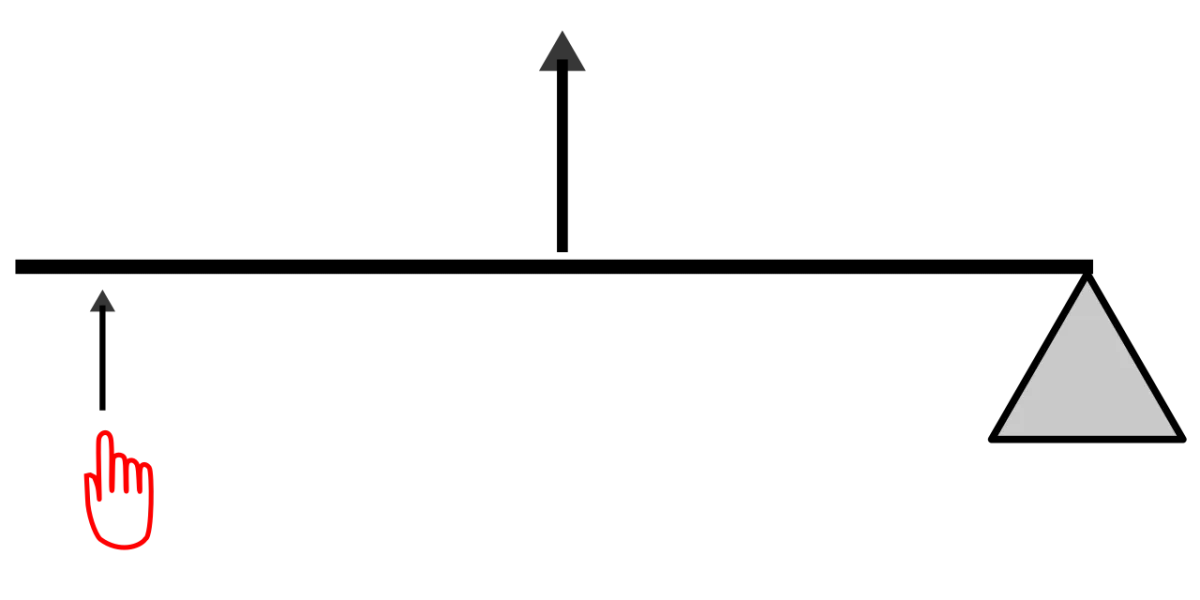
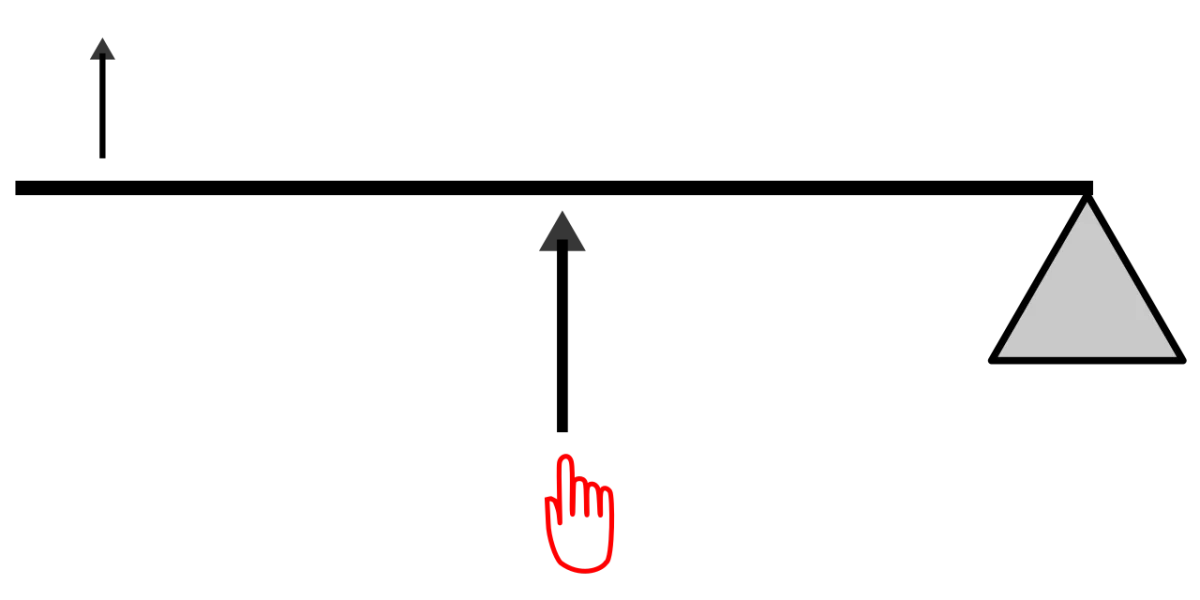
First-class lever: fulcrum in the middle. Seesaws, crowbars, scissors. Credit: Wikimedia Commons, CC BY-SASecond-class lever: load in the middle. Always a force multiplier (IMA > 1). Wheelbarrows, bottle openers. Credit: Wikimedia Commons, CC BY-SAThird-class lever: effort in the middle. Always a speed/distance multiplier (IMA < 1). Tweezers, fishing rods, the human forearm. Credit: Wikimedia Commons, CC BY-SA
For levers, IMA=(distance from effort to fulcrum)/(distance from load to fulcrum). A longer effort arm means greater mechanical advantage. (Why third-class levers always have IMA < 1: the effort sits closer to the fulcrum than the load, so the load arm is longer than the effort arm.)
Pulleys
Pulleys redirect force, and (when combined cleverly) multiply it. The key MCAT shortcut:
Pulley setup
IMA
Force needed for load W
Rope you must pull
Single fixed
1
W
d
Single movable
2
W/2
2d
One fixed + one movable
2
W/2
2d
Two movable (well-designed)
4
W/4
4d
Inclined Plane (Ramp)
The ramp is the most intuitive simple machine — you’ve used one every time you’ve walked up a hill instead of a vertical cliff. A gentle slope (long ramp, small rise) takes little force over a long distance. A steep slope (short ramp, big rise) takes more force over a shorter distance.
In the frictionless ideal case, the force needed to push an object up a ramp at constant speed is F=mgsinθ, where θ is the ramp angle. (This is the down-slope component of gravity from §1.11.)
Wheel and Axle
A wheel and axle is essentially a rotating lever. The IMA equals the ratio of the wheel radius to the axle radius:
IMA=RaxleRwheel
A large steering wheel makes it easy to turn a small steering shaft. A doorknob (big radius) makes it easy to turn a small latch mechanism. A screwdriver handle (wide grip) gives big mechanical advantage to the narrow shaft turning the screw.
A 10 m ramp is used to raise objects to a height of 2 m. What is the IMA? If a 500 N crate is pushed up the ramp (frictionless), what force is needed?
Click to reveal answer
IMA = 5, force = 100 N. IMA = length/height = 210 = 5. For an ideal machine: Fin=Fout/IMA=500/5=100 N. One-fifth the force, five times the distance.
A pulley system has 3 rope segments supporting the load. What force is needed to lift a 600 N object? How much rope must you pull to raise the object 1 m?
Click to reveal answer
Force = 200 N, rope pulled = 3 m. IMA = 3 (three supporting segments). Force = 3600 = 200 N. To raise the load 1 m, you must pull IMA × distance = 3 m of rope. Less force, more distance — total work the same.
A first-class lever has its fulcrum 0.2 m from the load and 0.8 m from where you push. What is the IMA?
Click to reveal answer
IMA = 4.IMA=(effort arm)/(load arm)=0.8/0.2=4. You apply 41 the force at 4× the distance — exactly the trade-off of every simple machine.
In §2.9 we assumed every machine was ideal — frictionless, no losses, every joule in equals a joule out. Reality is different. Every real machine wastes some energy.
A typical car engine delivers only about 25% of gasoline’s chemical energy to the crankshaft as work. The rest leaves as waste heat in the exhaust, the radiator, and the engine block. An incandescent light bulb converts about 5% of electrical energy into visible light — the other 95% becomes infrared “heat” radiation. Even your own muscles are only ~20–25% efficient — most of the energy you eat eventually leaves as body heat.
Efficiency tells you what fraction of the energy you put in actually does useful work. Higher efficiency = less waste = lower fuel/electricity costs.
The Efficiency Equation
You can also write this with power: e=(Pout/Pin)×100%, since power is just energy per unit time and the time cancels.
Why Real Machines Are Never 100% Efficient
Every real machine bleeds energy through one (or more) of these channels:
Loss mechanism
Where it goes
Example
Kinetic friction
Heat at contact surfaces
Pulley rope sliding over a wheel
Air resistance
Heat + turbulence in air
Moving parts of any machine
Sound
Acoustic energy (eventually heat)
Squeaky pulleys, engine noise
Deformation
Heat from material flexing
Tires squishing on the road
Internal electrical resistance
Heat in wires
Motor windings warming up
Notice the pattern: almost everything ends up as heat. Sound waves, turbulence, deformation, electrical losses — all of them eventually warm up the surroundings and become “thermal energy” that’s no longer easy to recapture as useful work.
Actual vs. Ideal Mechanical Advantage
Because of friction, the actual force output of a machine is less than the ideal calculation predicts. This gives a second way to express efficiency:
Worked Examples
Example 1. A motor uses 500 J of electrical energy to lift a 30 kg crate 1.5 m. What is the motor’s efficiency? (g=10 m/s².)
Wout=mgh=(30)(10)(1.5)=450 J.
e=(450/500)×100%=90%.
The other 50 J became waste heat in the motor windings.
Example 2. A ramp with IMA=5 requires 120 N of force to push a 500 N crate up it. What’s the efficiency?
AMA=Fout/Fin=500/120≈4.17.
e=(AMA/IMA)×100%=(4.17/5)×100%≈83%.
The 17% of energy “missing” from the ideal calculation went into friction between the crate and the ramp surface.
Efficiency of Common Systems
System
Typical efficiency
Main loss
Electric motor
85–95%
Resistive heating in windings
Human muscle
20–25%
Body heat
Car engine (gasoline)
20–30% (brake thermal)
Exhaust + radiator heat
Incandescent bulb
~5%
Infrared heat
LED bulb
~40–50%
Some heat (still much better than incandescent)
Photosynthesis
~1–2%
Heat, light reflected
Coal-fired power plant
~35–40%
Waste heat in cooling towers
The car engine row is brake thermal efficiency: the share of the fuel’s chemical energy that arrives at the crankshaft as useful work. Whole-vehicle figures, sometimes quoted as “tank-to-wheels” efficiency, are lower, because they also subtract drivetrain, idling, and accessory losses. Different denominators, so the two are not interchangeable.
For comparison: a Tesla Model 3’s electric motor + battery system runs around 75–85% efficient, vs. the 20–30% of a gasoline engine. That’s the main reason EVs cost less to fuel per mile.
Cascading Efficiency
When multiple machines are connected in series (the output of one feeds the input of the next), the overall efficiency is the product of the individual efficiencies:
etotal=e1×e2×e3×…
A 90% efficient motor driving an 80% efficient pump gives an overall system efficiency of 0.9×0.8=0.72=72%. Each stage loses a little, and the losses compound — which is why complex machinery (with many conversion stages) tends to be less efficient than direct ones.
A machine uses 800 J of energy to perform 600 J of useful work. What is its efficiency, and how much energy was "lost"?
Click to reveal answer
Efficiency = 75%. "Lost" = 200 J.e=(600/800)×100%=75%. The other 200 J became thermal energy (heat) via friction or other non-conservative forces. Total energy is still conserved: 800=600+200.
A pulley system has IMA=4. In practice, you need 60 N to lift a 200 N load. What is the efficiency?
Click to reveal answer
Efficiency ≈ 83%.AMA=Fout/Fin=200/60≈3.33. e=(AMA/IMA)×100%=(3.33/4)×100%≈83%. In an ideal (frictionless) system, you'd only need 200/4=50 N — the extra 10 N goes to fighting friction in the pulleys.
A 60% efficient generator drives a 75% efficient motor. What's the overall efficiency of this generator-motor combination?
Click to reveal answer
45%. Multiply: 0.60×0.75=0.45 → 45%. Cascaded efficiencies always multiply, never add. Each stage loses some energy, and the losses compound — which is why systems with many conversion steps usually have lower total efficiency than direct ones.
Energy diagrams are one of the most efficient tools in physics — a single PE-vs-position graph can tell you where an object will accelerate, where it will stop and reverse, where the equilibrium points are, and whether each equilibrium is stable or unstable.
The MCAT loves them because they reward big-picture reasoning. Read the graph fluently and you can answer five different questions about the same object’s motion without doing any algebra.
The mental trick that makes the whole thing click: imagine the PE curve as an actual landscape, and visualize a marble rolling on it. Valleys catch the marble (stable equilibrium). Hilltops throw it off in either direction (unstable equilibrium). The marble always rolls downhill on the PE graph — that’s the force.
Reading a PE vs. Position Graph
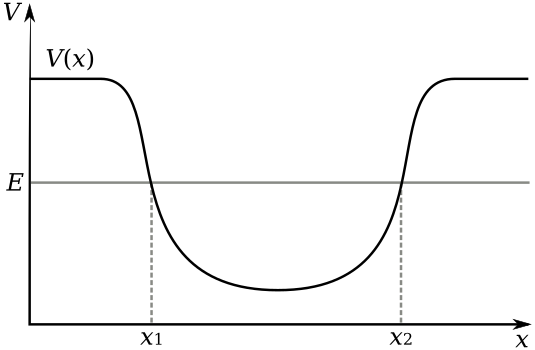
A potential-energy diagram puts PE on the y-axis and position x on the x-axis. The total mechanical energy (Etotal) is drawn as a horizontal line across the graph, since total energy stays constant when only conservative forces act.
A PE vs. x diagram with the total-energy line. Turning points occur where PE = Etotal. KE = Etotal − PE at any position. The object is confined between turning points. Credit: Wikimedia Commons, CC BY-SA
At any position, the kinetic energy is the vertical gap between the total-energy line and the PE curve:
This is the whole secret. Pick a position → look up the height of the PE curve there → subtract from total energy → that’s the KE → so the object is moving fast where PE is low and slow where PE is high.
Turning Points
A turning point is where KE=0 — the object momentarily stops and reverses direction. Graphically, it’s where the PE curve touches the total-energy line.
Between two turning points, the object oscillates back and forth (like a marble rolling in a bowl). The object can’t cross a PE “hill” that rises above its total-energy line — it doesn’t have enough KE to climb over. It’s effectively trapped.
This is exactly why a pendulum swings between two endpoints (its turning points) and not beyond — its mechanical energy isn’t enough to climb any higher.
Three Types of Equilibrium
Equilibrium happens wherever the slope of the PE curve is zero (flat spots). But not all equilibria are equal — the shape of the curve at the flat spot determines whether the equilibrium holds up under a small push.
Type
PE curve shape
Behavior when displaced
Physical analogy
Stable
Valley (local minimum)
Returns to equilibrium
Marble in a bowl
Unstable
Hilltop (local maximum)
Accelerates away
Marble on top of a hill
Neutral
Flat region
Stays in new position
Marble on a tabletop
Force from the PE Curve
There’s a direct relationship between the PE curve and the force on the object:
The negative sign matters. It encodes the “rolls downhill” intuition: force always points toward lower PE — never higher. Steep PE = strong force. Gentle PE = weak force. Flat PE = no force.
You don’t need calculus on the MCAT — just eyeball the slope of the PE curve at the position you’re asked about. Steep down to the right → strong force pointing right. Steep down to the left → strong force pointing left.
Putting It All Together: A Complete Example
Imagine a PE curve with a deep valley at x=2, a small hill at x=5, and a shallow valley at x=8. An object has total energy E shown as a horizontal line cutting through both valleys but just above the hilltop.
What can you say?
The object placed in the deep valley near x=2 oscillates between its two turning points (where the PE curve touches the E line).
If E is high enough to clear the hill at x=5, the object can travel into the shallow valley at x=8. If not, it’s trapped on one side.
At x=2 and x=8 (valley bottoms), the slope is zero → force = 0 → both are equilibrium positions. They’re stable (valleys).
At x=5 (hilltop), slope is also zero → force = 0 → equilibrium, but unstable.
Maximum KE (and maximum speed) occurs at the deepest point of the deepest valley — biggest gap between E and PE.
Speed is zero at every turning point.
Summary: Attacking Energy Diagram Problems
Find the total-energy line (horizontal).
Find turning points where the PE curve meets the energy line (KE=0).
KE at any position = vertical gap between Etotal and PE.
Maximum speed at the deepest valley bottom (largest KE).
On a PE vs. x diagram, an object has total energy E. At position x=3, PE = E. What is the object's KE and velocity at this point?
Click to reveal answer
KE=0, v=0.KE=Etotal−PE=E−E=0. The object is momentarily at rest. This is a turning point — the object will reverse direction here.
On a PE diagram, position A is at the bottom of a valley and position B is at the top of a hill. Which is stable equilibrium? What happens if a marble at each position is slightly displaced?
Click to reveal answer
A (valley) = stable. B (hilltop) = unstable. If displaced from A, the force (= negative slope) pushes back toward A — restoring. If displaced from B, the force pushes away from B — accelerating downhill. Both have F=0 at the equilibrium itself, but only A is self-correcting under perturbations.
A PE curve has a steep downward slope at x=4. What can you say about the force on the object at that position?
Click to reveal answer
The force is large and points toward lower PE.F=−dPE/dx — steep slope means big force; the negative sign means force points toward lower PE. So a steep "downhill" slope on the right side of x=4 produces a strong force pushing the object to the right (toward the lower PE).
The MCAT is an interdisciplinary exam, and energy is one of its favorite crossover topics. A single passage might describe a person climbing stairs and ask you to connect three subjects:
Physics:W=mgh (the work needed to lift the body’s mass).
Biology: ATP hydrolysis powers each muscle contraction.
Biochemistry: glucose oxidation produces the ATP.
This section bridges those worlds. Once you see how the same conservation laws govern both an engine pushing a car and a muscle pulling a tendon, the crossover questions stop feeling like trick questions.
ATP: The Energy Currency
Adenosine triphosphate (ATP) stores energy in its phosphoanhydride bonds. When ATP is hydrolyzed to ADP + Pi, it releases roughly 30.5 kJ/mol under standard conditions. Inside actual cells (where concentrations differ from standard state), the real release is closer to 50–54 kJ/mol — significantly more.
Muscle Contraction as Work
When a bicep lifts a weight, the physics work is W=mgh. But the biological work involves millions of myosin heads pulling on actin filaments, each driven by one ATP hydrolysis cycle. The bridge between scales:
Glucose is oxidized in cellular respiration, producing ATP.
ATP binds to myosin heads in the muscle.
ATP hydrolysis triggers the myosin “power stroke” — a tiny applied force over a tiny distance (work at the molecular level).
Many millions of power strokes happening simultaneously shorten the muscle, producing macroscopic force and shortening.
The macroscopic muscle force × the distance the load moves = the physics work done on the load.
So mgh at the gym scale and ΔG of ATP hydrolysis at the molecular scale are connected by an unbroken chain of energy transfers.
Metabolic Efficiency
The human body converts food energy to mechanical work with an efficiency of roughly 20–25%. The remaining 75–80% becomes body heat. That’s why you get hot during exercise — most of the metabolic energy you’re burning ends up as warmth, not motion.
Energy conversion step
Approximate efficiency
Glucose → ATP (cellular respiration)
~40%
ATP → muscle contraction
~50%
Overall (glucose → mechanical work)
~20–25%
The two stages multiply (cascading efficiency, §2.10): 0.40×0.50=0.20=20%. Just like any machine, every conversion step shaves off some of the original energy as heat.
Coupled Reactions and Free Energy
In biochemistry, endergonic reactions (positive ΔG, non-spontaneous) are made to proceed by coupling them to ATP hydrolysis (negative ΔG, very spontaneous). The combined ΔG has to be negative for the coupled reaction to actually go.
Example: phosphorylating glucose costs energy (ΔG=+13.8 kJ/mol — won’t happen by itself). Couple it to ATP hydrolysis (ΔG=−30.5 kJ/mol):
Combined: ΔG=+13.8+(−30.5)=−16.7 kJ/mol.
Now the overall reaction is exergonic and proceeds spontaneously.
This is the biological equivalent of using a heavy falling weight (ATP hydrolysis) to lift a lighter weight (glucose phosphorylation) — the surplus energy from ATP more than pays for the costly reaction. Energy is still conserved; the bookkeeping just spans both reactions.
Energy Storage in the Body
The body stores energy in multiple forms, each with a different energy density and accessibility:
Storage form
Energy density
Accessibility
Duration
ATP (in muscle)
Very small total amount
Immediate
~2–3 seconds
Creatine phosphate
Small total amount
Very fast
~8–10 seconds
Glycogen (muscle, liver)
Moderate
Fast (anaerobic or aerobic)
Minutes to ~1 hour
Fat (adipose tissue)
Very high (~9 kcal/g)
Slow (aerobic only)
Hours to days
This hierarchy is why athletes train differently for different events. A 100 m sprint is mostly ATP + creatine phosphate (already stored, instantly accessible). A marathon is mostly fat oxidation (vast reserves but slower to mobilize). A 400 m run is the painful in-between zone — too long for ATP/creatine, too fast for full aerobic fat metabolism — so it relies heavily on anaerobic glycolysis, producing lactate.
Biomechanics: The Body as a Machine
The musculoskeletal system is a collection of levers (§§2.8–2.9). Most joints operate as third-class levers: the effort (muscle) is between the fulcrum (joint) and the load (weight in hand). That gives a mechanical advantage less than 1 — the muscle has to pull much harder than the load it’s lifting.
That sounds like bad engineering, but it’s a deliberate trade-off: speed and range of motion. A small contraction of the bicep (a few centimeters) produces a large, fast movement at the hand (tens of centimeters). The body sacrifices brute force for quickness — exactly the opposite of what a crowbar does. Throwing a baseball, swinging a tennis racket, kicking a soccer ball — none of them would be possible with high-MA leverage; you need the speed.
An 80 kg person climbs a 10 m staircase. If their muscles are 25% efficient, how much total metabolic energy do they use? (g=10 m/s²)
Click to reveal answer
32,000 J (32 kJ). Useful work = mgh=(80)(10)(10)=8000 J. Efficiency = Wout/Ein → Ein=Wout/e=8000/0.25=32,000 J. The remaining 24 kJ is released as body heat (which is why you sweat).
Why does coupling ATP hydrolysis (ΔG=−30.5 kJ/mol) to an endergonic reaction (ΔG=+20 kJ/mol) allow the endergonic reaction to proceed?
Click to reveal answer
Because the combined ΔG is negative.ΔGtotal=(−30.5)+(+20)=−10.5 kJ/mol. Negative overall ΔG → the coupled reaction is exergonic → it proceeds spontaneously. ATP hydrolysis releases more than enough free energy to drive the endergonic step forward.
A candy bar provides 1000 kJ of food energy. If the body is 25% efficient, how much mechanical work could you do with it? How much heat is released?
Click to reveal answer
250 kJ of work; 750 kJ of heat. Useful work = 0.25×1000=250 kJ. The other 750 kJ becomes body heat. (For perspective: 250 kJ is enough to climb stairs continuously for a few minutes — way less than people intuitively expect from a candy bar.)