
Collisions
Two billiard balls collide on a pool table and bounce off each other with a sharp click. Almost no energy is lost — the balls keep moving with nearly the same total speed they had before.
A car rear-ends another car at a red light. The two crumple together and slide forward as one mangled unit. A huge fraction of the original kinetic energy is gone — converted to heat, twisted metal, and the sound of breaking glass.
Both events conserve momentum (the universe insists on this, always, in any isolated system). But only the billiard collision conserves kinetic energy. The difference between these two types of collisions — and a third in-between type — is one of the most heavily tested topics in MCAT physics.
Three Types of Collisions
| Type | Momentum conserved? | Kinetic energy conserved? | Objects after collision |
|------|---------------------|--------------------------|----------------------|
| Elastic | Yes | Yes | Bounce apart |
| Inelastic | Yes | No (some KE lost) | Bounce apart (with deformation) |
| Perfectly inelastic | Yes | No (maximum KE lost) | Stick together as one |
A moving billiard ball hits an identical stationary ball head-on in a perfectly elastic collision. What happens?
Test your prediction below. Set both masses to 4 kg, keep the mode on Elastic, and press Run; then switch to Perfectly inelastic and run it again. Watch the bar chart on the right: the momentum bars always match, but after an inelastic collision the kinetic energy bar comes up short.
Elastic Collisions
In a perfectly elastic collision, both momentum and kinetic energy are conserved:
- Momentum:
- Kinetic energy:
That’s two equations with two unknowns (). Solvable, but the algebra is annoying. There’s a much cleaner shortcut:
Special cases worth memorizing for elastic collisions:
| Scenario | Result |
|----------|--------|
| Equal masses, target at rest | Moving object stops dead; target moves off with the original velocity |
| Heavy hits light (at rest) | Heavy object barely slows; light object flies off at ~2× the heavy object’s speed |
| Light hits heavy (at rest) | Light object bounces back at nearly the same speed; heavy object barely budges |
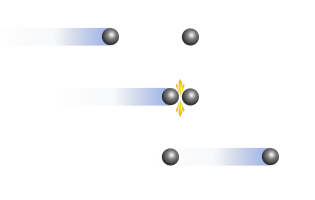
The “equal masses, target at rest” result is the entire physics behind a Newton’s cradle — when the first ball hits, it stops, and only the last ball flies off. Each pair of adjacent balls is doing the equal-mass elastic exchange, all at once.
Perfectly Inelastic Collisions
In a perfectly inelastic collision, the objects stick together and move as one combined unit. This is actually the simplest collision to calculate — there’s only one final velocity to solve for.
Worked example. A 4 kg block moving at 6 m/s right collides with and sticks to a 2 kg block at rest.
- m/s right.
How much kinetic energy was lost?
- J.
- J.
- KE lost = J — converted to heat, sound, and deformation.
Calculating Kinetic Energy Lost
For a perfectly inelastic collision where the target starts at rest, there’s a clean shortcut for the fraction of KE lost:
where is the moving object and is the stationary target. If the masses are equal, exactly half the kinetic energy is lost. If the target is much heavier than the projectile, almost all the KE is lost (think: bullet embedding in a wall — the wall barely moves and almost all the bullet’s energy goes into heat and damage).
2D Collisions (Brief Note)
On the MCAT, most collision problems are 1D. If a 2D collision shows up, apply conservation of momentum separately in the x- and y-directions — same approach as any vector problem (§1.3). Each direction is its own independent equation.
Summary Table
| Property | Elastic | Inelastic | Perfectly Inelastic |
|----------|---------|-----------|-------------------|
| Momentum conserved | Yes | Yes | Yes |
| KE conserved | Yes | No | No (maximum loss) |
| Objects after | Separate | Separate | Stuck together |
| KE after | Same as before | Less than before | Minimum possible |
| Real-world example | Billiard balls, atomic collisions | Most everyday collisions | Bullet in block, car pile-up |
m/s. KE lost = 60 J. m/s. J. J. KE lost = J. (Or use the shortcut: fraction lost = , and J.)
Momentum is conserved in ALL types (elastic, inelastic, perfectly inelastic) as long as the system is isolated. Kinetic energy is conserved ONLY in elastic collisions. In inelastic collisions, some KE is converted to other forms (heat, sound, deformation).
The first cart stops; the second cart moves at 6 m/s right. This is the special “equal masses, target at rest, elastic” case — the moving object hands off all its velocity to the target. It’s exactly what happens in a Newton’s cradle: the first ball stops dead and only the last one flies off.