You need to lift a 200 kg crate onto a 1.5 m high truck bed. You could deadlift it straight up — a couple thousand newtons of force, briefly. Or you could roll it up a 6 m ramp, using only one-quarter the force, but pushing it four times as far.
You do the same total work either way (about 3000 J in both cases). What changes is how that work is split between force and distance. The ramp lets a single human do what would otherwise require a forklift. That trade — give up distance to save force — is the magic of every simple machine, from the inclined plane the Egyptians used to build pyramids to the gear ratios in a modern bicycle.
The Core Principle: Energy Conservation
Every simple machine obeys the same rule: Win=Wout (in an ideal, frictionless machine). Since W=Fd:
Fin×din=Fout×dout
If the machine reduces the force you need (Fin<Fout), it must increase the distance you move (din>dout). The ratio is fixed by conservation of energy. There’s no free lunch.
Ideal Mechanical Advantage (IMA)
Levers
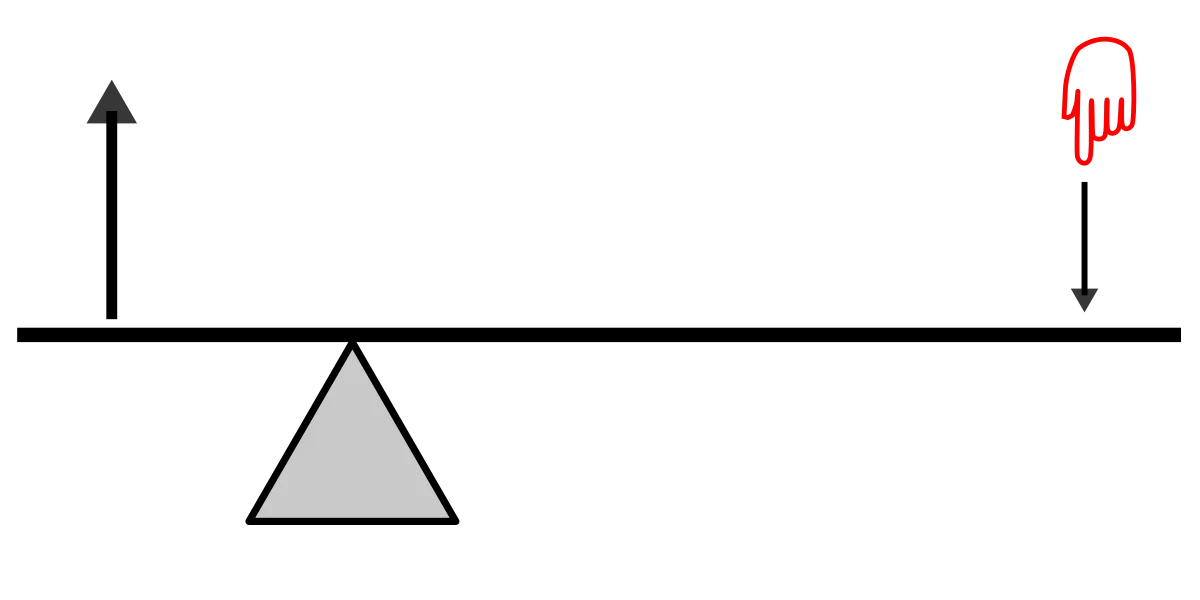
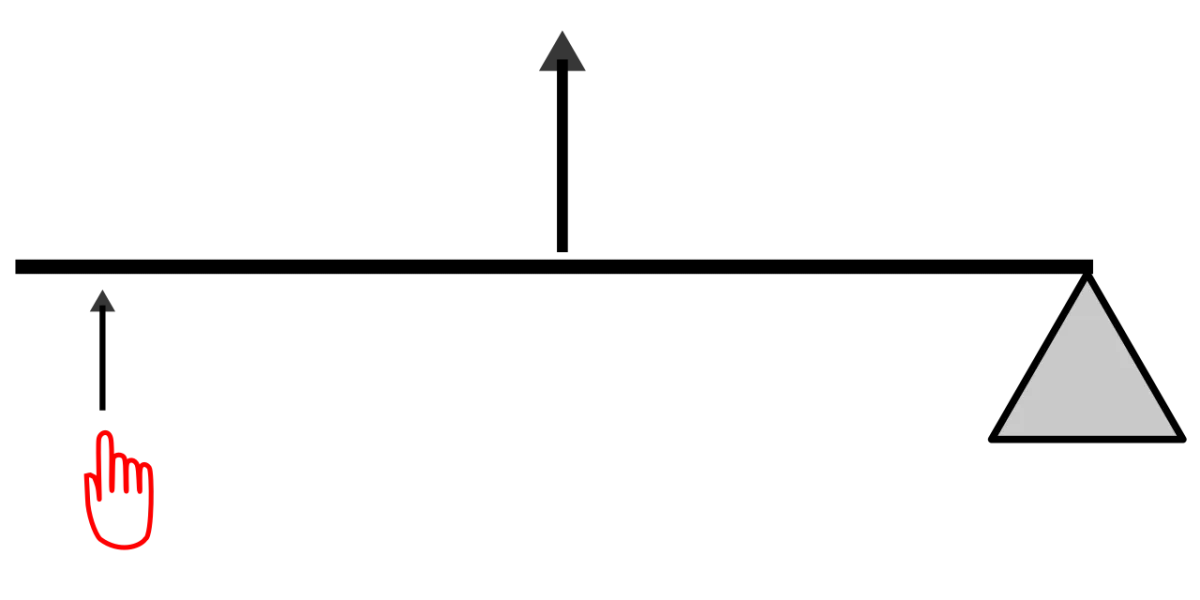
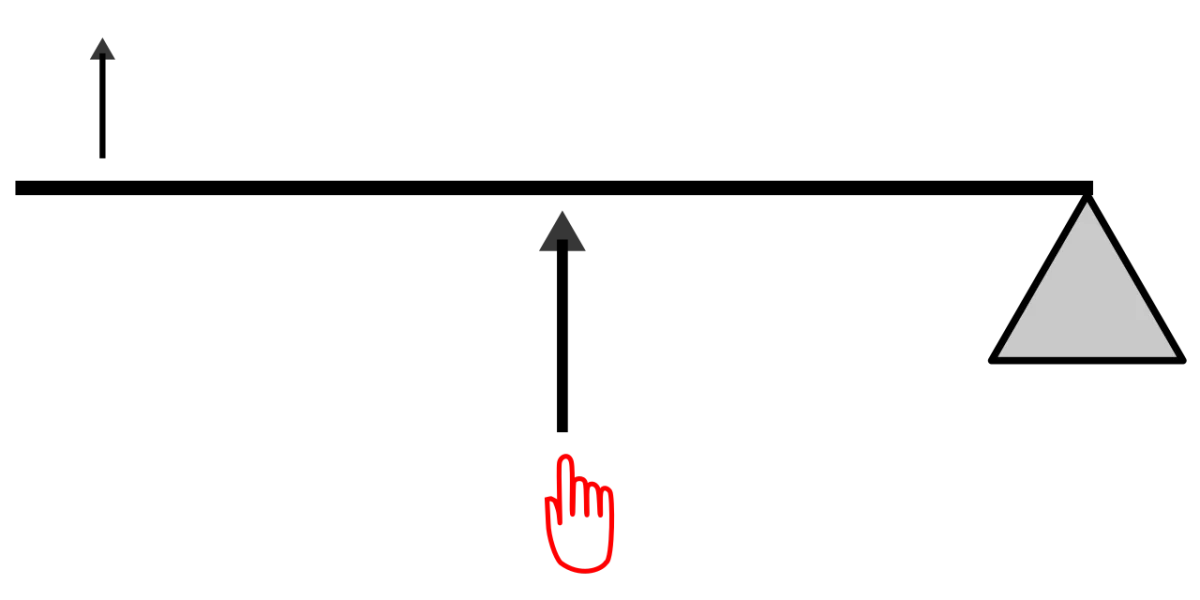
A lever is a rigid bar that pivots around a fixed point called the fulcrum. There are three classes, distinguished by which of three things — fulcrum, load, effort — sits in the middle.
Class
Fulcrum position
Example
IMA
1st class
Between effort and load
Seesaw, crowbar, scissors
Can be > 1, = 1, or < 1
2nd class
Load between fulcrum and effort
Wheelbarrow, nutcracker, bottle opener
Always > 1 (force multiplier)
3rd class
Effort between fulcrum and load
Tweezers, fishing rod, your bicep-forearm
Always < 1 (speed/distance multiplier)
First-class lever: fulcrum in the middle. Seesaws, crowbars, scissors. Credit: Wikimedia Commons, CC BY-SASecond-class lever: load in the middle. Always a force multiplier (IMA > 1). Wheelbarrows, bottle openers. Credit: Wikimedia Commons, CC BY-SAThird-class lever: effort in the middle. Always a speed/distance multiplier (IMA < 1). Tweezers, fishing rods, the human forearm. Credit: Wikimedia Commons, CC BY-SA
For levers, IMA=(distance from effort to fulcrum)/(distance from load to fulcrum). A longer effort arm means greater mechanical advantage. (Why third-class levers always have IMA < 1: the effort sits closer to the fulcrum than the load, so the load arm is longer than the effort arm.)
Pulleys
Pulleys redirect force, and (when combined cleverly) multiply it. The key MCAT shortcut:
Pulley setup
IMA
Force needed for load W
Rope you must pull
Single fixed
1
W
d
Single movable
2
W/2
2d
One fixed + one movable
2
W/2
2d
Two movable (well-designed)
4
W/4
4d
Inclined Plane (Ramp)
The ramp is the most intuitive simple machine — you’ve used one every time you’ve walked up a hill instead of a vertical cliff. A gentle slope (long ramp, small rise) takes little force over a long distance. A steep slope (short ramp, big rise) takes more force over a shorter distance.
In the frictionless ideal case, the force needed to push an object up a ramp at constant speed is F=mgsinθ, where θ is the ramp angle. (This is the down-slope component of gravity from §1.11.)
Wheel and Axle
A wheel and axle is essentially a rotating lever. The IMA equals the ratio of the wheel radius to the axle radius:
IMA=RaxleRwheel
A large steering wheel makes it easy to turn a small steering shaft. A doorknob (big radius) makes it easy to turn a small latch mechanism. A screwdriver handle (wide grip) gives big mechanical advantage to the narrow shaft turning the screw.
A 10 m ramp is used to raise objects to a height of 2 m. What is the IMA? If a 500 N crate is pushed up the ramp (frictionless), what force is needed?
Click to reveal answer
IMA = 5, force = 100 N. IMA = length/height = 210 = 5. For an ideal machine: Fin=Fout/IMA=500/5=100 N. One-fifth the force, five times the distance.
A pulley system has 3 rope segments supporting the load. What force is needed to lift a 600 N object? How much rope must you pull to raise the object 1 m?
Click to reveal answer
Force = 200 N, rope pulled = 3 m. IMA = 3 (three supporting segments). Force = 3600 = 200 N. To raise the load 1 m, you must pull IMA × distance = 3 m of rope. Less force, more distance — total work the same.
A first-class lever has its fulcrum 0.2 m from the load and 0.8 m from where you push. What is the IMA?
Click to reveal answer
IMA = 4.IMA=(effort arm)/(load arm)=0.8/0.2=4. You apply 41 the force at 4× the distance — exactly the trade-off of every simple machine.