Hold a phone above your kitchen counter and let go. It accelerates downward, picks up speed, and lands with a thud. Where did that kinetic energy come from?
It was stored in the phone the moment you lifted it off the counter. Lifting takes effort — your arm muscles do work against gravity. That work doesn’t disappear; it gets stored as gravitational potential energy (gravitational PE). The higher you raise something, the bigger the deposit, and the more kinetic energy it’ll have when it falls.
The same idea explains roller coasters (lift to the top, then convert to speed on the way down), water in a dam (high water = stored energy, released as the water falls through a turbine), and why falling from 30 feet is much more dangerous than falling from 5.
The Equation
This formula applies near Earth’s surface, where g is approximately constant. For objects far from Earth (satellites, spacecraft), gravity weakens with altitude and the MCAT uses a different formula. But for ~95% of MCAT problems, PE=mgh is all you need.
The Reference Point is Arbitrary
This is the part that confuses students most: the value of PE depends on where you set h=0 (your reference point). And that’s fine — because only changes in PE matter, and the changes come out the same no matter where you put zero.
Consider a ball on the edge of a 10 m cliff above a 5 m deep valley:
Reference = valley floor: PE at cliff edge = mg(15).
Reference = base of cliff: PE at cliff edge = mg(10).
Reference = cliff edge: PE at cliff edge = mg(0)=0.
The PE numbers are different. But if the ball falls from cliff edge to cliff base, every reference choice gives the same ΔPE=−mg(10), and the same final speed at the cliff base.
PE-KE Conversion
When an object falls freely (no friction, no air resistance), gravitational PE converts directly into KE:
At the top: maximum PE, minimum KE (object is momentarily at rest, KE = 0).
At the bottom: minimum PE (zero, if you set the reference there), maximum KE.
In between: PE shrinking, KE growing, total stays constant.
This is the foundation of energy conservation, which we’ll formalize in §2.6.
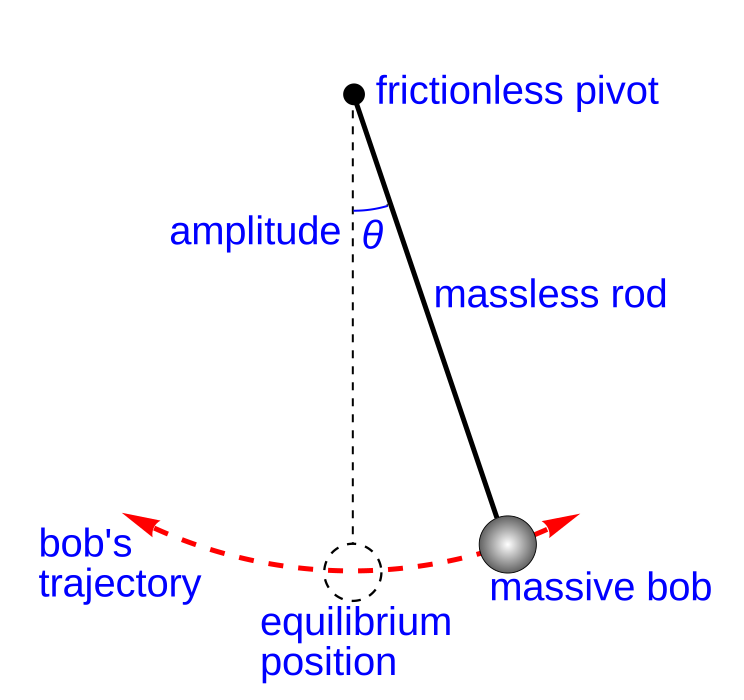
A pendulum demonstrates PE-KE conversion. At the highest points (ends of the swing), energy is all PE. At the lowest point, energy is all KE. Total mechanical energy stays constant throughout. Credit: Wikimedia Commons, CC BY-SA
Negative Heights
If an object is below your reference point, h is negative, and PE is negative. This is mathematically fine. A ball at the bottom of a well, with the reference set at ground level, has negative PE relative to ground level. As it falls deeper, PE becomes more negative (decreases), and KE increases.
The MCAT occasionally tests this. Don’t be thrown by a negative PE value — it just means the object is below the reference you chose.
Quick Calculation Tip
On the MCAT, g≈10 m/s² makes PE math fast. A 2 kg object at 5 m above the reference: PE=2×10×5=100 J. No calculator, no fuss.
To find the speed of a falling object from height h (starting from rest, no friction): set PE = KE, so mgh=21mv2. Mass cancels (everything falls the same), giving:
v=2gh
This shortcut shows up constantly. A 5 m drop: v=2(10)(5)=100=10 m/s. A 20 m drop: v=2(10)(20)=400=20 m/s. (Notice that quadrupling the height only doubles the impact speed — because of that .)
Worked Example
A 2 kg ball is dropped from a 5 m balcony onto a soft mat. What’s its speed just before hitting the mat? How much KE does it have at impact?
v=2gh=2(10)(5)=100=10 m/s.
KE=21mv2=21(2)(100)=100 J.
Sanity check: PEtop=mgh=2(10)(5)=100 J. The ball started with 100 J of PE and ended with 100 J of KE — exactly what energy conservation predicts. ✓
A 3 kg ball is dropped from 20 m. What is its speed just before hitting the ground? (Use g=10 m/s², no air resistance.)
Click to reveal answer
v=20 m/s. Use the shortcut: v=2gh=2(10)(20)=400=20 m/s. Or do it the long way: PEtop=mgh=600 J = KEbottom=21mv2 → v2=400 → v=20 m/s. Mass cancels.
Two students calculate the PE of a book on a table. Student A uses the floor as the reference and gets 30 J. Student B uses the tabletop as the reference and gets 0 J. Who's correct?
Click to reveal answer
Both are correct. The reference point is arbitrary, so both PE values are valid. What matters physically is the *change* in PE. If the book falls from the table to the floor, both students compute the same ΔPE and the same final speed. Absolute PE depends on the reference; the physics doesn't.
A roller coaster of mass 500 kg is released from rest at the top of a 30 m hill. Ignoring friction, what is its speed at the bottom?
Click to reveal answer
About 24.5 m/s.v=2gh=2(9.8)(30)=588≈24.2 m/s (using g=10: 600≈24.5 m/s). Mass doesn't appear — a 1500 kg coaster reaches the same speed. The coaster's mass cancels in the energy equation just like in free-fall problems.