
Conservation of Energy
A roller coaster grinds slowly up its first hill, pauses for a breathless second at the top, then plunges down — every joule of stored gravitational PE converting into screaming kinetic energy. If you could somehow eliminate friction and air resistance, the coaster could climb back up to exactly the same height on the next hill, without an engine, without any extra push. That’s conservation of energy in action.
This idea — energy doesn’t disappear, it just changes form — is one of the most powerful tools in physics. It lets you skip past acceleration, time, and force-balancing and jump straight from “starting condition” to “ending condition” using a single equation.
A 50 kg child and a 100 kg adult start from rest at the top of identical frictionless slides. Who is moving faster at the bottom?
Test your prediction below. Set a start height, press Release, and watch the stacked energy bar: blue PE trades for green KE while the total stays pinned. With friction at zero the ball climbs back to its start height on every pass; add friction and the orange heat band grows until the oscillation dies out, or raise the start height above the 5 m hill and watch the ball escape over the top.
Conservative vs. Non-Conservative Forces
The key to applying conservation of energy is knowing which forces play nice with it.
Conservative forces have two defining properties:
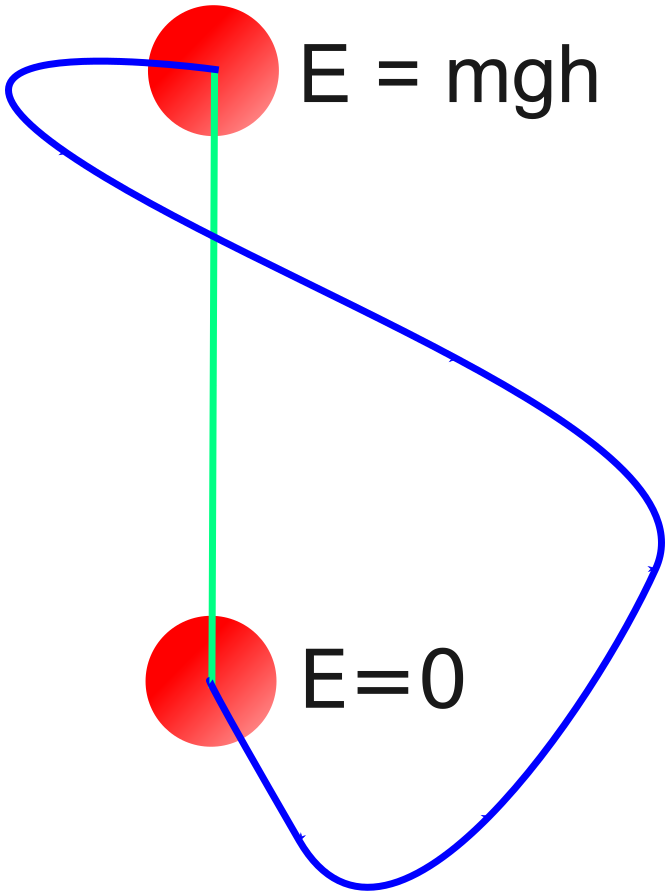
- The work they do is path-independent (only the start and end positions matter, not the route taken).
- The work done over a closed loop (back to the same starting point) is zero.
| Conservative forces | Non-conservative forces |
|--------------------|------------------------|
| Gravity | Friction |
| Spring (elastic) force | Air resistance |
| Electrostatic force | Tension (in many setups) |
| | Applied push/pull |
Path Independence: What It Really Means
Carry a 1 kg ball from the floor up to a shelf 2 m high. You could:
- Lift it straight up.
- Carry it up a spiral staircase.
- Hike it up a winding mountain trail until you reach 2 m above the floor.
In every case, gravity does the same amount of work: J. The path is irrelevant — only the height difference matters. That’s path independence.
Now slide a box across the floor. A short straight path produces less friction work than a long zigzag path covering more ground. Friction’s work depends entirely on the path length, so friction is non-conservative.
Applying Conservation of Energy
When only conservative forces act, the recipe is short and reliable:
- Choose the system and identify the initial and final states.
- Set a reference point for PE (usually the lowest point in the problem = 0).
- Write .
- Plug in knowns and solve.
Worked example. A 2 kg ball is dropped from 5 m. What’s its speed just before hitting the ground?
- → m/s.
Notice mass cancels when the only energies are gravitational PE and KE. That’s exactly why all objects fall at the same rate in a vacuum.
When Non-Conservative Forces Are Present
When friction (or air resistance, or any non-conservative force) does work, mechanical energy is not conserved. Some KE/PE gets siphoned off into heat, sound, or deformation. The equation becomes:
The Round-Trip Test
A quick way to check whether a force is conservative: imagine moving an object in a complete loop back to its starting point. If the force does zero net work over that round trip, it’s conservative.
- Gravity: lift a ball 5 m, then lower it 5 m. Gravity does on the way up and on the way down. Net = 0. ✓ Conservative.
- Friction: slide a box 5 m right, then 5 m left back to start. Friction opposes motion both ways, so it does negative work in both directions. Net is not zero — energy was bled into heat in both legs. Non-conservative.
This test instantly classifies any force you encounter.
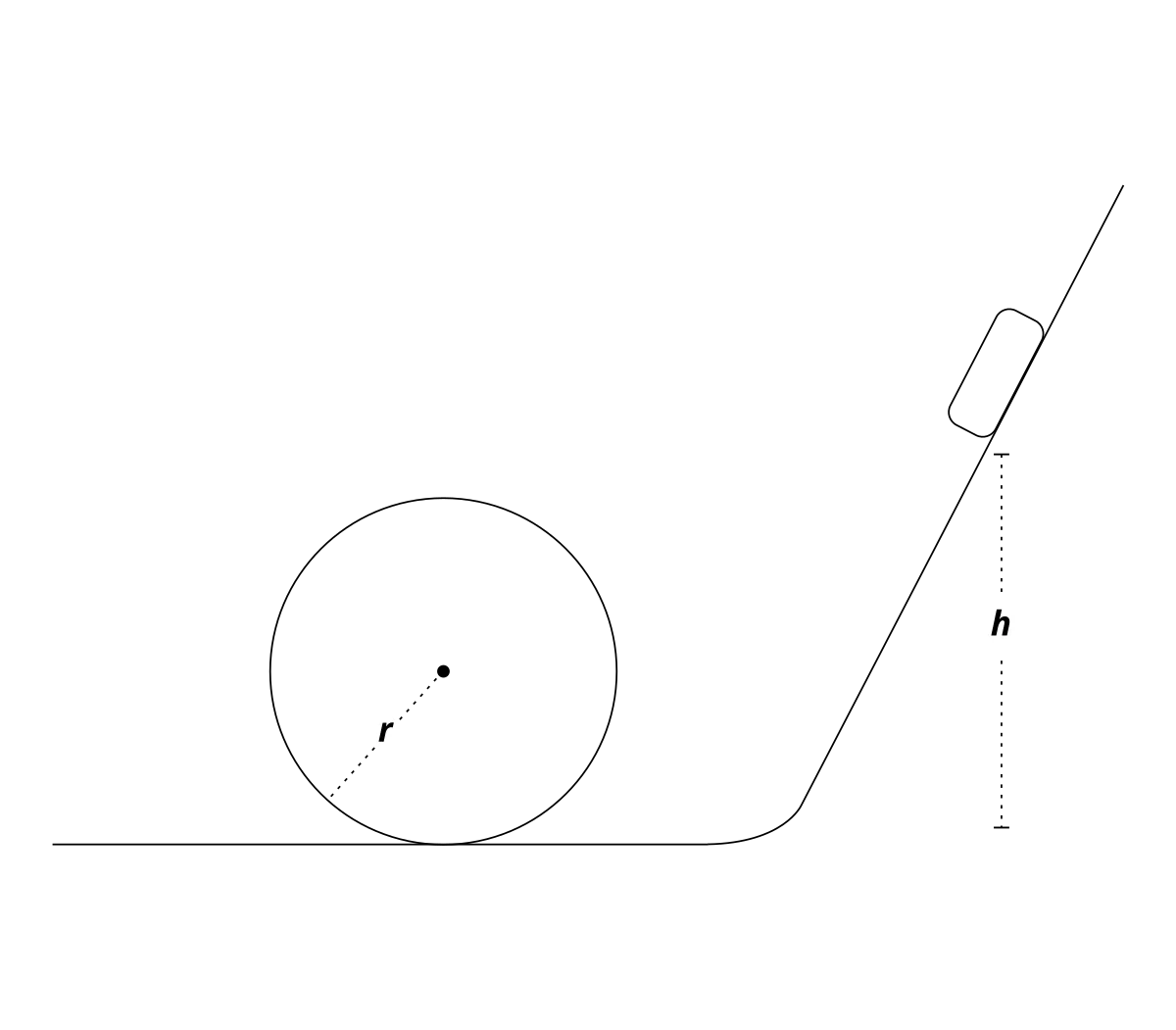
m/s. Conservation of energy: . Mass cancels: m/s. All gravitational PE converted to KE at the bottom of the swing.
m/s. . Starting from rest at the top: → → → m/s.
25% of the original PE was converted to other forms. Initial PE = . PE after bounce = = 75% of original. The missing 25% went into heat (slight warming of ball and floor), sound (the thud you hear), and a tiny bit of permanent deformation. Total energy is still conserved — it just left mechanical form.