
Springs & Hooke's Law
Press a Slinky against the floor and let go — it bounces back. Stretch a rubber band, then release — it snaps back hard enough to sting your fingers. Squish the bumper of a car against a wall and it pops back to shape (within reason).
These are all elastic systems. They share a beautifully simple rule, discovered by Robert Hooke in the 1600s: the more you deform an elastic object, the more strongly it pushes back — and that “push-back” force is exactly proportional to how far you’ve deformed it.
That single rule lets you predict spring forces, calculate stored energy, and analyze everything from car suspensions to pole vaulters to the elasticity of human tendons.
Hooke’s Law
The Spring Constant ()
The spring constant tells you how stiff the spring is. Big = stiff spring (a car suspension); small = soft spring (a Slinky).
| Property | High (stiff) | Low (soft) |
|---|---|---|
| Force for the same displacement | Large | Small |
| Hard to stretch/compress? | Yes | No |
| Example | Truck shock absorber | Slinky, soft pillow spring |
Units of : N/m. If N/m, the spring exerts 500 N of restoring force for every meter of displacement (or 5 N for every centimeter).
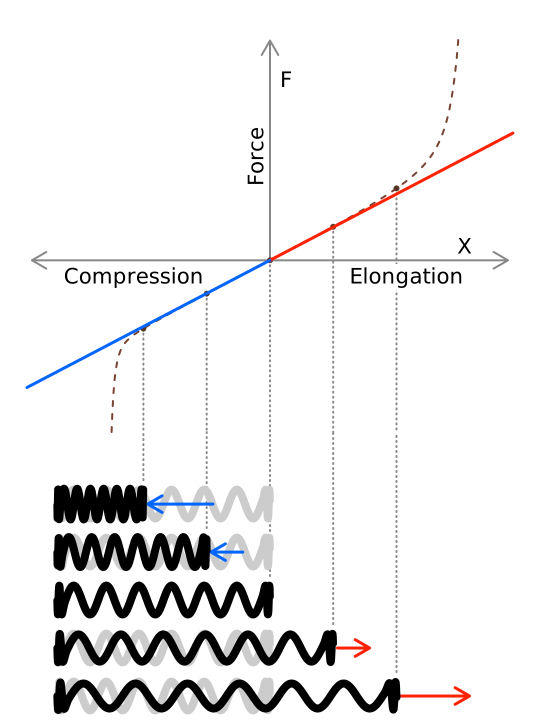
The Negative Sign
The minus sign in is the single most important detail of the equation. It’s what makes the spring force a restoring force — always directed back toward the equilibrium position.
- Stretch the spring () → force is negative (pulls back toward center).
- Compress the spring () → force is positive (pushes back toward center).
Elastic Potential Energy
A compressed or stretched spring stores energy. That stored energy is elastic potential energy.
This is the same formula we derived graphically in §2.2 (the area of the triangle under vs. ).
Notice the . Just like KE depends on , elastic PE depends on — doubling the displacement quadruples the stored energy. This is why pulling a bowstring back the last few inches takes so much more effort than the first few.
Symmetry of Elastic PE
Because is squared, a spring compressed by 3 cm stores exactly the same energy as the same spring stretched by 3 cm. The direction of displacement doesn’t matter — only the magnitude.
This symmetry is also why a spring oscillates back and forth between equal stretch and compression. The energy at the two extremes is identical, so the motion is symmetric.
Springs and Simple Harmonic Motion
When a mass attached to a spring is pulled and released, it oscillates back and forth. Energy continuously trades between KE and elastic PE:
- At maximum stretch (or compression): all PE, zero KE, mass momentarily at rest.
- At equilibrium position (natural length): all KE, zero PE, maximum speed.
- In between: a mix of both, total mechanical energy stays constant.
That oscillation is simple harmonic motion (SHM), covered in detail in the waves and sound chapter. For now: a spring-mass system is the prototype example.
When Hooke’s Law Breaks Down
Hooke’s law only holds within the elastic limit — the range where the material returns to its original shape after you release it. Stretch a spring (or a tendon, or any elastic material) too far and it deforms permanently. Beyond the elastic limit, the F vs. x graph stops being a straight line, and no longer applies.
That’s why a Slinky stretched all the way down a flight of stairs never quite returns to its original shape — you exceeded its elastic limit. Same idea for a paper clip you’ve bent too far, or a rubber band that’s been stretched until it goes slack.
Worked Example
A spring with N/m is compressed 0.1 m and used to launch a 2 kg block on a frictionless surface. What’s the block’s speed when the spring returns to its natural length?
- Stored PE in spring: J.
- All converts to KE: → → m/s.
The 2 J of stored energy fully transferred into the block’s KE the moment the spring reached its natural length. After that, the spring has no more energy to give and the block coasts away at 1.41 m/s.