In everyday English, “work” means effort. You worked hard at the gym. You pulled an all-nighter. You worked all summer at a coffee shop.
Physics is much more particular. To a physicist, you only do work if you push or pull something and it actually moves and the force has at least some component in the direction of motion. Stand still holding a 50 lb weight overhead for an hour and your muscles will be on fire — but in physics terms, you’ve done zero work on that weight, because nothing moved.
This is one of those sections where intuition will betray you. The MCAT writes great trap questions around it. Lock in the formula, learn the three cases (positive, negative, zero), and the rest is plug-and-chug.
The Work Equation
Work is a scalar, not a vector — it can be positive, negative, or zero, but it has no direction.
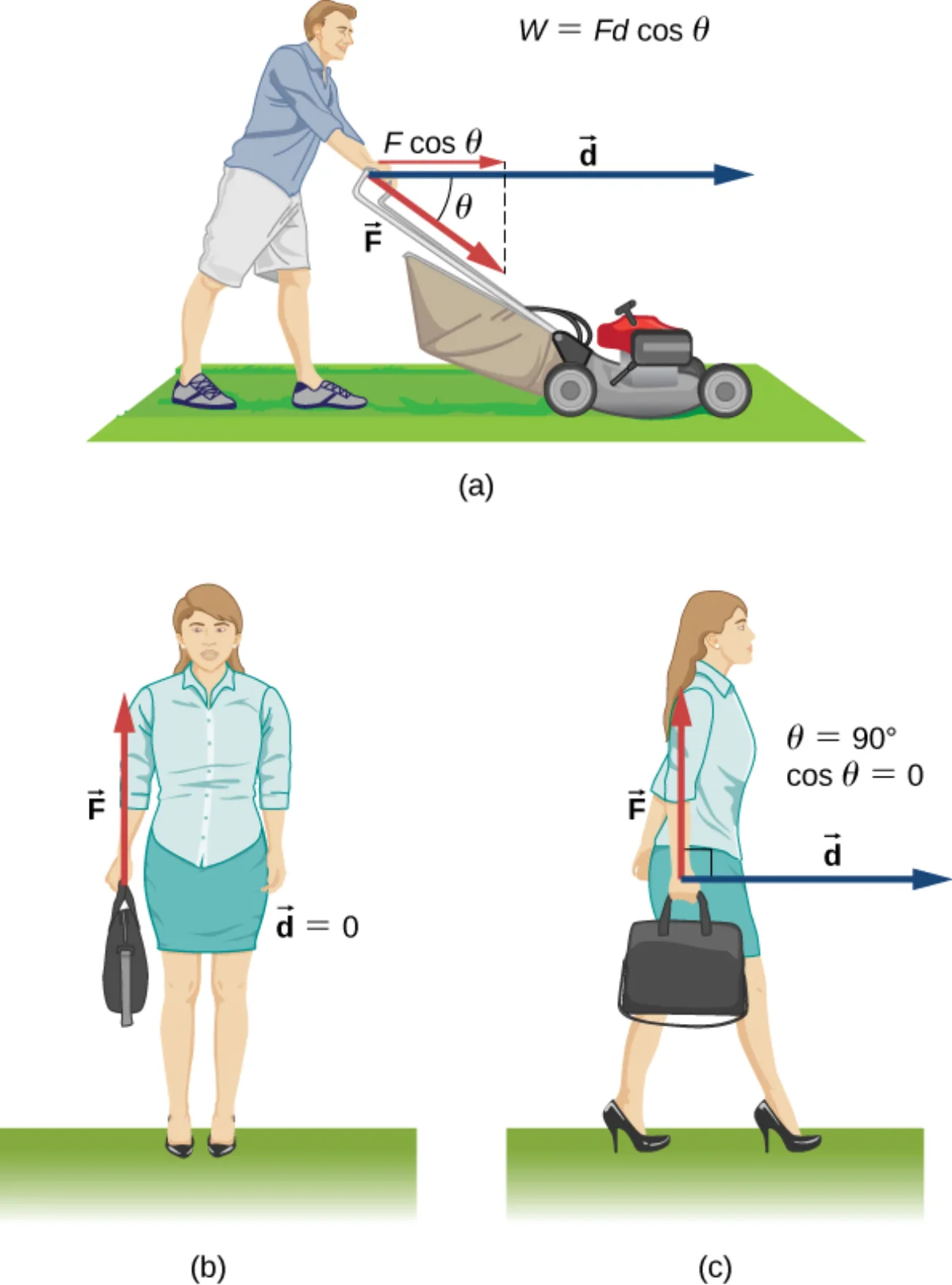
The whole reason this equation is more nuanced than “force times distance” is the cosθ term. That cosine picks out only the part of the force that lines up with the motion. A force perpendicular to motion does zero work; a force directly opposite to motion does negative work.
Only the component of force parallel to displacement (Fcosθ) contributes to work. The perpendicular component does no work. Credit: OpenStax, CC BY 4.0
The Three Cases: Positive, Negative, Zero
The sign of work tells you whether energy is flowing into or out of the object.
Case
Angle θ
cosθ
What happens
Example
Positive work
0° to 89°
Positive
Force adds energy to the object
Pushing a box in the direction it slides
Negative work
91° to 180°
Negative
Force removes energy from the object
Friction slowing a sliding box
Zero work
90°
0
Force transfers no energy
Carrying a box horizontally (gravity is perpendicular to motion)
Special Cases Worth Memorizing
θ=0° (force in same direction as motion):cos0°=1, so W=Fd. Maximum work for a given force and distance. Example: pushing a crate in a straight line behind it.
θ=180° (force opposite to motion):cos180°=−1, so W=−Fd. Negative work. Example: kinetic friction always opposes motion, so friction always does negative work on a sliding object.
θ=90° (force perpendicular to motion):cos90°=0, so W=0. Examples: the normal force on a box sliding across the floor; the centripetal force on an object in circular motion.
Work Done by Multiple Forces
When several forces act on an object at once, you have two equally valid options:
Calculate work for each force separately, then add them: Wnet=W1+W2+W3+…
Find the net force first, then compute: Wnet=Fnet⋅d⋅cosθ.
Both give the same answer. Pick whichever is faster for the question in front of you.
Gravity’s Work
Gravity deserves special attention because it shows up in nearly every energy problem. The work done by gravity on an object that moves vertically by height h is:
Wgravity=−mgh if the object moves up (gravity opposes the motion).
Wgravity=+mgh if the object moves down (gravity helps the motion).
If the object moves along a diagonal path (like up a ramp), only the vertical component of displacement matters for gravity’s work. Horizontal motion is perpendicular to gravity, so it contributes nothing. This is why a 10 m walk across a flat floor and a 10 m walk across a higher floor both involve zero gravitational work — but climbing stairs to that higher floor does involve work.
Worked Example
You push a 20 kg box across a frictionless floor with a 30 N force at 60° below horizontal (you’re pushing down on a handle), moving it 5 m. How much work do you do?
Use W=Fdcosθ with θ=60°.
W=30×5×cos60°=30×5×0.5=75 J.
Your full 30 N push covered 5 m, but only 30cos60°=15 N of it actually pointed forward. The other 30sin60°≈26 N pressed straight down into the floor and did nothing useful. That’s why the work is 75 J, not 150 J.
A 50 N force is applied at a 60° angle to the horizontal as a box is dragged 4 m across the floor. How much work is done by the applied force?
Click to reveal answer
W=Fdcosθ=(50)(4)(cos60°)=(50)(4)(0.5)=100 J. Only the horizontal component of the force (Fcos60°=25 N) does work on the box.
A satellite orbits Earth in a perfect circle. How much work does gravity do on the satellite per orbit?
Click to reveal answer
Zero. In a circular orbit, gravity always points toward the center while the satellite's displacement at any instant is tangent to the circle. The angle between force and displacement is always 90°, cos90°=0, so gravity does no work. The satellite's speed stays constant — which is exactly why circular orbits are stable.
You hold a 10 kg dumbbell perfectly still at shoulder height for 30 seconds. How much work do you do on the dumbbell?
Click to reveal answer
Zero. Work requires displacement. The dumbbell didn't move (d=0), so W=Fdcosθ=0 regardless of the force or the angle. Your muscles still burn — that's biology (sustained muscle contraction uses ATP) — but in physics terms, no work is done on the dumbbell.