
Study Planning
Should You Retake the MCAT? A Strategic Guide
A 527 scorer walks through when retaking the MCAT is worth it, what the AAMC score-change data really says, and how to prep so your second attempt actually improves.
A student emailed me last week. She scored a 508 on her first MCAT, wants to apply to schools with 512+ medians, and is trying to decide: retake in three months, or apply with what she has.
It’s the most common question I get. And most of the advice out there is either “always retake if you can improve” (not true) or “only retake if you scored below 500” (also not true). Both miss the point.
Retaking the MCAT is a strategic decision, not a reflexive one. It costs you four months of your application cycle, $355 in registration fees, and carries a real risk that your second score will be lower than your first. Whether it’s the right call depends on factors most students don’t think through carefully before registering.
Here’s how to decide.
The honest data on MCAT retakes
Before we get into the decision framework, you should know what actually happens when students retake.
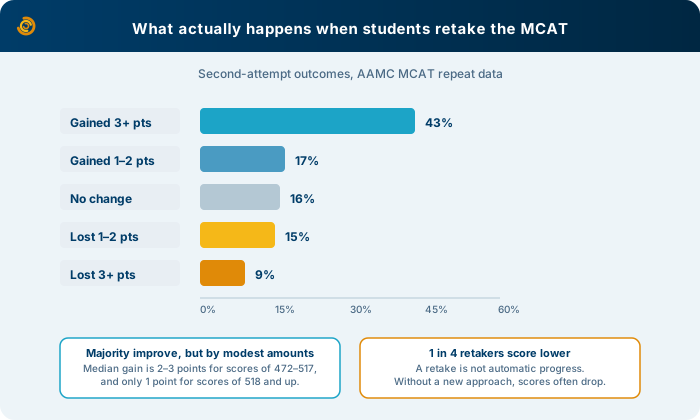
A few things to take from this:
- Most retakers improve, but the gains are modest. The median gain is 2–3 points for scores between 472 and 517, and only about 1 point for scores of 518 and above. If you’re hoping to jump from a 505 to a 518 in three months, you’re hoping for an outcome that sits in the top few percent of retake results.
- Nearly 1 in 4 students score lower on the retake. This isn’t rare. It’s the single biggest reason I tell students not to rush the decision.
- Longer gaps between attempts correlate with bigger gains. Students who study for 6–8 months between attempts improve more, on average, than students who turn around in 6 weeks.
The retake is not a free roll. It’s a second attempt at a high-stakes exam, and if you walk in with the same preparation that produced your first score, the data says you’ll walk out with roughly the same score, or a slightly worse one.
The decision framework
The question isn’t “could my score improve?” It’s “will the improvement be worth the cost?” Here’s the sequence I walk through with every student considering a retake.
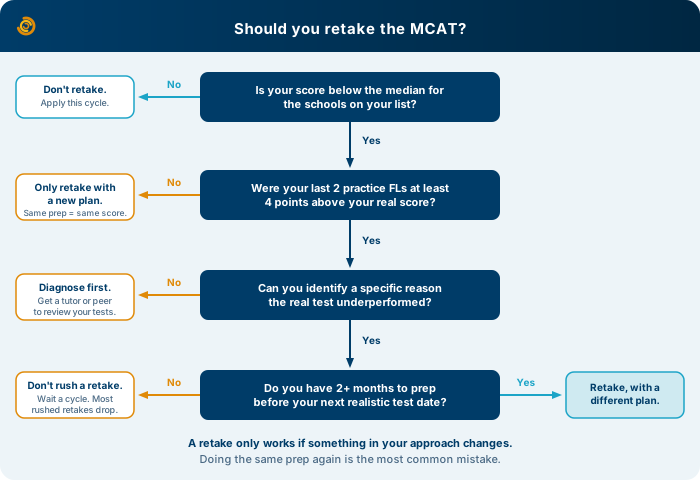
Step 1: Is your current score actually a problem?
Pull up the MCAT score percentiles and look at the median scores for the schools on your list. The fastest way to do this is our Med School Explorer, a free MSAR alternative that shows the median MCAT and GPA (plus an honest “can I get in?” read) for every US MD and DO program. If your current score is at or above the median of your target range, don’t retake. Your score is not what’s holding your application back.
This sounds obvious, but students retake scores that are genuinely competitive all the time. I’ve had applicants with 513s retake because “my friend got a 518.” Your friend’s score is irrelevant. What matters is whether your score clears the bar at the schools you want to attend.
A useful rule: if your score is within 2 points of the median for most of your target schools, retaking probably won’t change your admissions outcome meaningfully. Your time is better spent on your personal statement, experiences, and secondary essays. Check our guide to what counts as a good MCAT score for school-tier mapping.
Step 2: Were your practice scores clearly higher than your real score?
If your last two AAMC full-length exams were 4+ points higher than what you scored on test day, there’s a real argument that your test-day score was an underperformance, not your true ability. Test anxiety, illness, bad sleep, and timing mistakes all produce real scores below what the student could have gotten.
If your practice scores were roughly the same as your real score, that’s different. That means your real score is an accurate reflection of where you are right now. A retake in that scenario only works if you can genuinely change something about your preparation, not just repeat what you did the first time, slightly harder.
Read the MCAT practice test vs actual score analysis to understand what your practice scores actually predict. Most students overestimate their real-score ceiling based on outlier practice scores.
Step 3: Can you identify a specific reason you underperformed?
If you can point to a concrete issue (you ran out of time on CARS, you blanked on an organic chemistry passage, you got sick the week before), you have something specific to address. That’s a retake candidate.
If you can’t identify a reason, you need to diagnose before you register. An undiagnosed problem is going to show up on the second attempt too. Our MCAT score not improving post walks through the four error types that drive most plateaus. Go through your last two practice tests and categorize every missed question. The pattern tells you whether your issue is content, reasoning, carelessness, or timing, and each one has a different fix.
Step 4: Do you have real time to prep again?
The biggest predictor of a failed retake isn’t intelligence or starting score. It’s compressed timelines. Students who schedule a retake 6 weeks out, on top of a full course load and clinical hours, almost never improve meaningfully.
For a retake to be worth the risk, you need at least 2 months of substantial study time, at 15+ hours per week. If that isn’t possible in the next 3–4 months, the math says wait. Apply this cycle if your score allows, or take a gap year and retake with a real runway.
If you decide to retake: how to study differently
This is the part students skip, and it’s the reason so many retakes disappoint. If you do what you did last time, you’ll get what you got last time. The retake study plan has to be different from the first-attempt study plan in concrete, identifiable ways.
Diagnose before you study
Don’t jump straight into content review. Spend the first 10 days doing an audit of your first attempt:
- Take a fresh AAMC full-length with the accommodations and conditions you’ll have on your real retake. This is your new baseline.
- Categorize every missed question by error type (content gap, reasoning, careless, timing).
- Identify your single weakest section. Not your weakest topic, your weakest section. Most improvement on retakes comes from fixing one section by 2–3 points, not lifting all four equally.
A 505 retaker with a 122/124/127/126 breakdown doesn’t need to “study more MCAT.” She needs to fix C/P specifically. That’s a completely different study plan than “do another content review pass.”
Build your plan around the gap, not the test
Retakers who improve the most design their study around the specific reason they underperformed. If it was C/P content, that’s 60% of your new study time, probably starting with the essential MCAT equations and the general chemistry and physics books. If it was CARS timing, that’s daily CARS passages under strict time pressure with the same passage-review routine every session.
Whatever section you’re fixing, the ratio should be something like:
- 50–60% on targeted weakness
- 25–30% on maintenance of your strong sections
- 15–20% on full-length practice and review
If you’re splitting study time evenly across sections again (the way most first-attempt plans are structured), you’re rerunning your first attempt.
Take more full-lengths, and review them harder
First-attempt students often do 4–6 full-lengths. Retakers should do 6–10, with a strict rule: no new full-length until you’ve fully reviewed the last one. “Fully reviewed” means you can explain every missed question and every right answer you were uncertain about, out loud, without looking at the explanation.
Full-length review is where score improvement actually happens on a retake. The full-length itself just produces data. The review is where you turn data into changed behavior on the next one.
Get eyes on your reasoning
One of the hardest things about a retake is that you can’t see your own reasoning errors. The thoughts that felt correct the first time will feel correct the second time too, because nothing has forced you to interrogate them.
This is the single place where outside help returns the most value. A tutor who has scored 520+ can sit with you through a passage and hear the specific moment your thinking goes off track. That’s not something you can do alone, and it’s the most common thing that separates retakers who break through their old score from retakers who repeat it.
If a tutor isn’t in the budget, find a study partner who scored higher than you and review missed passages together out loud. You’ll be surprised how often the two of you read the same passage and arrive at different answers, and it’ll expose exactly where your reasoning diverges from theirs.
When NOT to retake
A few situations where the right answer is clearly “apply with your current score”:
Your score is already at or above your target schools’ medians. The marginal value of pushing a 514 to a 517 for schools with a 512 median is near zero, and you’re risking a 511.
You can’t commit to 2+ months of serious study. Working full time, heavy course load, research deadlines: if the retake is going to happen in the margins of an already-full schedule, it will probably go worse than the first attempt.
You’ve already retaken once. Three MCAT attempts starts to raise questions for adcoms. If you’ve taken it twice and your score is competitive, stop. The third attempt is high-risk and often signals to schools that you don’t know when to pivot.
Your reason for retaking is emotional, not strategic. “I should have done better” and “my friends all scored higher” are not retake reasons. They are personal-statement reasons, maybe, but not reasons to spend 3 months redoing an exam.
When a retake is clearly worth it
Conversely, here’s when I tell students “yes, retake, and here’s how”:
Your score is 4+ points below the median for most of your target schools. The gap is large enough that improving 2–3 points still won’t help, so you need a real improvement, which means a real change in approach.
You underperformed your practice average by 4+ points. You know you had more in you. The retake is your chance to actually show it, ideally with deliberate practice on whatever made test day go sideways (anxiety protocols, timing drills, better sleep the week before).
You have a specific, diagnosable issue and a plan to fix it. “I didn’t finish CARS” plus “I’m doing daily timed CARS passages with a new pacing rule” is a retake plan. “I just want to score higher” is not.
You have time. 3+ months of real study, a clear plan, and a realistic test date. Retakes that happen under these conditions genuinely do produce 3–5 point improvements on a regular basis.
The bottom line
Retaking the MCAT can work. It often does. But it works when students approach it as a new project with a new plan, not as “let’s run that back.”
Before you register for the retake, get specific: What’s different this time? What exactly failed the first time? What will I do, on a Tuesday morning in week 6, that’s different from what I did the first time around?
If you can answer those questions clearly, a retake is likely to move your score. If you can’t, the retake is likely to cost you four months and leave you roughly where you started, or slightly worse.
Related reading:
- MCAT Score Not Improving? Here’s What to Change: diagnose which of the four error types is dragging your score
- MCAT Practice Test Scores vs. Actual: what your practice scores really predict about test day
- MCAT Score Percentiles: see exactly how your score stacks up
- How to Score 520+ on the MCAT: the full playbook if your retake target is in reach
- Is MCAT Tutoring Worth It?: when outside help justifies the cost, especially for retakes
Thinking about a retake? Talk to a 520+ tutor for a free consultation. We’ll look at your breakdown and tell you honestly whether a retake makes sense, and what would need to change to make it work.
Frequently asked questions
Is it worth retaking the MCAT?
It depends on three things: how far below the median your score is for your target schools, whether your practice scores were clearly higher than your real score, and whether you can change your study approach. If you can't change the approach, you'll likely get the same score.
How much do most people improve on an MCAT retake?
AAMC data shows the median gain is 2–3 points for scores between 472 and 517, and about 1 point for scores of 518+. Roughly 43% of retakers gain 3 or more points, but nearly 1 in 4 score lower the second time.
How many times can you take the MCAT?
Up to three times in a single testing year, four times across two consecutive years, and seven times in a lifetime. Most schools look unfavorably on more than three attempts.
Do medical schools see all MCAT scores?
Yes. All MCAT scores from the last three testing years are automatically reported to AMCAS. You cannot hide a previous attempt, though most schools weight the most recent score most heavily.
How long should I study before retaking the MCAT?
Plan for at least 2–3 months of dedicated prep between attempts. AAMC data shows score gains correlate with longer gaps between attempts, and rushed retakes (under 6 weeks) account for most score drops.