
Encoding, Retrieval, and Forgetting
Memory is not a recording device. Getting information in (encoding) and getting it back out (retrieval) are two separate, fallible processes, and forgetting happens at many stages between them. Understanding where failure happens is half the MCAT battle.
Encoding Strategies
Encoding moves information from working memory into long-term storage. Some strategies work better than others:
- Rote rehearsal. Repeating the same material over and over. The weakest strategy. Sufficient to keep info in working memory, poor for LTM.
- Chunking. Grouping individual items into meaningful units. The number 1776202520 is ten items; “1776, 2025, 20” is three chunks. Expands working memory capacity effectively.
- Self-referencing. Tying new material to your own experiences. Relating a historical event to something that happened in your life. Engages rich associative networks.
- Elaborative rehearsal. Connecting new information to existing knowledge. Explaining it in your own words. Far more effective than rote.
- Mnemonics.
- Method of loci - visualize walking through a familiar place and “dropping” items at specific locations. Used by memory champions.
- Peg word system - link items to a pre-memorized rhyming list (1=bun, 2=shoe, 3=tree…).
- Acronyms - HOMES for the Great Lakes.
- Spacing effect. Distributing study over time beats cramming the same total amount into one session. Spaced study is one of the most robust findings in all of cognitive psychology.
- Encoding specificity. Memory is best when retrieval conditions match encoding conditions. Study in a quiet room, test in a quiet room.
Retrieval Cues
Retrieval depends on cues that were present at encoding.
- Context-dependent memory. Being in the same physical environment as encoding helps. Scuba divers who learned material underwater remembered it better underwater than on land.
- State-dependent memory. Being in the same internal state (mood, intoxication, fatigue) at retrieval as at encoding helps. Learn something drunk, easier to recall drunk. Learn something while sad, easier to recall while sad (a nasty feature of depression).
- Priming. Prior exposure to related concepts eases retrieval of linked ones. Reading about apples speeds up recognizing the word “fruit.”
Types of Retrieval
- Free recall - produce the material with no cues. Hardest.
- Cued recall - produce the material with a partial cue (“pl____” for “planet”). Easier.
- Recognition - pick the correct item from a set (“was it fork or spoon?”). Easiest.
Serial Position Effect
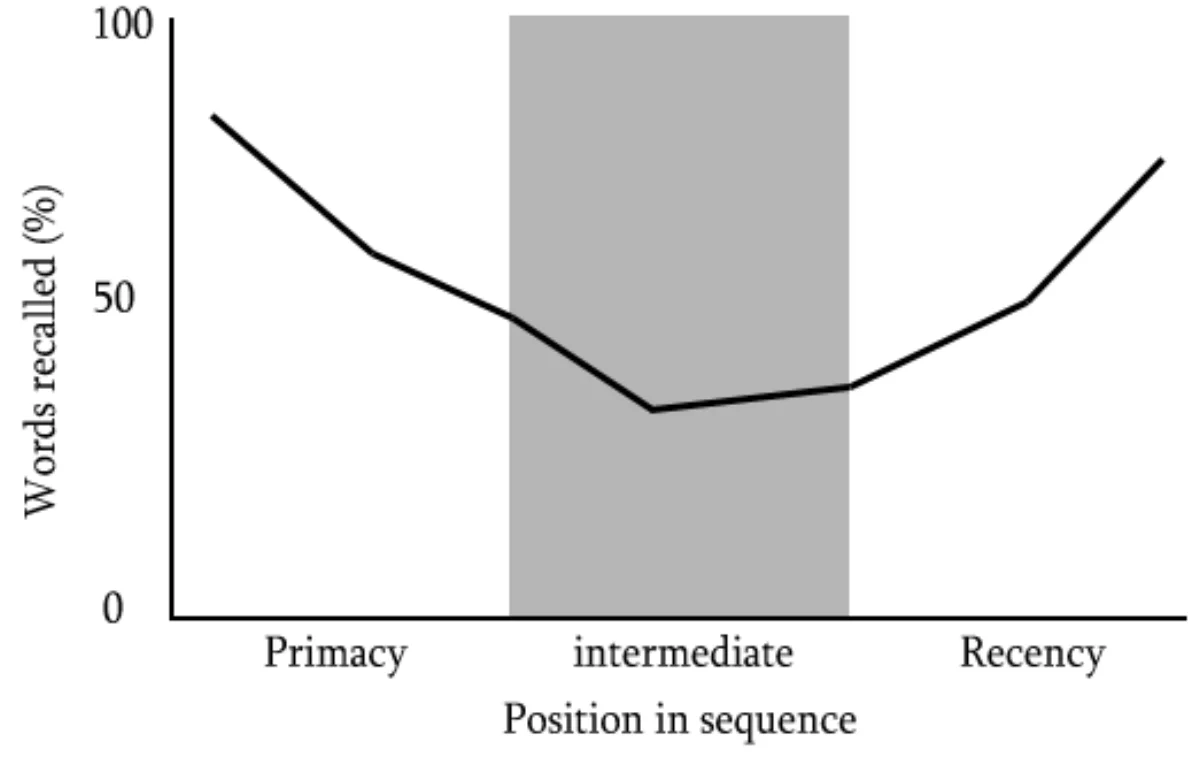
Given a list to remember, people show the serial position curve:
- Primacy effect - superior recall for items at the beginning of the list. Because you had time to rehearse them into LTM.
- Recency effect - superior recall for items at the end of the list. Because they are still in working memory.
- Middle items get the worst of both.
Delay or interference between presentation and recall wipes out the recency effect but not primacy.
Why We Forget
Decay
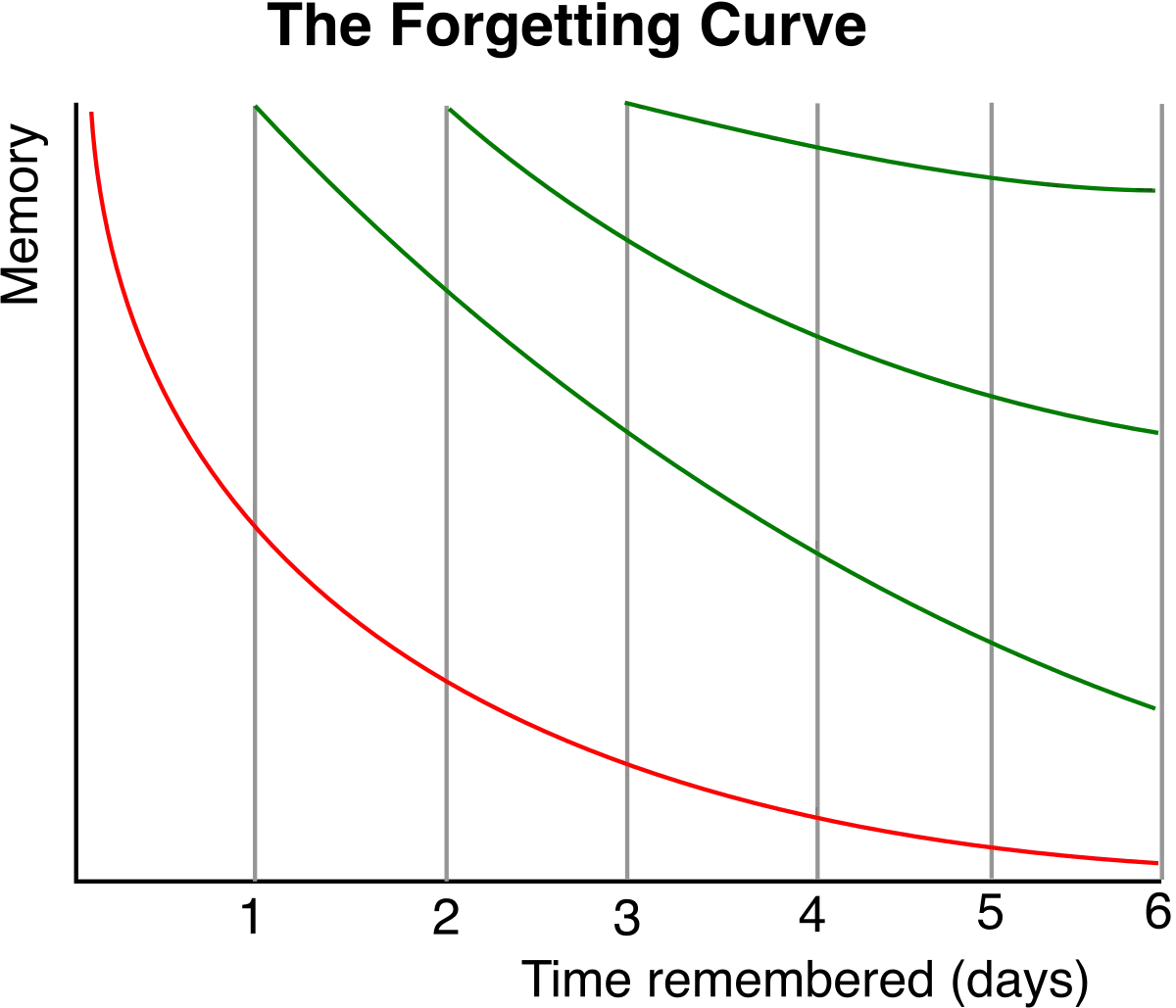
Memories fade with time and disuse. Ebbinghaus’s forgetting curve: most forgetting happens in the first day; the curve levels off afterward. Relearning is faster than first learning, demonstrating a savings effect - some residue of the memory persists even when you cannot explicitly retrieve it.
Interference
Other memories compete with the one you want.
- Retroactive interference. New learning impairs old material. Learning a new phone number makes the old one harder to recall.
- Proactive interference. Old learning impairs new material. Habitual old passwords interfere with learning the new password.
Memory Is Reconstructed, Not Replayed
Every time you retrieve a memory, you rebuild it. Reconstruction is imperfect and sometimes flat wrong.
- False memories. Subjects shown a video of a car at a yield sign, then given a misleading verbal description mentioning a stop sign, frequently remember a stop sign.
- Misleading-questions effect (Loftus). Asking subjects “how fast were the cars going when they SMASHED into each other?” produces higher speed estimates and more reports of broken glass than asking “when they HIT each other.” The verb loaded the question and reshaped the memory.
- Source monitoring errors. Forgetting where a memory came from. Recalling a detail from a movie but thinking it was from real life. Source amnesia is the extreme form.
Flashbulb Memories
Emotional events create vivid, detailed memories that feel exact - where you were when you heard about , for example. Despite the vividness, flashbulb memories are just as susceptible to reconstruction errors as any other memory. They feel accurate because the emotional tag makes them easy to retrieve and easy to trust, not because the details are protected from distortion.
Amnesia
- Retrograde amnesia. Inability to recall memories formed before the brain injury or onset. “Retro = before.”
- Anterograde amnesia. Inability to form new memories after the injury. “Antero = after.”
Both can coexist, and both typically reflect damage to the medial temporal lobe (hippocampus).
Alzheimer’s Disease
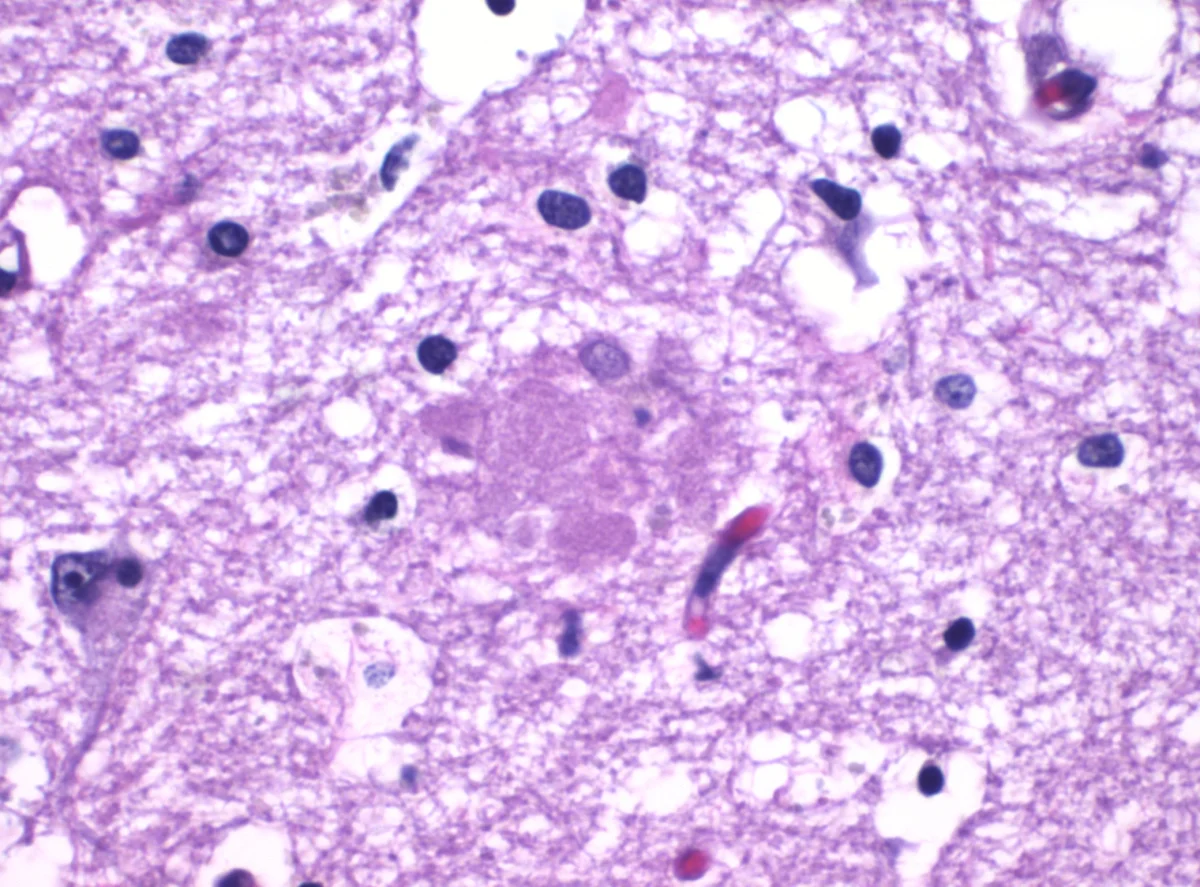
Alzheimer’s is the most common form of dementia (the umbrella term for significant cognitive decline interfering with daily life). Neurons die; the cerebral cortex shrinks.
- Hallmark pathology: amyloid plaques (beta-amyloid aggregates) and neurofibrillary tangles (tau protein).
- Earliest symptom: difficulty forming new memories (anterograde amnesia) - short-term memory fails first.
- Progression: episodic, semantic, and eventually procedural memory all decline; language deteriorates; patients may fail to recognize family.
- Cause unknown. Treatment is symptomatic, not curative. Terminal.
Korsakoff Syndrome
Caused by thiamine (vitamin B1) deficiency, most often from chronic alcoholism. Preceded by Wernicke’s encephalopathy (confusion, abnormal eye movements, ataxia), which if untreated can progress to full Korsakoff syndrome.
- Severe anterograde and retrograde amnesia.
- Confabulation - patients invent plausible but false memories to fill the gaps, often without realizing it.
- Unlike Alzheimer’s, Korsakoff is NOT progressive if treated with thiamine and abstinence. Often stable or improving with proper care.