
Language and the Brain
Language is an astonishing achievement. Children master grammar by age 3 without formal teaching. Adults can process rapid speech, recognize thousands of words, and understand utterances they’ve never heard before. This section covers the brain machinery behind language, the competing theories of how children acquire it, and the debate over whether language shapes thought.
Broca’s Area and Wernicke’s Area
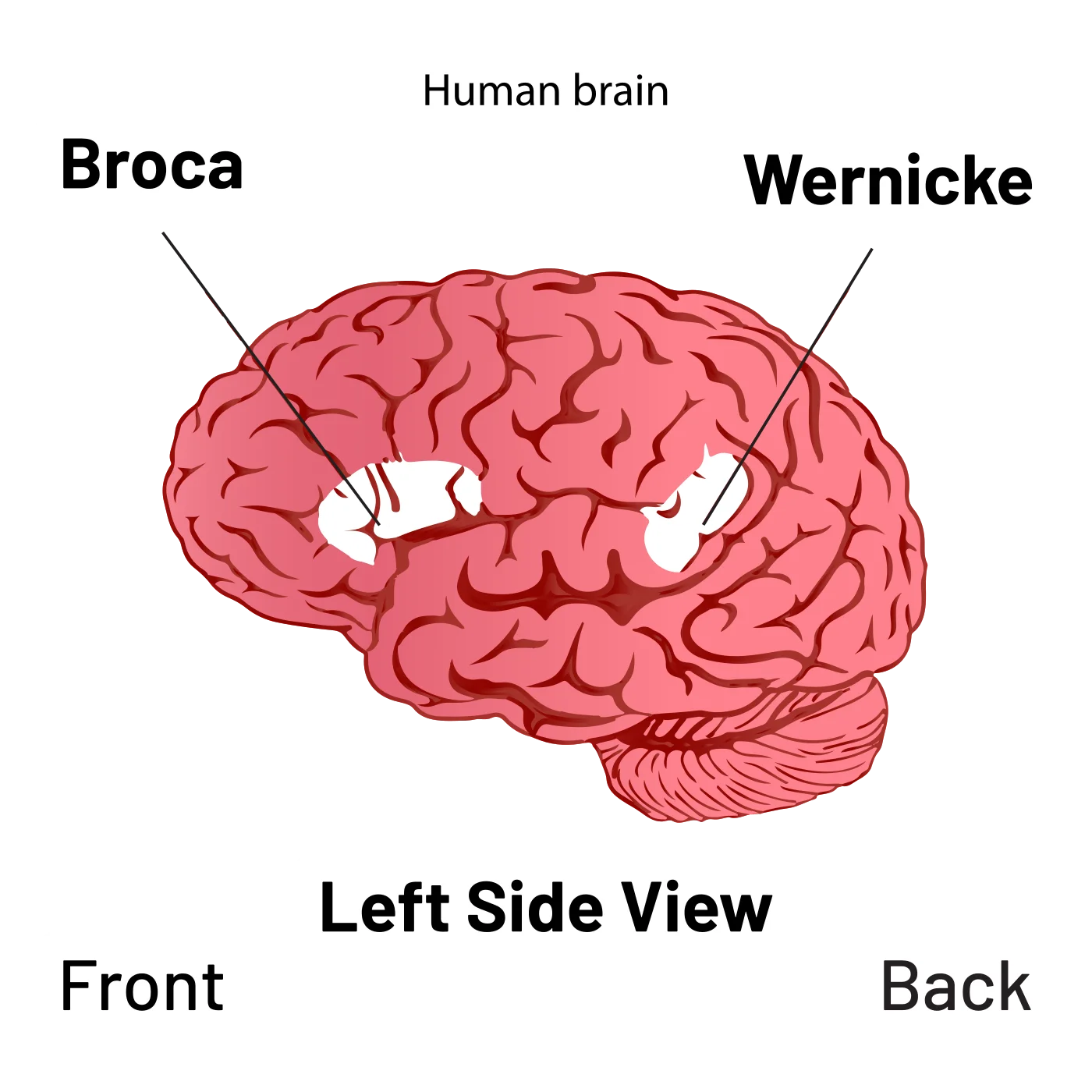
In ~90% of people (including most left-handers), language lives primarily in the left hemisphere. Two key regions:
- Broca’s area - frontal lobe, inferior frontal gyrus. Responsible for speech production and grammar.
- Wernicke’s area - temporal lobe, superior temporal gyrus. Responsible for language comprehension.
The two are connected by a bundle of fibers called the arcuate fasciculus, which lets comprehension (Wernicke’s) feed production (Broca’s).
The Aphasias
Aphasia = a disorder of language production or comprehension. Each region’s damage produces a characteristic pattern.
Broca’s Aphasia (Nonfluent / Expressive)
Damage to Broca’s area. Speech is labored, halted, grammatically simplified. “Water… glass… please.” Comprehension is largely preserved - the patient understands what you say but struggles to produce a fluent response. Patients are often acutely aware and frustrated by their deficit.
Mnemonic: Broca’s is broken speech.
Wernicke’s Aphasia (Fluent / Receptive)
Damage to Wernicke’s area. Speech is fluent and grammatically normal-sounding but nonsensical - “word salad.” Patients may produce made-up words, irrelevant substitutions, and sentences that lack meaning. Comprehension is impaired; the patient does not understand what others say and often does not notice their own errors.
Mnemonic: Wernicke’s comprehension is crappy.
Global Aphasia
Damage to both Broca’s and Wernicke’s areas. Both production and comprehension severely impaired.
Conduction Aphasia
Damage to the arcuate fasciculus (the wiring between Broca’s and Wernicke’s). Production and comprehension are relatively intact, but patients cannot repeat what they just heard. The auditory input reaches comprehension but cannot be routed to the production system.
Split-Brain Patients
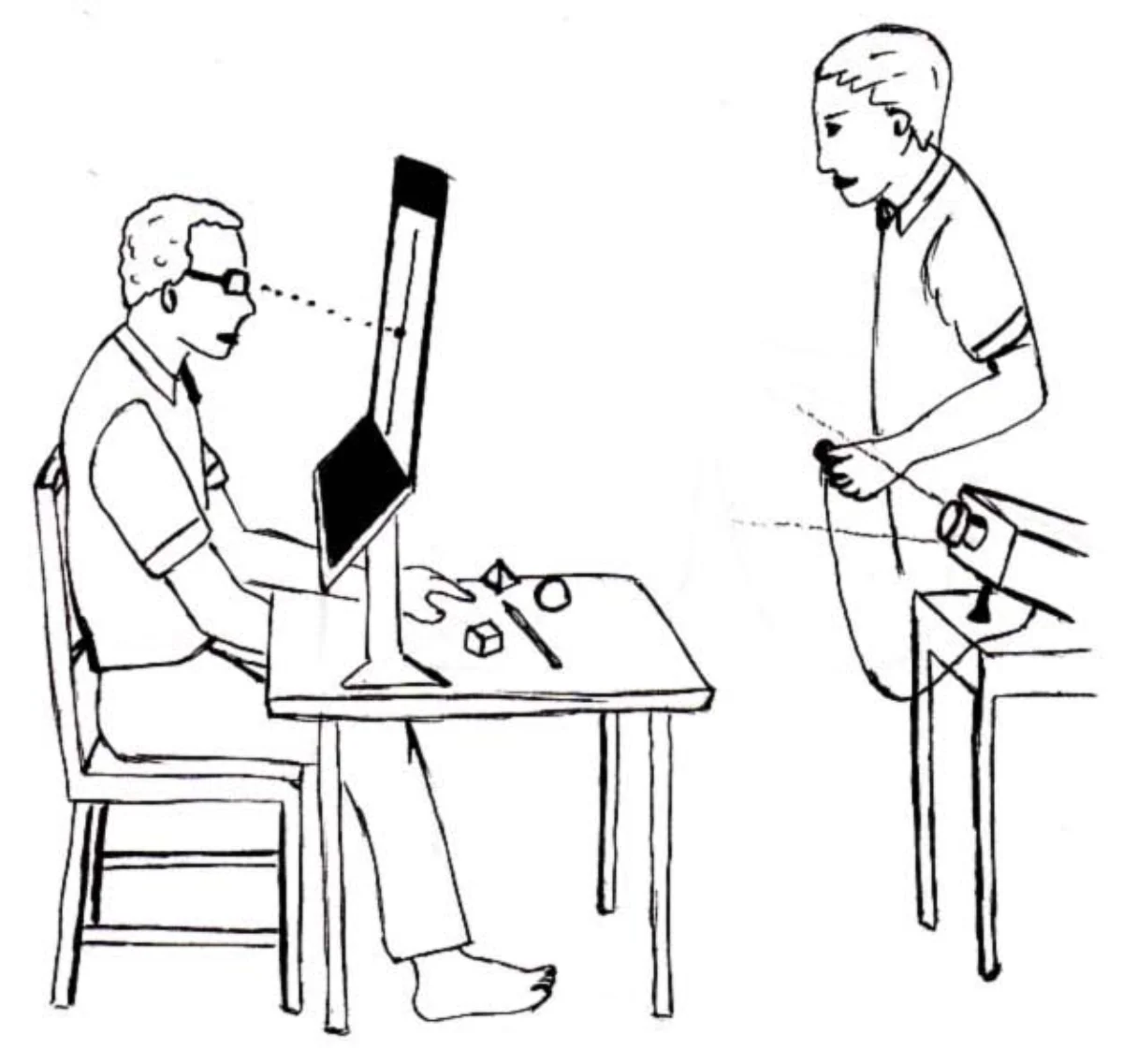
The corpus callosum is a thick band of fibers connecting the left and right hemispheres. In rare surgical cases (historically for intractable epilepsy), it is severed to prevent seizures from spreading between hemispheres. The resulting split-brain patients gave neuroscience its richest window into hemispheric specialization.
- Show a picture to the right visual field (left hemisphere), and the patient can name it - language processing is on the same side.
- Show the same picture to the left visual field (right hemisphere), and the patient cannot name it - the right hemisphere sees it, but cannot ship the information to the language areas on the left. The patient can pick up the object with their left hand (right hemisphere controls left hand), but cannot say what it is.
Classic split-brain research (Roger Sperry, Nobel 1981) showed that each hemisphere has its own perceptual, cognitive, and even emotional life when disconnected.
Prosody and the Right Hemisphere
While grammar and word meaning live mostly on the left, the right hemisphere contributes prosody - the music of speech: intonation, stress, emotional tone, sarcasm, emphasis. Right-hemisphere damage often spares word-level language but flattens emotional expression and the ability to detect sarcasm or irony in others.
Theories of Language Acquisition
How do children acquire language? Three competing perspectives.
Nativist (Biological) - Noam Chomsky
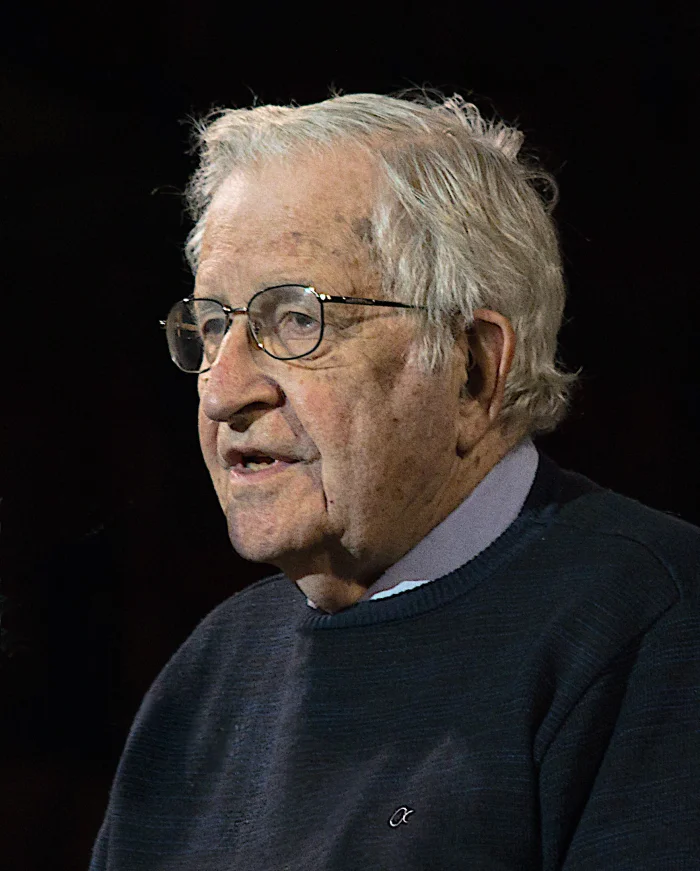
Children are born with a language acquisition device (LAD) - an innate, specialized mental module for learning language. All languages share a universal grammar at some deep level. The LAD gets activated by exposure and tunes itself to whichever specific language the child hears.
Evidence: children acquire grammar far faster than any general-purpose learning system could explain; they produce grammatically novel sentences they have never heard; the timing of acquisition is strikingly uniform across languages and cultures.
Learning (Behaviorist) - B.F. Skinner
Language is acquired like any other behavior: imitation, reinforcement, and operant shaping. Parents reward correct grammar and approximations; children refine their speech through feedback.
Critique: this cannot easily explain the speed and systematicity of language acquisition or the rarity of explicit correction in most parental speech.
Interactionist
Language acquisition depends on both biological predisposition AND social interaction. Children need contact with fluent speakers at critical periods; language emerges from the interplay of an innate apparatus and meaningful conversation.
The Critical Period Hypothesis
Critical period (or sensitive period) - a window during development (roughly birth to age 8 or so) during which language acquisition is easiest. After the critical period closes, learning a new language becomes significantly harder, particularly grammar and accent. Tragic case studies (like Genie, an abused child isolated from language until age 13) support the existence of a critical period - Genie never fully acquired grammatical language despite extensive teaching.
Does Language Shape Thought?
Universalism
Thought determines language, not the other way around. A tribe with only two words for color can still think about colors; they just don’t have labels.
Linguistic Relativity (Weak Whorfian)
Language influences thought by making some thoughts easier or more habitual, without determining them.
Linguistic Determinism (Strong Whorfian / Sapir-Whorf Hypothesis)
Language determines thought. You cannot think concepts your language doesn’t have words for. The Hopi language is often cited as having no grammatical tense, supposedly preventing Hopi speakers from thinking about time the way English speakers do. Modern linguistics largely rejects the strong version; the weak version has some empirical support.
Piaget and Vygotsky on Language
- Piaget. Thought develops first; language labels existing cognitive structures. Babies develop object permanence before they learn words like “gone.”
- Vygotsky. Language and thought develop independently but converge through social interaction. Children internalize the language they hear in conversation, which then becomes the tool of their inner thought.