The Information-Processing Model of Memory
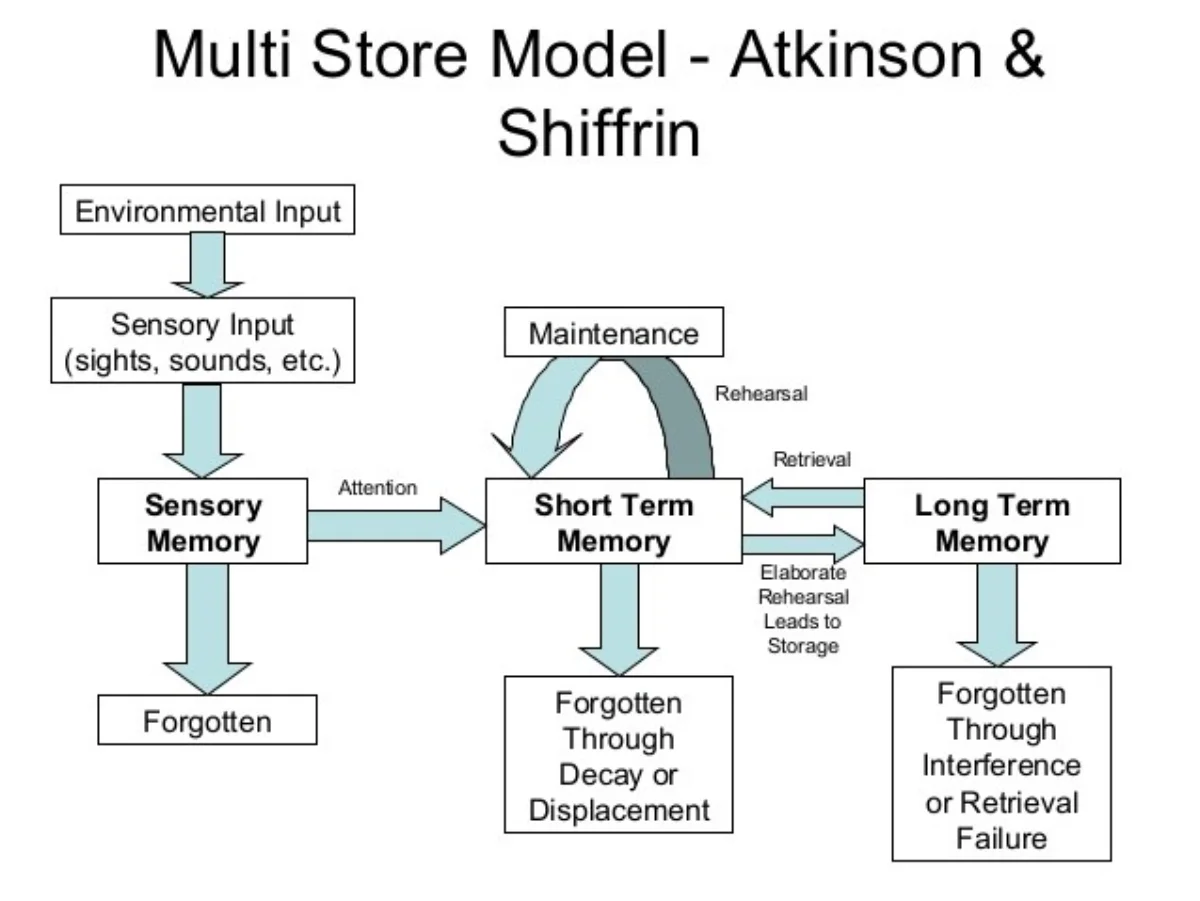
The information-processing model treats the brain like a computer: INPUT → PROCESS → OUTPUT. Information flows through three stages of memory: sensory, working (short-term), and long-term. Each has a different capacity, duration, and purpose. This is the scaffolding of everything in the memory section.
Sensory Memory: The Brief Snapshot
Sensory memory (or sensory register) is the very first stage. It holds an extremely brief, high-capacity snapshot of raw sensory input. Two sub-types, one per modality:
- Iconic memory - visual sensory memory. Lasts about 0.5 seconds.
- Echoic memory - auditory sensory memory. Lasts about 3–4 seconds.
Why so brief? Sensory memory is a holding pen that lets the brain decide which information to attend to and promote to working memory. Everything else decays.
Sperling’s experiment (1960) is the classic demonstration. Subjects see 12 letters arranged in a 3×4 grid for 50 ms. In the whole-report condition, they try to name as many letters as possible - typically 3–5 (~35%). In the partial-report condition, an auditory cue after the display tells them which row to report; performance jumps to about 75% per row, implying the whole 12-letter display was briefly available in memory, but faded before it could be reported.
Working Memory (Short-Term Memory)
Working memory holds the information you are currently consciously thinking about. Classic capacity: 7 ± 2 items (Miller, 1956). This is why phone numbers are 7 digits. Items decay within about 20–30 seconds unless rehearsed.
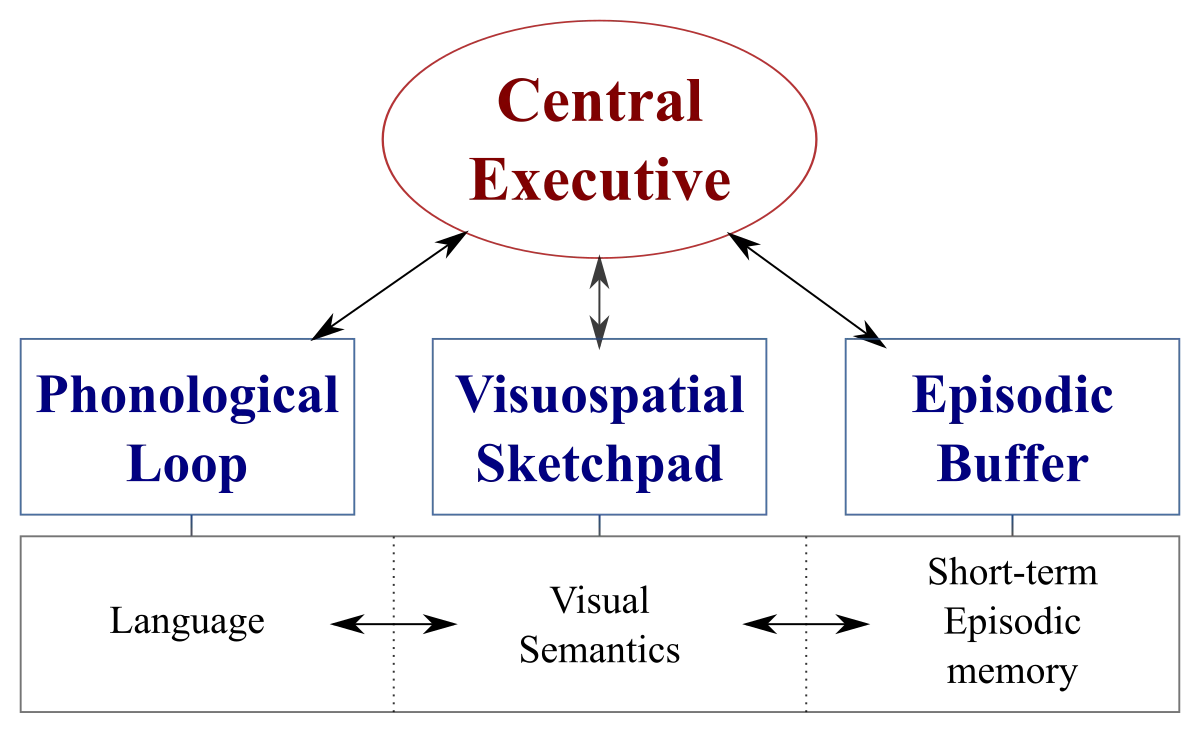
Baddeley and Hitch (1974) proposed a more detailed model with four components:
- Phonological loop - holds verbal/acoustic information. Capacity around 2 seconds’ worth of sound. Repeating a phone number to yourself uses the phonological loop.
- Visuospatial sketchpad - holds visual and spatial information. Mental images, mental rotation.
- Episodic buffer - integrates information from the loop, sketchpad, and long-term memory into a coherent episode. Added to the model in 2000.
- Central executive - directs attention among the other components. Decides what to focus on, coordinates rehearsal, manages task switching. Think of it as the conductor of the memory orchestra.
Measuring Working Memory: Span Tasks
Working memory span tasks quantify how much information a person can actively hold and manipulate. They are heavily used in research and clinical assessment. Three variants you should know:
- Digit span (simple span). The examiner reads out a string of digits; the participant repeats them back. Measures the storage side of working memory only. Normal adult span: about 7 ± 2.
- Backward digit span. Same task, but the participant must repeat the digits in reverse order. Requires simultaneously holding the digits and reorganizing them. Measures both storage and manipulation - central-executive work. Typical span drops to 5–6.
- Operational span (OSPAN). A dual-task paradigm. The participant solves a short math problem, then reads a word, then solves another math problem, then reads another word, and so on. At the end of the set they recall the words in order. The math problems force continuous central-executive engagement; the word recall measures residual storage capacity. OSPAN scores predict performance on complex tasks like reading comprehension, multitasking, and fluid intelligence better than simple span does - because real-life cognition almost always involves holding information while doing something else.
Long-Term Memory: Where Things Live Long-Term
Long-term memory (LTM) has effectively unlimited capacity and can last a lifetime. Two broad categories:
Explicit (Declarative) Memory
Memories you can consciously recall and describe. Two sub-types:
- Episodic memory - autobiographical events. “The time I broke my arm at summer camp.”
- Semantic memory - general knowledge and facts. “The capital of France is Paris.” “H2O is water.”
Explicit memory is heavily dependent on the hippocampus for encoding new memories. Damage to the hippocampus (famously, patient H.M.) produces severe anterograde amnesia for explicit material but preserves implicit memory.
Implicit (Non-Declarative) Memory
Memories that influence behavior without conscious recall. Several sub-types:
- Procedural memory - how to do things. Riding a bike, typing, playing a learned piano piece. Stored in the basal ganglia and cerebellum.
- Priming - prior exposure to a stimulus influences later responses, without awareness.
- Classical conditioning associations - we saw these in Chapter 3. Unconscious stimulus pairings.
A famous example of the dissociation: patient H.M. could learn a new motor skill (procedural) across days even though he had no conscious memory of practicing. His implicit learning system worked; his explicit was shattered.
| Memory Type | Conscious? | Example | Brain Region |
|---|---|---|---|
| Episodic | Yes | My last birthday | Hippocampus, cortex |
| Semantic | Yes | Paris is in France | Temporal cortex |
| Procedural | No | Riding a bike | Basal ganglia, cerebellum |
| Priming | No | Recent word influences later choice | Cortex |
Long-Term Potentiation: How Memories Stick
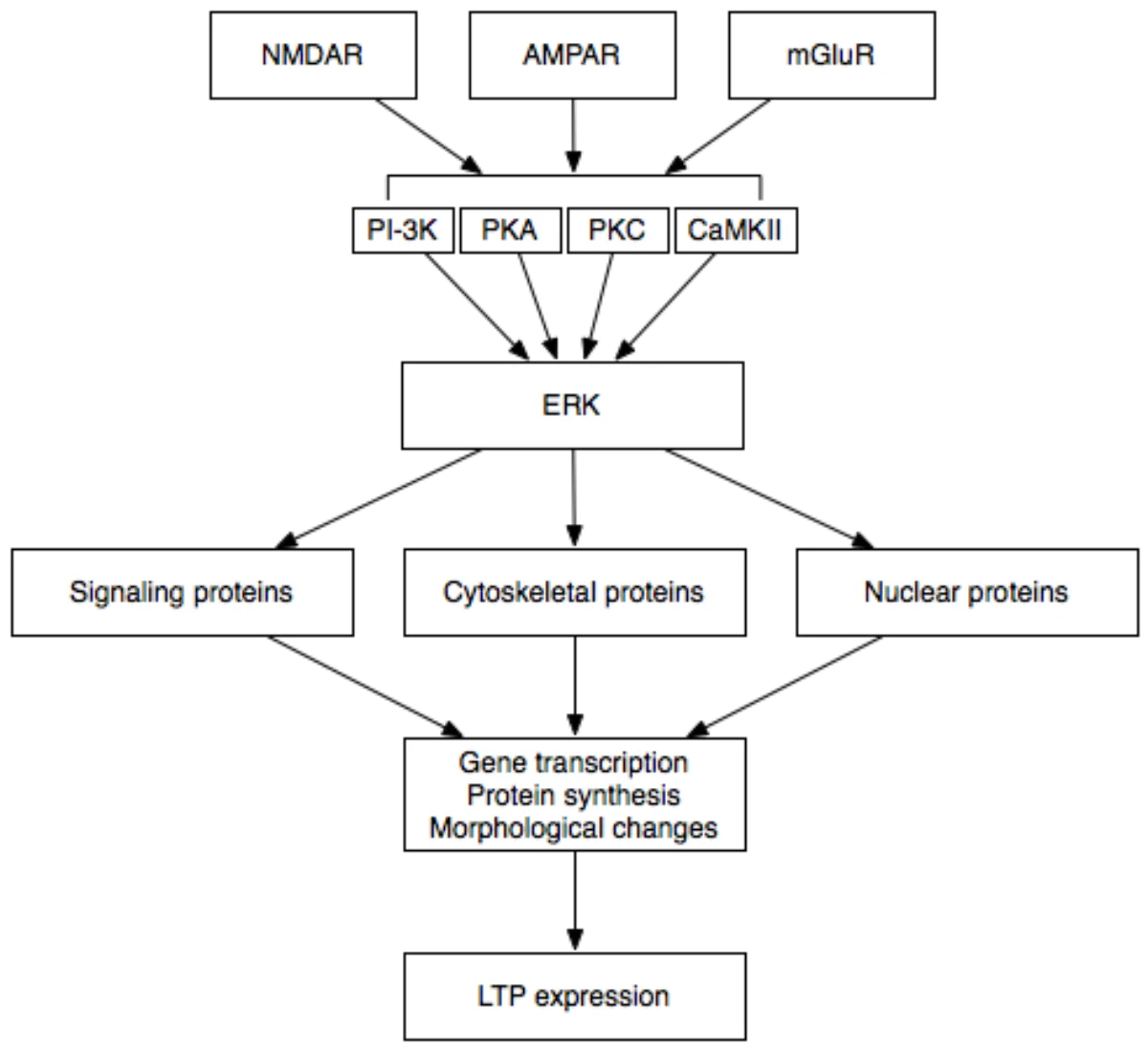
Long-term potentiation (LTP) is the cellular mechanism behind memory formation. When a presynaptic neuron repeatedly stimulates a postsynaptic neuron, the synapse strengthens: the same stimulation later produces a bigger postsynaptic response.
Mechanism, briefly:
- Glutamate released from presynaptic neuron activates AMPA and NMDA receptors on the postsynaptic neuron.
- NMDA receptors, normally blocked by Mg²⁺, open only when the postsynaptic cell is already depolarized. So they detect coincidence: “pre-synaptic fired AND post-synaptic is excited.”
- Ca²⁺ flows through NMDA channels, triggering signaling cascades that insert more AMPA receptors and strengthen the synapse.
The motto: “Cells that fire together, wire together” (Hebb’s rule). LTP is the leading candidate neural substrate for learning and memory. It exemplifies synaptic plasticity - the ability of synapses to change their strength with experience.