
Intelligence
What is intelligence, and do we all have the same kind? Psychologists have been arguing about this for a century. For the MCAT, know the four major theories, the key theorists, and the basic facts about IQ.
One Intelligence or Many?
Spearman’s g (General Intelligence)
Charles Spearman noticed that people who scored well on one kind of mental test tended to score well on others - verbal tests, math tests, spatial tests. He argued for a single underlying factor he called g (general intelligence). Supported by factor analysis: scores across different tests show a common dimension.
If you buy Spearman, IQ tests do capture something real. And they do correlate with many life outcomes (academic success, job performance, health). But g alone doesn’t explain variation in specific abilities.
Thurstone’s Primary Mental Abilities
L.L. Thurstone argued for 7 independent primary mental abilities: word fluency, verbal comprehension, spatial reasoning, perceptual speed, numerical ability, inductive reasoning, and memory. He did not accept that a single g factor could explain everything.
Gardner’s Multiple Intelligences
Howard Gardner expanded the idea further: there are 8–9 independent intelligences, including:
- Logical-mathematical
- Verbal-linguistic
- Spatial-visual
- Bodily-kinesthetic
- Interpersonal (understanding others)
- Intrapersonal (understanding yourself)
- Musical
- Naturalist
- Existential (added later)
Gardner’s theory is popular in educational circles but controversial among psychometricians - the “intelligences” tend to correlate, suggesting they may be variations on g rather than independent abilities.
Sternberg’s Triarchic Theory
Robert Sternberg proposed three intelligences based on real-world success:
- Analytical intelligence - academic problem-solving (what IQ tests measure).
- Creative intelligence - novel problem-solving, generating new ideas.
- Practical intelligence - everyday “street smarts,” adapting to environments.
Fluid vs. Crystallized Intelligence
Cattell distinguished:
- Fluid intelligence. Ability to reason quickly and abstractly in novel situations. Solving logic puzzles you’ve never seen. Declines with age, starting around 20–30.
- Crystallized intelligence. Accumulated knowledge and verbal skills. Vocabulary, general knowledge, experience. Stable or improves through middle age, declining slowly only in advanced old age.
Older adults often appear sharp because their crystallized intelligence compensates for modest declines in fluid intelligence. Crossword champions tend to be older.
Emotional Intelligence (EQ)
Proposed by Salovey, Mayer, and popularized by Daniel Goleman. The ability to perceive, understand, manage, and use emotions in self and others. Includes empathy, emotional regulation, and interpersonal effectiveness. Correlates with workplace success and relationship quality, though psychometrically less well validated than g.
IQ Testing: Brief History
- Alfred Binet (early 1900s, France) developed the first IQ test to identify French children who needed extra help in school. Introduced the idea of mental age - the age at which a child’s intellectual performance is typical.
- Lewis Terman (Stanford) adapted Binet’s test for American children and adults, creating the Stanford-Binet Intelligence Scale.
- David Wechsler developed the WAIS (adults) and WISC (children), now the most widely used IQ tests.
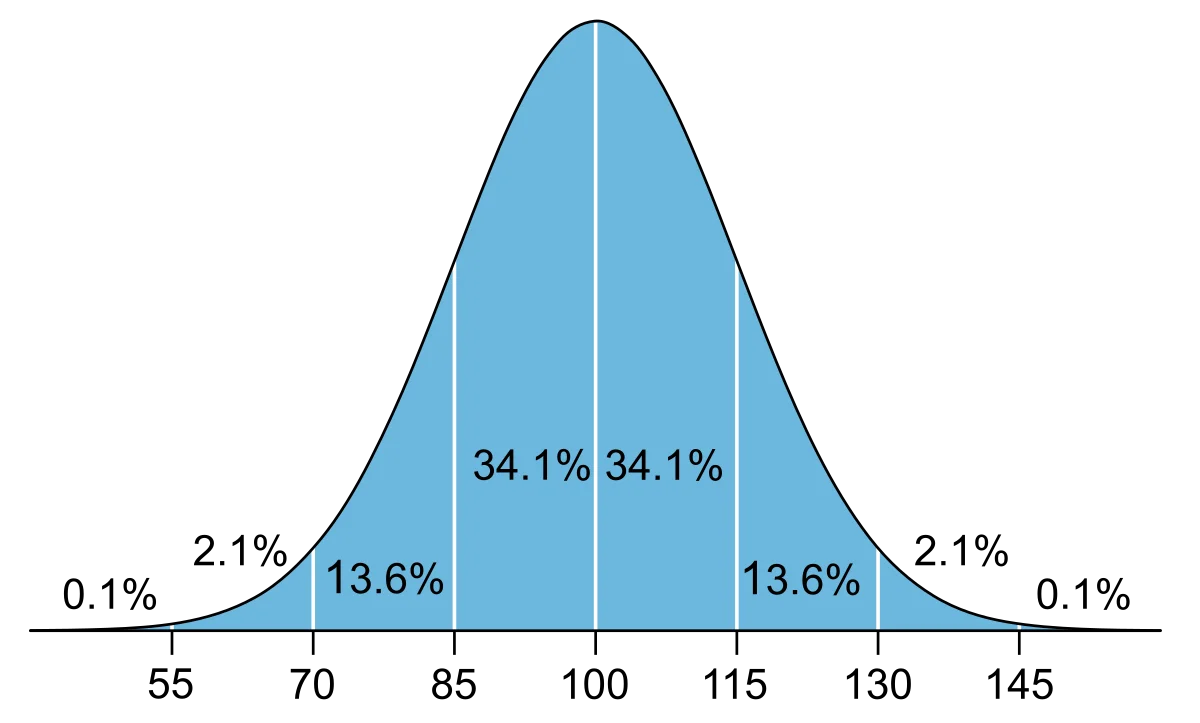
- IQ is normalized so the population mean is 100 with a standard deviation of 15. ~68% of people fall between 85 and 115.
Nature vs. Nurture for Intelligence
Twin and adoption studies show IQ has a substantial genetic component (~50% heritability in adults) but also a strong environmental component. Identical twins raised apart show higher IQ correlation than fraternal twins raised together, supporting heritability. But environments that deprive children of stimulation, language, or nutrition clearly impair cognitive development.
Modern view: neither genes nor environment alone determines intelligence. Genes set a range; environment determines where in that range an individual lands.
Fixed vs. Growth Mindset
Carol Dweck identified two belief systems about intelligence:
- Fixed mindset. Intelligence is innate and unchangeable. “Either you’re smart or you’re not.”
- Growth mindset. Intelligence is malleable with effort and learning. “I can get better at this.”
Students with a growth mindset achieve more over time because they persist through challenges rather than giving up. Praise that emphasizes effort (“you worked hard on this”) fosters a growth mindset; praise that emphasizes ability (“you’re so smart”) can reinforce a fixed mindset.