Heuristics, Biases, and Decision Making
The MCAT loves to ask about heuristics and biases because they are a great way to test whether students understand that human reasoning is systematically, predictably flawed. Most of what follows is the work of Daniel Kahneman and Amos Tversky, who showed that we are not broken rational agents - we are using mental shortcuts that work most of the time and fail in consistent, discoverable ways.

Availability Heuristic
Judging the probability of an event by how easily examples come to mind.
- You hear three shark attack stories on the news this month. You avoid the beach. Actual risk is microscopic, but the recent vivid memories make shark attacks feel more common.
- Americans consistently overestimate their risk of terrorism and underestimate their risk of heart disease. Terrorism is memorable; heart disease is boring.
The availability heuristic is efficient because frequent events actually do tend to be more memorable. It misfires when vividness, recency, or media coverage make rare events disproportionately available.
Representativeness Heuristic
Judging probability by how well something matches a prototype.
Linda problem (Tversky and Kahneman, 1983). Linda is 31, outspoken, bright, majored in philosophy, and was active in antinuclear demonstrations. Which is more likely: (a) Linda is a bank teller, or (b) Linda is a feminist bank teller?
Most people pick (b). They are wrong. The set of feminist bank tellers is a subset of bank tellers, so (a) must be at least as probable. People fall for (b) because the description is more representative of a feminist than of a bank teller.
This error is called the conjunction fallacy: thinking the probability of two things (A and B) is higher than the probability of one thing (A) alone.
Anchoring-and-Adjustment
Starting from an initial estimate (anchor) and adjusting toward a final answer. The adjustment is usually insufficient, so final answers are biased toward the anchor.
Classic demonstration: ask people whether Gandhi died before or after age 9, and whether he died before or after age 140. Both groups then estimate his actual age at death. The “age 9” group guesses much lower than the “age 140” group, even though both anchors are absurd.
Negotiators use anchoring deliberately. The first price in a negotiation powerfully shapes the final deal, which is why car dealers love to start high.
Biases in Decision Making
- Overconfidence. People overestimate the accuracy of their own judgments. Why students can walk out of an exam thinking they aced it and score poorly.
- Belief perseverance. Clinging to a belief despite clear contradicting evidence. Once we form an opinion, new data is easier to ignore than to reckon with.
- Confirmation bias. Actively seeking out and weighting information that supports existing beliefs while ignoring or discounting contrary information. Why people who believe the earth is flat find “evidence” everywhere.
Framing Effects
The same information, presented differently, produces different decisions.
Tversky and Kahneman’s Asian disease problem: A disease is expected to kill 600 people. Subjects choose between two treatments.
- Group 1, positive frame:
- Treatment A: “200 people will be saved.”
- Treatment B: ” chance all 600 will be saved, chance no one will be saved.”
- Majority picks A (risk-averse with gains).
- Group 2, negative frame:
- Treatment A: “400 people will die.”
- Treatment B: ” chance no one will die, chance 600 will die.”
- Majority picks B (risk-seeking with losses).
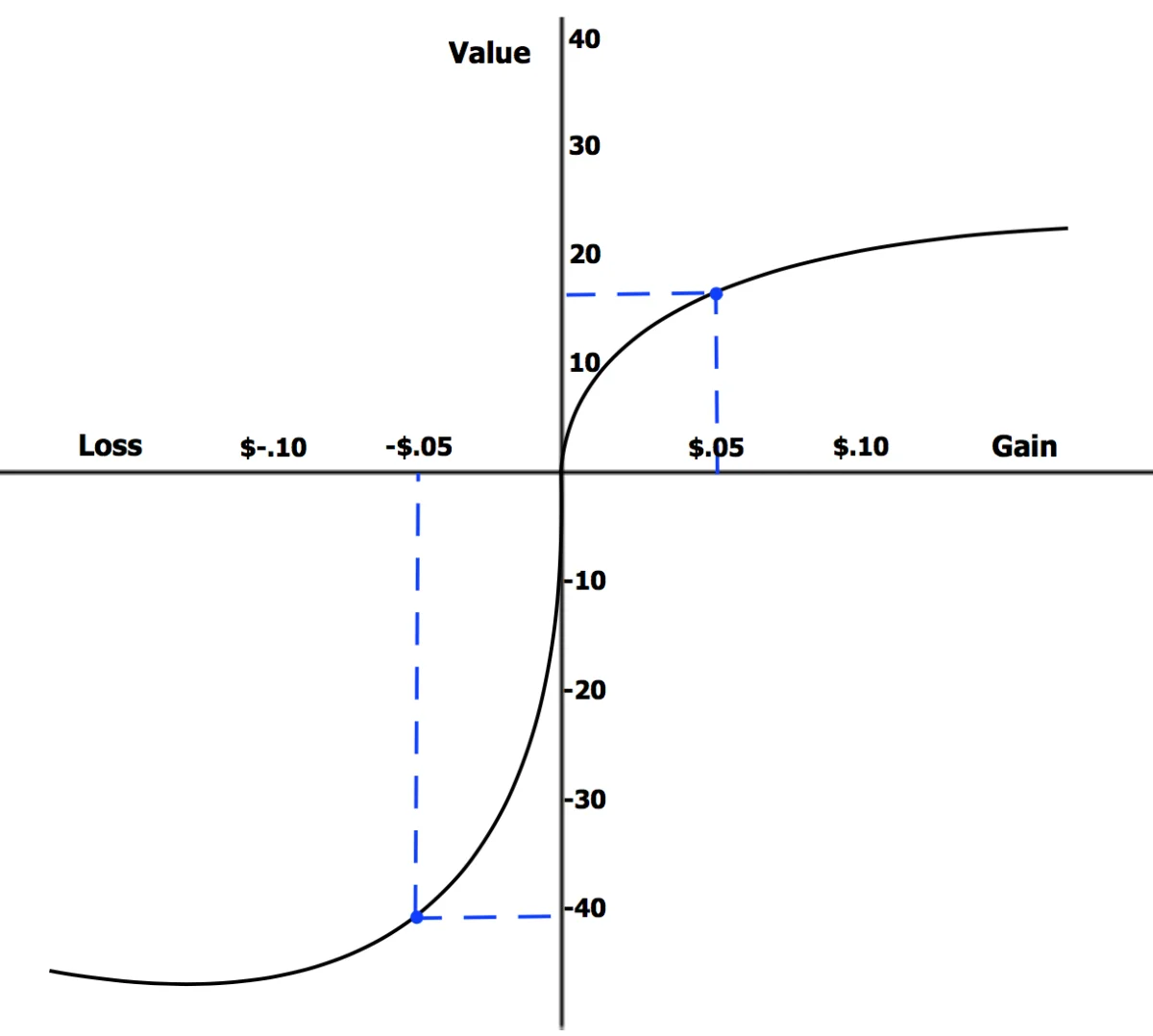
The options are mathematically identical across groups. The framing alone flips the choice. This is the central insight of prospect theory: people are more sensitive to losses than to equivalent gains (loss aversion), and they take bigger risks to avoid losses than to secure gains.