
Dramaturgy and Animal Behavior
Two last topics for this chapter: the dramaturgical approach to everyday interaction, and the basics of animal behavior that frame the human examples in sociology.
The Dramaturgical Approach (Goffman)

Erving Goffman’s The Presentation of Self in Everyday Life (1959) proposed that social life is like theater. People are actors performing roles for various audiences, using impression management to control how others perceive them.
Front Stage and Back Stage
- Front stage. Where performance happens - the setting where you maintain a particular identity for an audience. The classroom for a teacher, the exam room for a doctor, the dining area for a restaurant server.
- Back stage. Where the performer steps out of character and relaxes. The teacher’s lounge, the doctor’s workroom, the restaurant kitchen. Behaviors here would be inappropriate or embarrassing if seen by the audience.
The boundary matters. An audience member straying “back stage” (a customer wandering into the kitchen) disrupts the performance. Social embarrassment often reflects a slip between stages - being caught in a role you weren’t performing.
Impression Management
Impression management is active effort to control how others perceive you. Dressing for an interview, rehearsing a speech, adjusting your tone on the phone to sound friendly - all impression management.
Most impression management is automatic and unconscious. You don’t deliberately think about how to stand during casual conversation, but you’re still doing it.
Face and Face-Work
Goffman introduced face - the positive social image a person wants to claim in an interaction. Face-work is the effort to maintain one’s own face and protect others’ face. Avoiding topics that would embarrass someone, helping a friend save face after a mistake, offering polite phrases to smooth over awkwardness - all face-work.
Face-work keeps interactions running smoothly. Without it, conversations would constantly collapse into conflict and shame.
Symbolic Interactionism
The theoretical framework that underlies Goffman, Mead, and Cooley. Core claims:
- Humans act based on the meanings things have for them. A classroom means different things to a student, a teacher, and a janitor.
- Meanings arise through social interaction. We learn what things mean from others, not from the objects themselves.
- Meanings are interpreted and modified through ongoing interaction. Meanings are not fixed - they’re renegotiated constantly.
Symbolic interactionism is a micro-level sociology - focused on face-to-face interaction - in contrast with macro-level theories (functionalism, conflict theory) that emphasize large-scale structures.
Animal Behavior
Human behavior didn’t arise in a vacuum. Evolutionary and ethological research on animal behavior frames many MCAT questions.
Foraging
Optimal foraging theory predicts animals will forage in ways that maximize caloric intake per unit of time and risk. An animal must decide:
- Where to forage.
- What to eat (marginal value).
- When to move to a new patch.
Observable choices often match the theoretical predictions, with deviations suggesting additional factors (predation risk, social competition).

Mating and Inclusive Fitness
Strategies for maximizing inclusive fitness (own reproduction + that of relatives):
- Monogamy. Pair bonding; associated with species where males contribute significantly to raising offspring.
- Polygyny. One male, multiple female mates. Common in species where females can raise offspring alone.
- Polyandry. One female, multiple male mates. Rarer; sometimes involves paternal care of young.
- Promiscuity. No stable bonds; each mating is opportunistic.
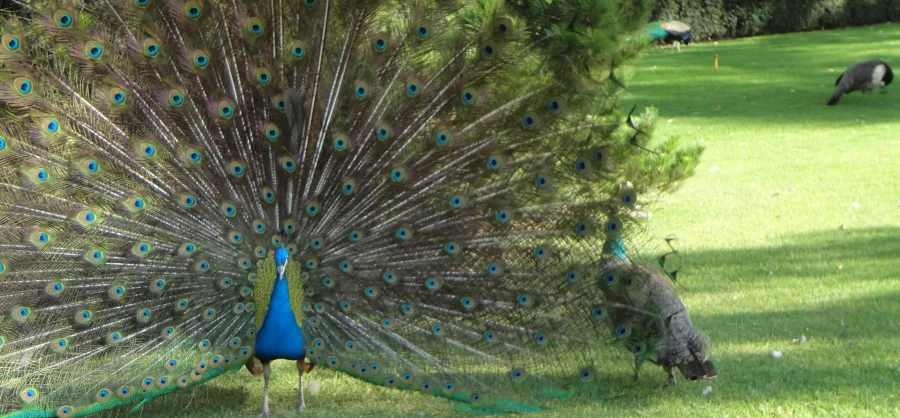
Sexual selection (Darwin): traits that increase mating success evolve even if they cost survival. Peacock tails, songbird displays, deer antlers. Female preference shapes male traits over generations.


Communication and Pheromones
Animals communicate via:
- Visual signals (postures, colors).
- Auditory signals (calls, songs).
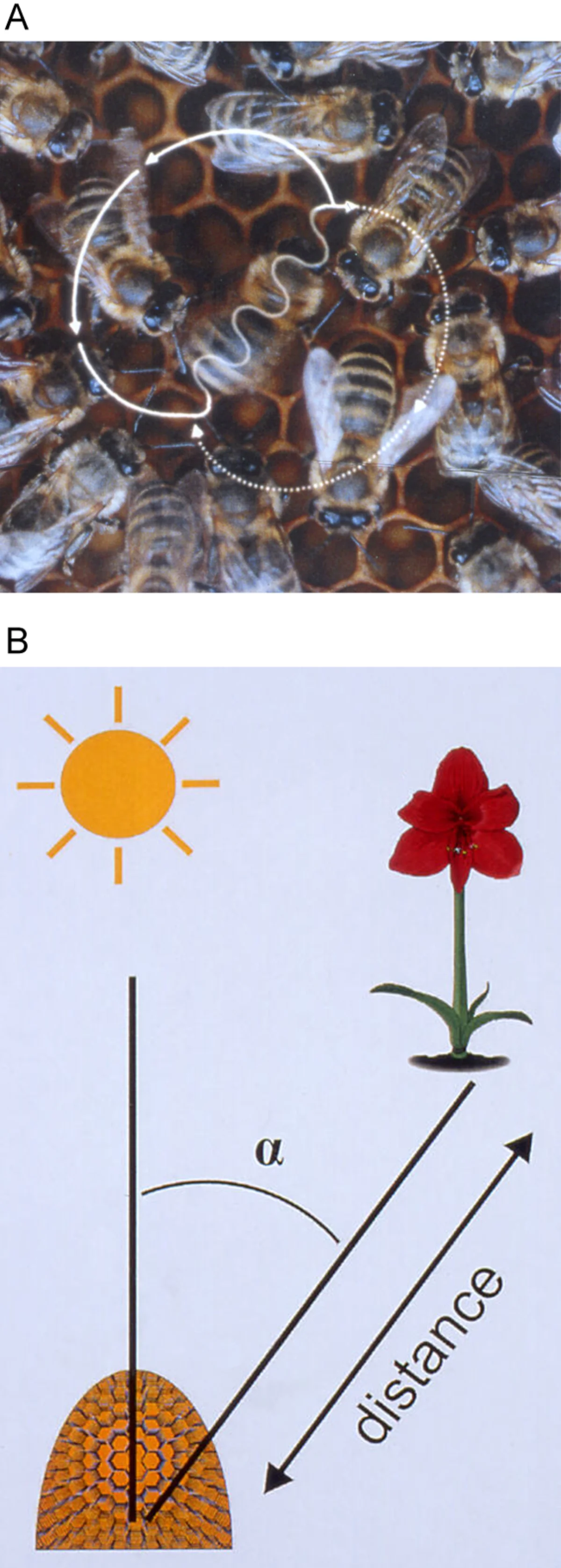
- Chemical signals (pheromones - species-specific chemicals that trigger innate responses in other members of the species).
- Tactile signals (touch, grooming).
In humans, pheromone use is vestigial - we have a partially functional vomeronasal organ - but visual, auditory, and tactile communication dominate. Nonverbal communication (facial expressions, body language, tone of voice) often carries more weight in interpersonal interactions than the verbal content.
Evolutionary Game Theory
Extends classical game theory (prisoner’s dilemma, hawk-dove) to evolution. Strategies succeed if they produce more offspring than alternatives. Cooperation can evolve in repeated interactions when reciprocal strategies (tit-for-tat) outperform constant defection.