
Sleep Disorders, Hypnosis, and Meditation
About a third of adults report frequent sleep problems, and the MCAT expects you to recognize the big four sleep disorders, plus induced altered states like hypnosis and meditation.
Sleep Deprivation
Before the disorders, a baseline on sleep loss. Chronic sleep deprivation is associated with:
- Reduced attention and memory.
- Increased cortisol (stress hormone).
- Increased ghrelin and decreased leptin (hungrier, overeat).
- Higher risk of depression, cardiovascular disease, obesity.
- Impaired immune function.
Adults need roughly 7–9 hours per night. Children need more (12+ for infants, 10+ for preschoolers, 9+ for school-age kids). The concept of sleep debt - missed sleep that accumulates and must be repaid - is real. One or two nights of recovery sleep partially (not fully) restore function.
Insomnia
Insomnia is persistent trouble falling or staying asleep, at least three nights a week for at least three months. Causes include stress, anxiety, poor sleep hygiene, caffeine, and primary neurological issues.
- First-line treatment is cognitive behavioral therapy for insomnia (CBT-I), which retrains sleep associations and schedules.
- Sleep aids (benzodiazepines, “Z-drugs” like zolpidem) work short-term but risk dependence and tolerance, so they are not a long-term answer.
Narcolepsy
Narcolepsy is sudden, uncontrollable sleep attacks during the day. Affected people drop directly into REM sleep, often within minutes of onset.
- Associated with cataplexy - sudden loss of muscle tone, often triggered by strong emotion (laughter, surprise). The person collapses awake. Cataplexy is REM muscle atonia intruding into wakefulness.
- Linked to low levels of the neuropeptide orexin (hypocretin), which promotes wakefulness.
- Roughly 1 in 2000 people.
- Strongly genetic.
Sleep Apnea
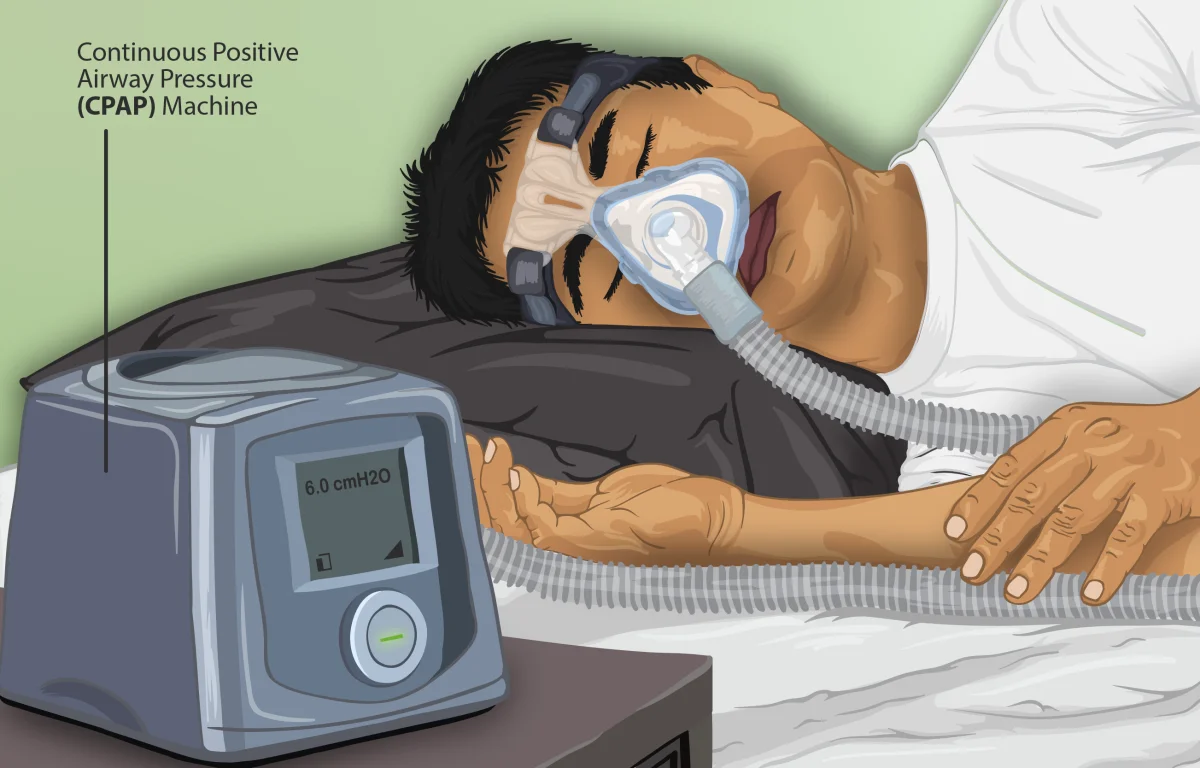
Sleep apnea is the repeated, brief cessation of breathing during sleep. The most common form, obstructive sleep apnea, happens when throat muscles relax and block the airway.
- Classic features: loud snoring, gasping awakenings, daytime fatigue despite a full night in bed.
- Affected individuals rarely get enough N3 (deep sleep) because they keep semi-waking to breathe.
- Roughly 1 in 20 adults; much higher in overweight individuals.
- Treated with CPAP (continuous positive airway pressure) masks, weight loss, or surgery.
Parasomnias
Parasomnias are abnormal behaviors during sleep.
- Sleepwalking (somnambulism) and sleep talking occur in N3 (deep slow-wave sleep). They are harmless, largely genetic, and more common in children (who have more N3). Waking a sleepwalker is fine, just disorienting.
- Night terrors also occur in N3. A child screams and appears terrified but is not really awake and won’t remember the episode. Distinct from nightmares, which happen in REM and are remembered.
- REM sleep behavior disorder (RBD) is the failure of REM muscle atonia. The person acts out vivid dreams (punching, kicking). RBD is often an early sign of Parkinson’s disease and related neurodegenerative conditions.
Hypnosis
Hypnosis is an induced state in which a subject is deeply relaxed, focused, and more susceptible to suggestion. The EEG shows more alpha waves - characteristic of a relaxed but awake state, not sleep.
- Applications: pain management, smoking cessation, anxiety.
- False memory risk. Hypnotic suggestion can implant confabulated “memories,” which is why forensic hypnosis is generally inadmissible in court.
- Only works if the subject wants it to work and is highly suggestible. You cannot be hypnotized into doing something against your will.
Two competing theories:
- Dissociation theory (Hilgard). Hypnosis is a state of divided consciousness, where one part of the mind obeys the hypnotist while another “hidden observer” remains aware.
- Social influence theory. Hypnotized subjects are playing a role shaped by social expectations - like actors following a script. They actually experience what they are told to experience because the context makes it real to them.
Meditation
Meditation is a practice of self-regulating attention and awareness. It is not a single altered state; styles range from focused attention (on breath or a mantra) to open awareness (letting thoughts pass without engagement).
- Light meditation shows more alpha waves than baseline rest.
- Deep meditation in experienced practitioners shows increased theta waves and gamma activity.
- Long-term practitioners show increased activity in the prefrontal cortex and the right anterior insula (attention control) and changes in hippocampal volume.
- Clinical uses: anxiety reduction, mood disorders, chronic pain, and as an adjunct to treatment for ADHD.