
Classification
Memorizing 20 random structures is a slog. Grouping them by what their R group does is a cheat code. Once you see that histidine, lysine, and arginine all have nitrogen that grabs a proton and becomes positive, you know what they do in a protein regardless of which one the passage names.
The 20 standard amino acids split into five main buckets plus three special cases. Learn the buckets first. Individual structures come in the next section.
The Five R-Group Buckets
| Category | What the R group does | Members | At pH 7 charge |
|---|---|---|---|
| Nonpolar aliphatic | Greasy, hates water, buried inside proteins | Gly, Ala, Val, Leu, Ile, Met, Pro | 0 |
| Aromatic | Has a benzene-like ring, mostly hydrophobic | Phe, Trp, Tyr (Tyr is slightly polar from its -OH) | 0 |
| Polar uncharged | Has -OH, -SH, or amide, loves water but no charge | Ser, Thr, Cys, Asn, Gln | 0 |
| Positively charged (basic) | Nitrogen that grabs H+ | Lys, Arg, His | +1 (His often partial) |
| Negatively charged (acidic) | Extra -COOH that gives up H+ | Asp, Glu | -1 |
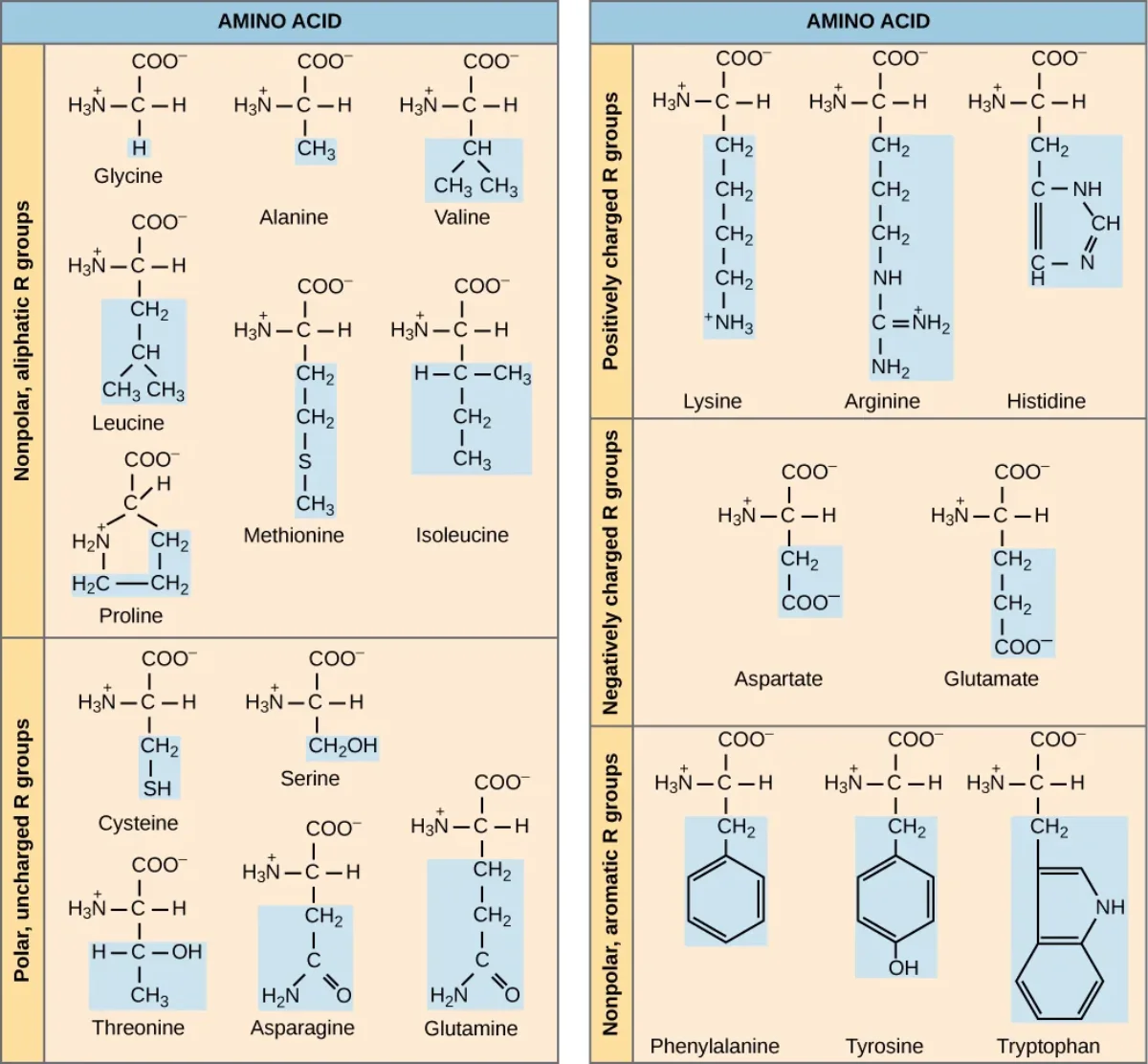
Nonpolar R Groups (Hydrophobic)
These have alkyl chains, sulfur atoms (in methionine), or aromatic rings with no polar groups. They are greasy. In a folded protein, they huddle in the interior away from water - the hydrophobic core. Aromatic residues also stack with each other for extra stability.
Polar Uncharged R Groups
These have heteroatoms (O, N, S) that form hydrogen bonds but do not carry a net charge at pH 7. They love water. They sit on the protein surface or in active sites where they can hydrogen bond to substrates.
- Serine, Threonine - have -OH groups
- Tyrosine - aromatic ring with -OH (classified polar or aromatic depending on the chart)
- Cysteine - has -SH (thiol)
- Asparagine (N), Glutamine (Q) - have amide side chains
Positively Charged R Groups (Basic)
Three amino acids. Their side chains carry a nitrogen lone pair that picks up a proton and becomes positively charged at pH 7.
- Lysine (K) - long chain ending in -NH3+
- Arginine (R) - guanidinium group, very basic (pKa about 12, fully protonated at pH 7)
- Histidine (H) - imidazole ring, pKa near 6, so at pH 7 it is partly protonated. This makes histidine uniquely useful in enzyme active sites that need to shuttle protons.
Negatively Charged R Groups (Acidic)
Two amino acids, both ending in “-ate” because they donate their carboxyl proton at pH 7.
- Aspartate (Asp, D) - one -CH2- linker, then -COO-
- Glutamate (Glu, E) - two -CH2- linkers, then -COO-
Their protonated forms are called aspartic acid and glutamic acid, but at physiological pH they are almost always in the deprotonated “-ate” form.
The Three Special Cases
Glycine (Gly, G). R group is just -H. Smallest amino acid. Only achiral one. Flexible - fits anywhere. Often found at tight turns in a protein.
Proline (Pro, P). Its R group loops back and bonds to the amino nitrogen, forming a rigid five-membered ring. This kink disrupts alpha helices and creates helix breakers or sharp bends.
Cysteine (Cys, C). Its -SH (thiol) can form a covalent disulfide bond (-S-S-) with another cysteine. This is the only covalent bond (besides peptide bonds) that stabilizes folded proteins.