Biologists have used two models to describe how a substrate fits into an active site. The MCAT expects you to know both, to know which is modern and correct, and to know why the distinction matters.
Lock-and-Key Model (Emil Fischer, 1894)
In the lock-and-key model, the active site has a fixed, rigid shape. Only a substrate with the exact complementary shape can fit - like a key fitting a particular lock. Binding does not change either partner; the shapes are pre-formed.
This model correctly predicts enzyme specificity but is too simple. It implies the enzyme is a static sculpture, which it is not.
Induced Fit Model (Daniel Koshland, 1958)
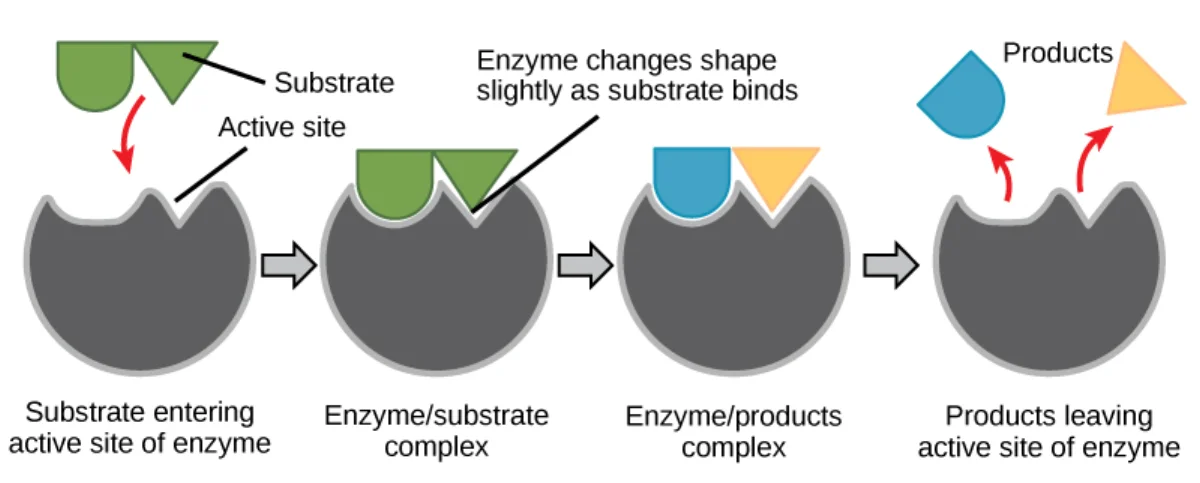
In induced fit, the active site is flexible. When the substrate begins to bind, the enzyme changes shape to wrap around the substrate more snugly. The substrate may also deform slightly. The resulting “mutual adjustment” creates the catalytically active arrangement of residues that was not quite right in the empty enzyme.
Induced fit: both enzyme and substrate adjust their shapes when they come together. The empty active site is not the same shape as the bound active site. Credit: OpenStax Biology 2e, CC BY 4.0
Induced fit is the modern, correct model for most enzymes. It explains why enzymes are so good at stabilizing the transition state - the post-binding conformation is complementary to the transition state, not the ground-state substrate.
Hexokinase - The Classic Example
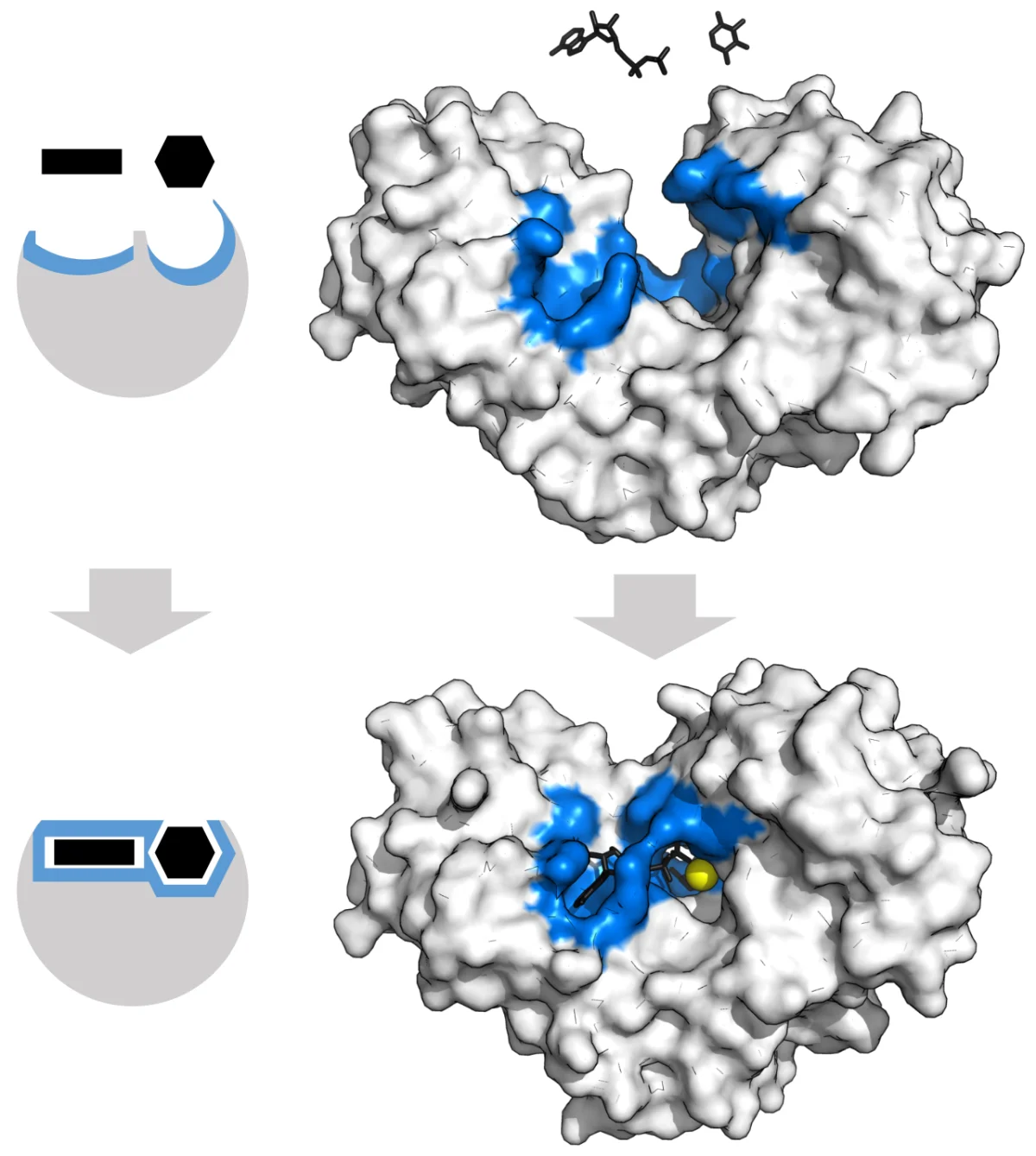
Hexokinase is the first enzyme of glycolysis. It transfers a phosphate from ATP onto glucose. When only the enzyme is present, the two lobes of hexokinase are open. When glucose binds, the lobes clamp down like a Venus flytrap, surrounding the sugar and excluding water.
Why the drama? Water would ruin everything. If water got into the active site, the ATP phosphate would be transferred onto water instead of glucose (ATP hydrolysis, a wasted reaction). By slamming shut on glucose, hexokinase guarantees that only glucose - not water - gets phosphorylated.
Hexokinase open vs. closed states. Glucose binding triggers a large conformational change that closes the active site and excludes water. Credit: Wikimedia Commons, CC BY-SA
What is the key difference between lock-and-key and induced fit models?
Click to reveal answer
Lock-and-key says the active site is rigid and pre-shaped to fit only one exact substrate. Induced fit says the active site (and sometimes the substrate) changes shape during binding, producing the active conformation only after contact. Induced fit is the modern, correct model.
Why does hexokinase undergo such a large conformational change on binding glucose?
Click to reveal answer
Closing around glucose excludes water from the active site. If water were present, the enzyme would wastefully transfer the phosphate from ATP onto water (ATP hydrolysis) instead of glucose. Induced fit enforces substrate specificity by geometrically shielding the chemistry.