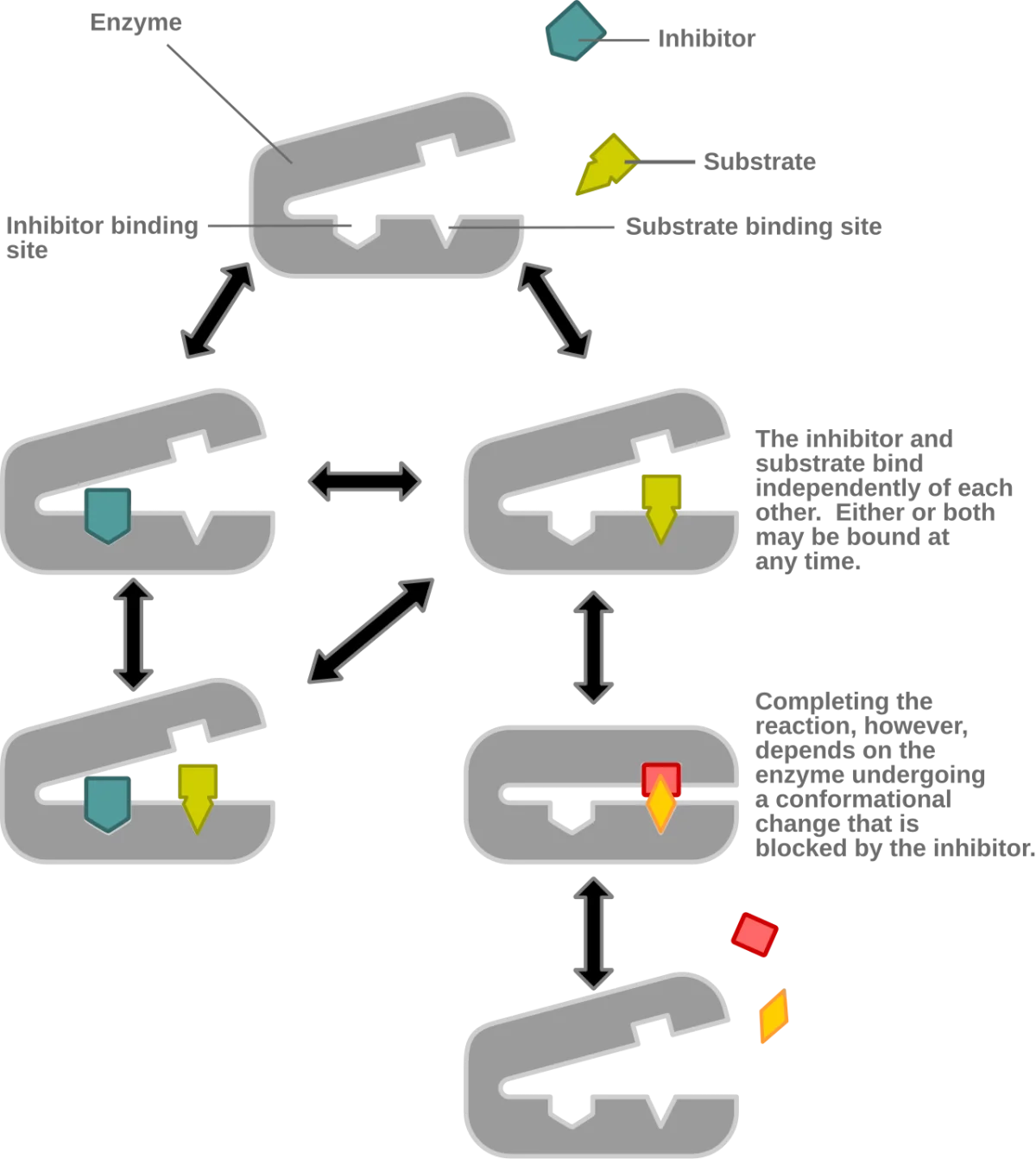
Pure noncompetitive inhibition (inhibitor binds E and ES with identical affinity) is mathematically tidy but biologically rare. Real-world “noncompetitive” inhibitors usually have unequal affinities for E vs. ES. That is mixed inhibition. It is the most common real form of allosteric inhibition.
The Big Idea
A mixed inhibitor binds both free enzyme (E) and the enzyme-substrate complex (ES), but not with the same strength. Let Ki be the dissociation constant for binding E, and Ki’ be the dissociation constant for binding ES.
If Ki < Ki’ (inhibitor prefers the free enzyme), behavior looks competitive-ish: Km appears to rise.
If Ki > Ki’ (inhibitor prefers the enzyme-substrate complex), behavior looks uncompetitive-ish: Km appears to fall.
In both cases, Vmax drops because some enzyme is always in an inhibitor-bound state.
Mixed inhibition on Lineweaver-Burk. The two lines intersect at a point that is neither on the x-axis nor the y-axis - an "off-axis" intersection. Credit: Wikimedia Commons, CC BY-SA
Kinetic Effect
Parameter
Change
Why
Vmax
Always decreases
Some enzyme is always inactive in an inhibitor complex
Km
Can go up or down
Depends on which form (E or ES) the inhibitor prefers
Binding site
Allosteric
Same site, different affinities for E and ES
LB signature
Off-axis intersection
The classic “neither purely competitive nor purely noncompetitive” pattern
Lineweaver-Burk Decision Tree
When you see an unknown inhibitor on a double-reciprocal plot, use this decision tree:
Do both lines share the y-intercept? Yes → competitive. No → go to step 2.
Do both lines share the x-intercept? Yes → noncompetitive. No → go to step 3.
Are the lines parallel? Yes → uncompetitive. No → mixed.
Why This Category Exists
Mixed inhibition is the honest description of what most allosteric regulators actually do. The MCAT used to lump everything non-competitive into “noncompetitive.” Modern biochem courses and the AAMC outline now distinguish mixed from pure noncompetitive. You should recognize both.
How does mixed inhibition differ from pure noncompetitive inhibition?
Click to reveal answer
Both bind allosteric sites and both lower Vmax. Pure noncompetitive requires identical affinity for E and ES, leaving Km unchanged. Mixed inhibition has different affinities for E and ES, so Km shifts (up or down depending on which form is preferred).
On a Lineweaver-Burk plot showing mixed inhibition, where do the two lines intersect?
Click to reveal answer
At an off-axis point - neither on the y-axis (which would indicate competitive) nor on the x-axis (which would indicate noncompetitive). The position of that intersection depends on whether Km rises or falls.
A mixed inhibitor binds the free enzyme more tightly than the ES complex. What happens to the apparent Km?
Click to reveal answer
Apparent Km increases. Because the inhibitor preferentially grabs free enzyme, substrate must compete for the remaining free E, so it takes more substrate to reach half-Vmax. Vmax still drops because no matter how much substrate you add, some enzyme is always inhibitor-bound.