
Noncompetitive & Uncompetitive
Not every inhibitor plays by the rules of competition. Some bind sites other than the active site and distort the enzyme. Some only bind after the substrate has already arrived. These inhibitors produce distinctly different kinetic signatures, and the MCAT will test whether you can tell them apart.
Noncompetitive Inhibition
A noncompetitive inhibitor binds at a site other than the active site (an allosteric site) and bends the enzyme into an inactive shape. It can bind the free enzyme (E) or the enzyme-substrate complex (ES) with equal affinity. Adding more substrate does NOT help - the substrate can still slip into the active site, but the catalytic step is broken because the enzyme is distorted.
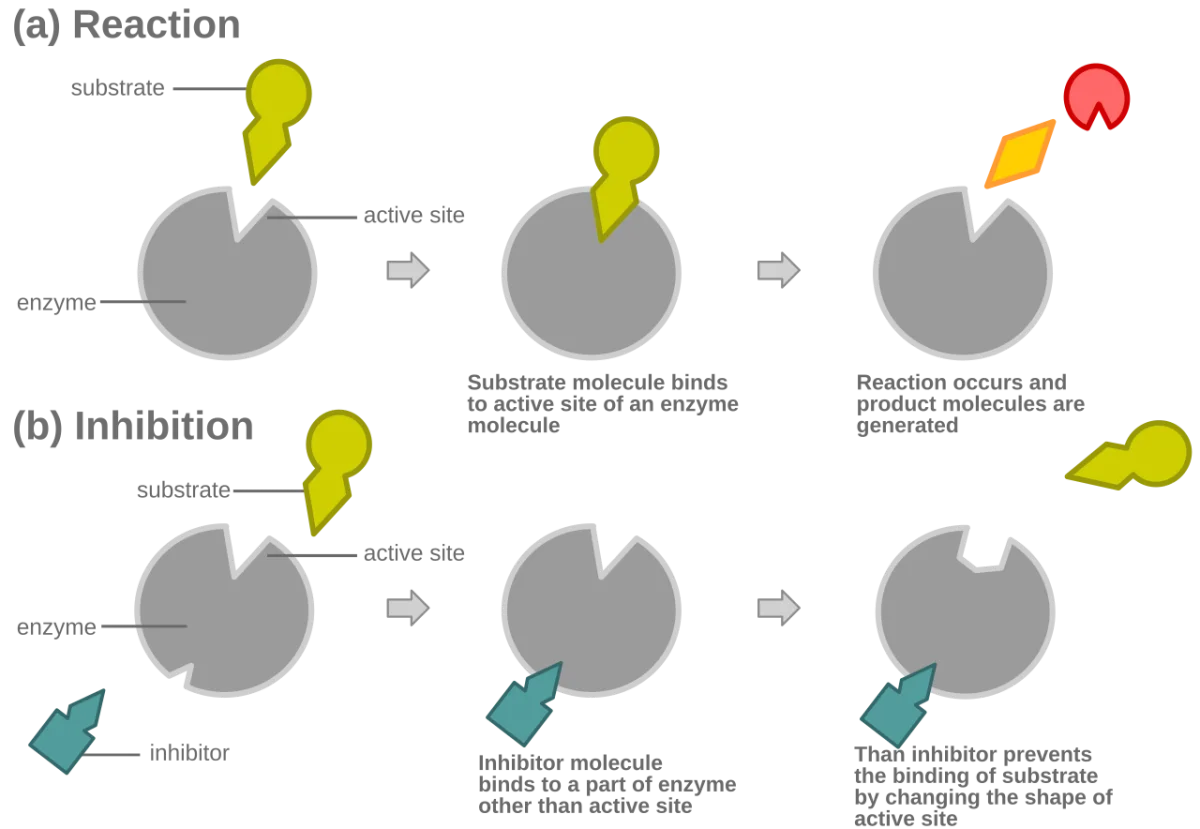
Kinetic Effect
| Parameter | Change | Why |
|---|---|---|
| Vmax | Decreases | Some enzyme molecules are permanently broken (effectively [E] decreases) |
| Km | Unchanged | Substrate still binds the remaining functional enzymes the same way |
| Binding site | Allosteric (non-active) | Inhibitor does not compete with substrate for position |
On Lineweaver-Burk, noncompetitive inhibition shifts lines up (higher y-intercept, because 1/Vmax is larger) but the x-intercept stays the same (Km unchanged). The two lines cross on the x-axis.
Uncompetitive Inhibition
An uncompetitive inhibitor binds ONLY the enzyme-substrate complex (ES), not the free enzyme. The inhibitor needs the substrate to be in place first - it binds a shape that only exists after substrate binding triggers a conformational change.
The result is counterintuitive: both Vmax AND Km decrease.
- Vmax decreases because some ES complexes are trapped and cannot release product.
- Km decreases because trapping ES pulls the E + S ⇌ ES equilibrium to the right (Le Chatelier), making it look as if the enzyme has higher affinity. More substrate is captured, not less.
| Parameter | Change | Why |
|---|---|---|
| Vmax | Decreases | Trapped ES cannot produce product |
| Km | Decreases | Equilibrium pulled toward ES; apparent affinity increases |
| Binding site | Only binds ES, not E | Needs the substrate-induced conformation |
Lineweaver-Burk Signature - Parallel Lines
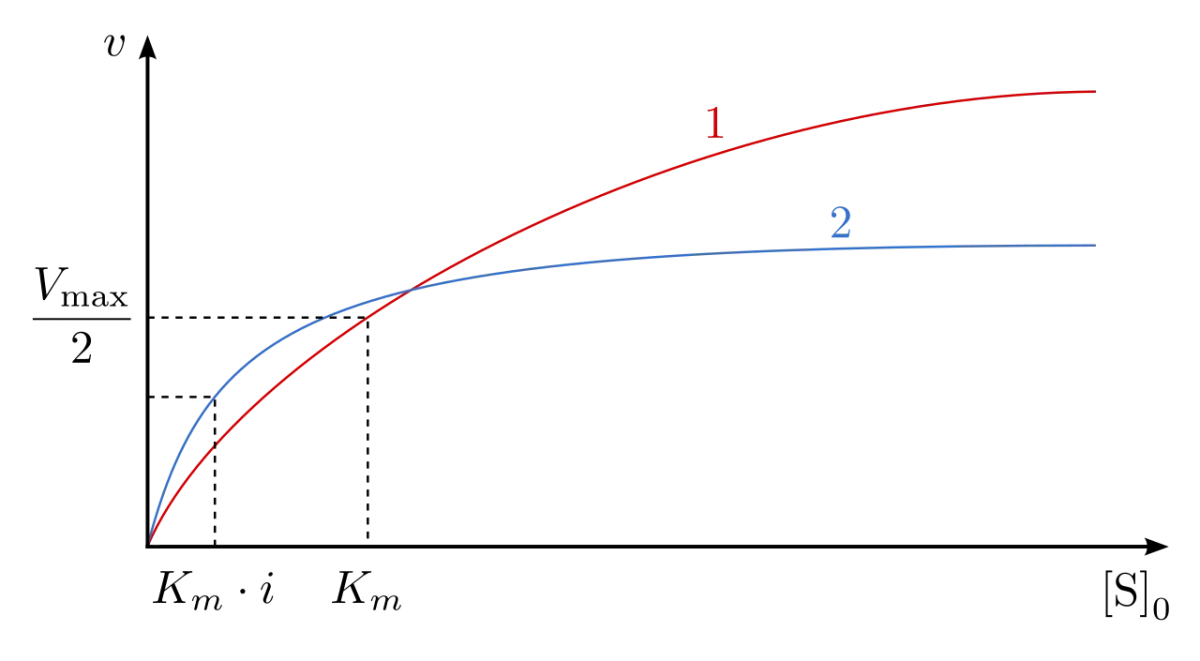
Because both Vmax and Km decrease by the same factor, Km/Vmax (the slope on Lineweaver-Burk) is unchanged. The result is parallel lines on a double-reciprocal plot - different intercepts, same slope.
Real Examples
- Lithium (for bipolar disorder) uncompetitively inhibits inositol monophosphatase. Because lithium only binds when substrate is already there, its effect is stronger where the substrate is abundant - a neat clinical quirk.
- Some antibiotics targeting bacterial enzymes are uncompetitive to avoid complete shutdown of related human enzymes that lack the ES conformation the drug recognizes.
Side-by-Side Comparison
| Inhibitor type | Binds | Km | Vmax | LB lines |
|---|---|---|---|---|
| Competitive | E only (active site) | Up | Same | Cross on y-axis |
| Noncompetitive | E and ES equally (allosteric) | Same | Down | Cross on x-axis |
| Uncompetitive | Only ES | Down | Down | Parallel |
| Mixed (next section) | E and ES, different affinity | Up or down | Down | Cross off-axis |