
Zymogens
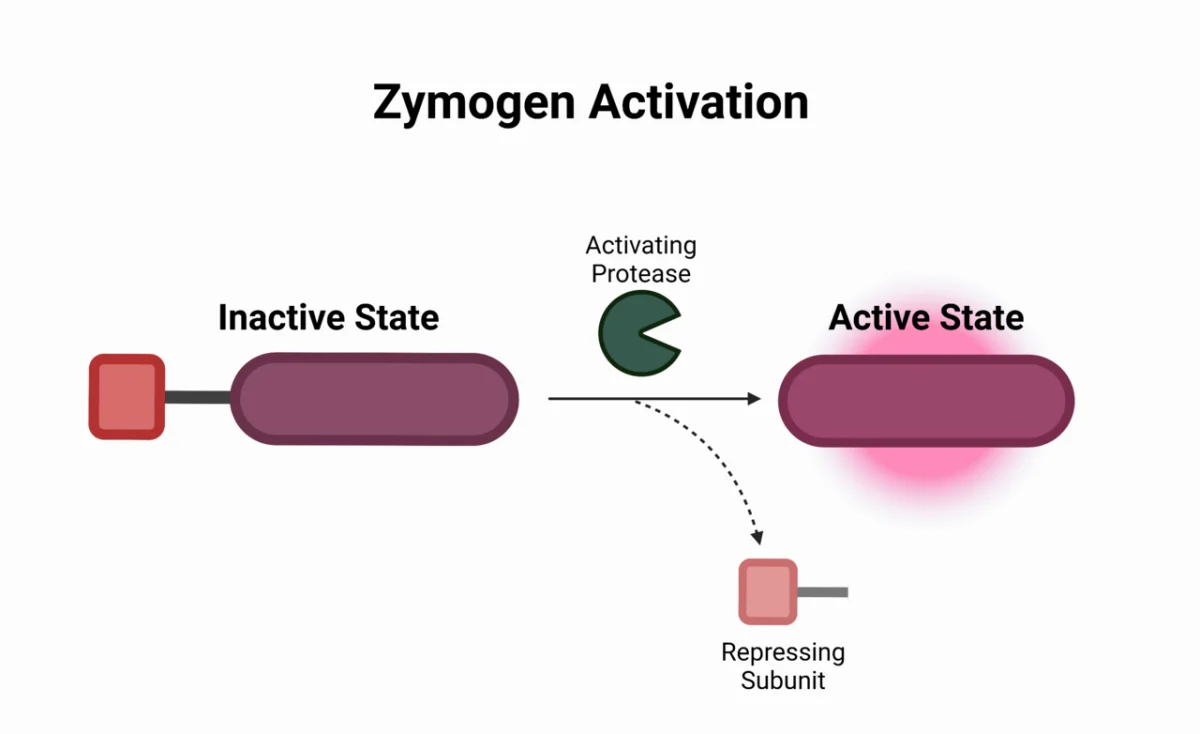
Some enzymes are dangerous if they are active in the wrong place at the wrong time. The cell synthesizes them in an inactive precursor form called a zymogen (or proenzyme) and activates them only when and where needed, usually by cleaving off a peptide. Once cut, the zymogen cannot go back to being inactive - activation is irreversible, which is why the cell is so careful about where it happens.
Digestive Zymogens
Pancreatic digestive enzymes are the textbook example. If pepsin, trypsin, chymotrypsin, or elastase were active in the pancreas, they would digest the pancreas itself (a real disease: acute pancreatitis). So the pancreas synthesizes them as zymogens and releases them into the small intestine for activation.
| Zymogen | Where made | Where activated | Active enzyme | Activated by |
|---|---|---|---|---|
| Pepsinogen | Stomach (chief cells) | Stomach (low pH) | Pepsin | Autocatalysis at pH < 5, plus existing pepsin |
| Trypsinogen | Pancreas | Small intestine | Trypsin | Enteropeptidase (duodenum), then autocatalysis |
| Chymotrypsinogen | Pancreas | Small intestine | Chymotrypsin | Trypsin |
| Proelastase | Pancreas | Small intestine | Elastase | Trypsin |
| Procarboxypeptidase | Pancreas | Small intestine | Carboxypeptidase | Trypsin |
| Prolipase | Pancreas | Small intestine | Lipase | Trypsin |
Notice the key node: trypsin activates all the others. Enteropeptidase (also called enterokinase) in the duodenal brush border cleaves trypsinogen to trypsin; trypsin then activates itself and every other pancreatic zymogen. This is called a proteolytic cascade.
The Blood Clotting Cascade
Clotting is a proteolytic cascade of zymogen activations. Each factor is a zymogen; when cut, it becomes an active protease that cuts the next factor in line. This amplifies the signal - a tiny initial trigger produces a large, localized clot within seconds.
- Intrinsic pathway: triggered by contact with damaged surface (Factor XII → XI → IX → X).
- Extrinsic pathway: triggered by tissue factor (VII → X).
- Both pathways converge at Factor X → Xa, which activates prothrombin (II) to thrombin (IIa). Thrombin converts fibrinogen to fibrin, forming the clot.
Warfarin blocks vitamin K recycling, which is needed to gamma-carboxylate clotting factors II, VII, IX, and X - so warfarin indirectly inhibits clotting by producing non-functional zymogens.
Apoptosis - Caspase Cascade
Programmed cell death uses a similar cascade of zymogen activations. Caspases (cysteine-aspartate proteases) are synthesized as procaspases. Initiator caspases (e.g., caspase-8, -9) cleave and activate executioner caspases (caspase-3, -6, -7), which then dismantle the cell in an orderly way. Because the cascade is irreversible, the decision to die is committed once the first executioner caspase is activated.
Regulatory Enzymes in a Pathway
Beyond zymogens, most metabolic pathways have one or two “regulatory enzymes” that control flux. These are usually:
- The rate-limiting enzyme (slowest step of the pathway at normal conditions).
- An enzyme catalyzing an irreversible step, so regulation is meaningful.
- Subject to multiple regulatory inputs - allosteric effectors, covalent modification, hormonal control.
Examples you should recognize:
- PFK-1 regulates glycolysis.
- HMG-CoA reductase regulates cholesterol synthesis (target of statins).
- Acetyl-CoA carboxylase regulates fatty acid synthesis.
- Glycogen phosphorylase regulates glycogen breakdown.
These are expanded in the metabolism chapters. For now, just know that the cell concentrates regulation at a few key control points rather than controlling every step of every pathway.