
Structural Proteins
Structural proteins are the beams, cables, and sheets of the body. They are designed to resist force. Most are long, repetitive, and fibrous rather than globular. The MCAT focuses on three: collagen, keratin, and elastin, plus a passing nod to the cytoskeletal proteins (actin, microtubules, intermediate filaments).
Collagen
Collagen is the most abundant protein in the body - about 25-30 percent of total protein. It is the main component of bone, tendons, cartilage, skin, blood vessels, and basement membranes. Its job is to resist stretching.
Collagen has a distinctive triple helix structure. Three polypeptide chains (called alpha chains) wrap around each other in a right-handed superhelix. Each chain has the repeating sequence Gly-X-Y, where X is often proline and Y is often hydroxyproline. Glycine’s tiny R group (just -H) is essential because only glycine is small enough to fit in the tight interior of the triple helix. Every third position MUST be glycine.
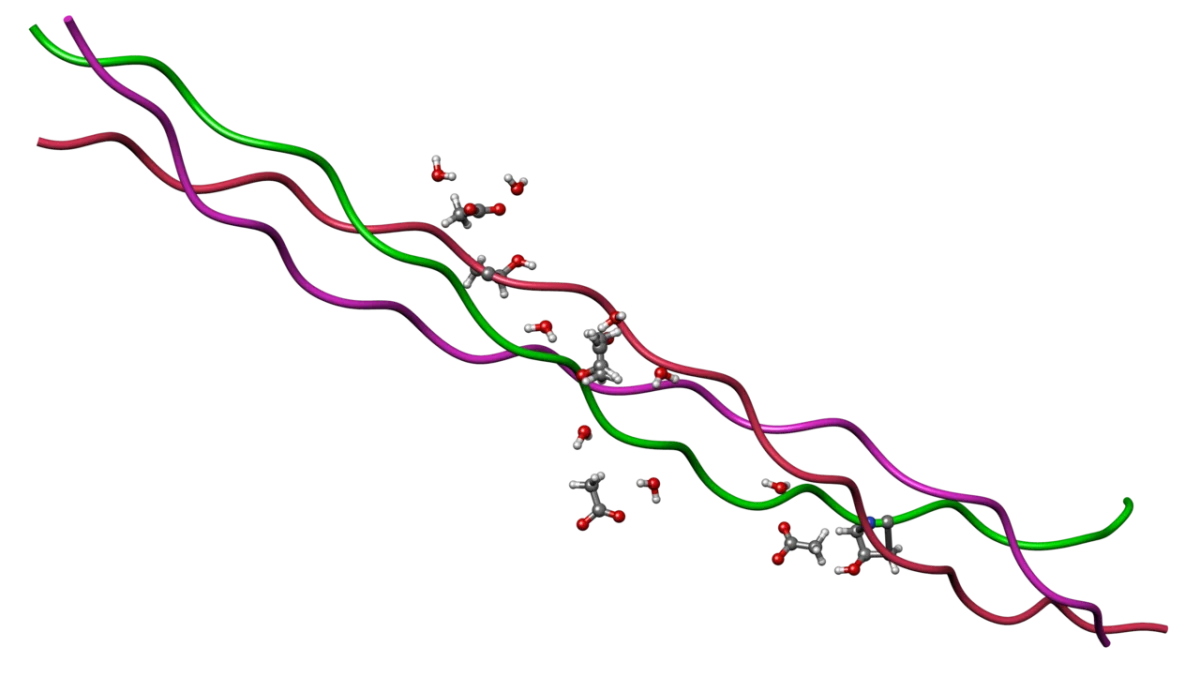
Why Collagen Needs Vitamin C
The hydroxyprolines and hydroxylysines are not encoded in DNA. They are made after translation by enzymes called prolyl hydroxylase and lysyl hydroxylase, which need vitamin C (ascorbate) as a cofactor. Vitamin C keeps the iron in these enzymes in the Fe2+ state, which is required for hydroxylation.
Without hydroxylation, collagen fibers cannot form the hydrogen bonds that stabilize the triple helix. Weak collagen means weak blood vessels, gums, and connective tissue. That is scurvy: bleeding gums, loose teeth, poor wound healing, fragile skin.
Keratin
Keratin is the protein in hair, nails, horns, feathers, and the outer layer of skin. Two types:
- Alpha-keratin is rich in alpha helices coiled around each other in coiled coils. Found in hair, wool, nails, and epidermis.
- Beta-keratin is rich in beta sheets. Found in feathers, scales, and beaks.
Keratins also contain many cysteines, which form cross-linking disulfide bonds between chains. The more disulfide bonds, the tougher the keratin (nails and claws are harder than hair).
Elastin
Elastin is what allows stretchy tissues (skin, lungs, large arteries) to snap back to their original shape after being deformed. It is a rubber-like protein. Elastin forms a loose, cross-linked network rather than a rigid fiber. When the tissue stretches, the chains pull apart; when force is released, they spring back - entropy drives the recoil.
Elastin is cross-linked by an unusual amino acid called desmosine (formed from 4 lysines). The AAMC outline does not require you to memorize desmosine, but you should know that elastin is extensively cross-linked.
Cell Adhesion Molecules
Proteins at the cell surface decide what sticks to what. The MCAT tests three families - cadherins, integrins, and selectins - and their specific roles in tissue architecture, wound healing, and leukocyte migration.
| CAM family | What it binds | Calcium-dependent? | Signature role |
|---|---|---|---|
| Cadherins | Identical cadherins on a neighboring cell (homophilic, cell-cell) | Yes (Ca2+ required) | Hold epithelial tissues together at adherens junctions |
| Integrins | Extracellular matrix proteins (fibronectin, laminin, collagen) via RGD motifs | Yes (Ca2+/Mg2+) | Anchor cells to the ECM; trigger inside-out and outside-in signaling |
| Selectins | Carbohydrate ligands on other cells (e.g., sialyl-Lewis X) | Yes | Initial tethering and rolling of leukocytes on endothelium |
Cytoskeletal Proteins
Inside cells, three main polymer systems form the cytoskeleton:
| Polymer | Monomer | Diameter | Jobs |
|---|---|---|---|
| Actin / microfilaments | G-actin | ~7 nm | Cell shape, muscle contraction, cytokinesis |
| Microtubules | Tubulin dimers (alpha + beta) | ~25 nm | Tracks for motor proteins, mitotic spindle |
| Intermediate filaments | Varies (keratin, lamin, vimentin, neurofilament) | ~10 nm | Mechanical strength, nuclear envelope support |
Actin and microtubules are dynamic (assembly and disassembly are regulated). Intermediate filaments are mostly stable and provide tensile strength.