
Binding Proteins & Antibodies
Binding proteins grab small molecules or ions and carry them somewhere. They do not transform their cargo chemically. Immunoglobulins are a specialized class of binding proteins that grab foreign antigens to mark them for destruction. Both are essential MCAT topics.
Plasma Binding Proteins
The most abundant protein in blood plasma is albumin, which binds and transports fatty acids, bilirubin, steroid hormones, thyroid hormones, and many drugs. Albumin also contributes most of the plasma oncotic pressure (the osmotic pull that keeps fluid inside blood vessels). Low albumin causes edema.
Other important binding proteins:
- Transferrin binds iron (Fe3+) and delivers it to cells via the transferrin receptor.
- Ferritin stores iron inside cells.
- Sex hormone binding globulin (SHBG) carries testosterone and estradiol.
- Corticosteroid binding globulin (CBG) carries cortisol.
- Hemoglobin is the quintessential binding protein (it carries O2 inside red blood cells). Covered in detail in sections 3.5 and 3.6.
Immunoglobulins (Antibodies)
An antibody is a Y-shaped protein that recognizes a specific shape (an epitope on an antigen) and binds it with very high affinity. Each antibody is made of two identical heavy chains and two identical light chains, held together by disulfide bonds.
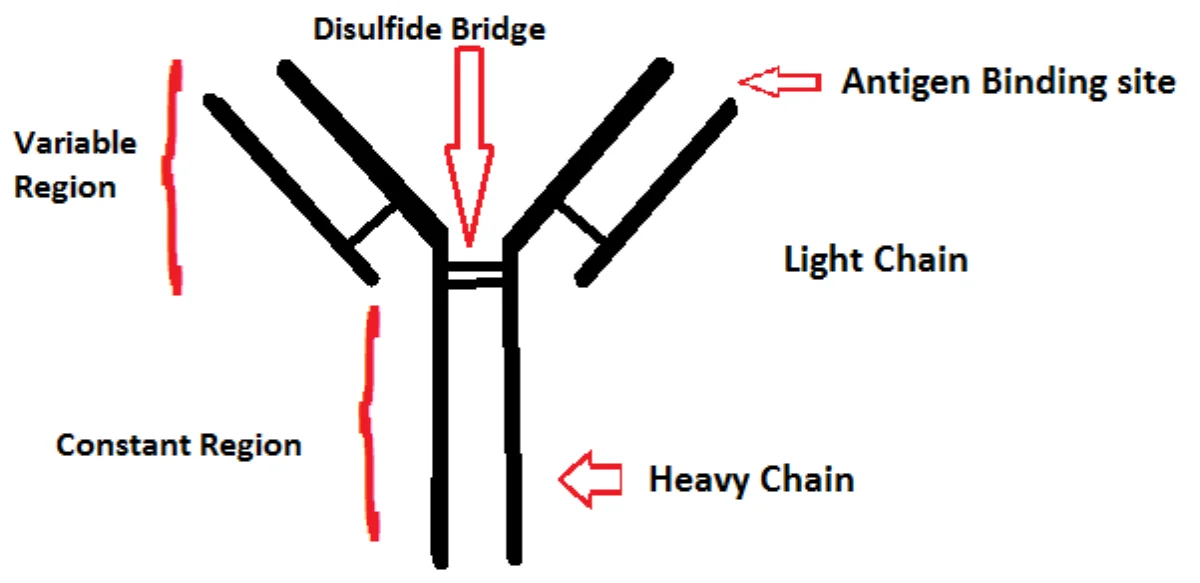
Heavy and Light Chain Architecture
Every IgG has exactly 4 polypeptide chains:
- 2 heavy (H) chains: ~50 kDa each. Each has one variable domain (VH) at the N-terminal tip, followed by three or four constant domains (CH1, CH2, CH3).
- 2 light (L) chains: ~25 kDa each. Each has one variable domain (VL) and one constant domain (CL). Light chains come in two flavors: kappa (κ) or lambda (λ).
The chains are held together by disulfide bonds: two interchain disulfides link the two heavy chains to each other in the hinge region, and one disulfide links each light chain to its heavy-chain partner. Intrachain disulfides fold each domain into a compact immunoglobulin fold (a beta sandwich).
Variable vs. Constant Regions
- Variable (V) regions are at the N-terminal tips of the Fab arms. They are encoded by V, D, and J gene segments that rearrange during B-cell development, producing a near-infinite library of binding shapes. The three hypervariable loops (complementarity-determining regions, CDRs) from VH and VL together form the antigen-binding site.
- Constant (C) regions are identical within an isotype. They determine antibody class (IgG vs. IgA vs. IgM, etc.) and effector function - which immune cells and complement proteins the antibody recruits.
Fab vs. Fc
- Fab (fragment antigen-binding) - the two arms of the Y. Each arm is built from one whole light chain + the N-terminal half of one heavy chain (VH + CH1). Antigen binds at the VH/VL tip.
- Fc (fragment crystallizable) - the stem of the Y. Made entirely of the two heavy chains’ C-terminal constant domains (CH2 + CH3). This is where Fc receptors on immune cells and complement C1q bind after the antibody has grabbed its antigen.
The Five Immunoglobulin Classes
The class of an antibody is determined by its heavy chain constant region. Five MCAT-relevant classes, each with distinctive biology:
| Class | Structure | Where found | Function |
|---|---|---|---|
| IgG | Monomer | Plasma, crosses placenta | Main circulating antibody; long-term immunity |
| IgA | Dimer (with a J chain) | Mucosal secretions, breast milk, saliva | Mucosal immunity |
| IgM | Pentamer | Blood | First antibody made in a new infection; activates complement |
| IgE | Monomer | Bound to mast cells | Allergies; parasite defense |
| IgD | Monomer | B-cell surface | B-cell receptor for naive B cells |
Antibody Specificity
The variable region of an antibody is generated by random recombination of V, D, and J gene segments during B-cell development. The variable region on each arm has three hypervariable loops (also called complementarity-determining regions, CDRs) that physically contact the antigen. Small differences in the CDRs produce the enormous diversity that lets your immune system recognize almost any foreign molecule.
Monoclonal Antibodies
A monoclonal antibody (mAb) is a cloned population of identical antibodies, all recognizing the same epitope. Monoclonals are the fastest-growing class of drugs - examples include trastuzumab (HER2-targeted cancer therapy), adalimumab (anti-TNF for autoimmune disease), and many COVID-19 treatments. You do not need to memorize drug names, but you should know that monoclonals are a major real-world use of antibody specificity.