A catalyst is a substance that speeds up a reaction without being consumed in the process. It participates in the reaction mechanism, but it is regenerated by the end - what goes in comes back out unchanged. Catalysts are arguably the most important concept connecting general chemistry kinetics to biochemistry, because enzymes are biological catalysts.
How Catalysts Work
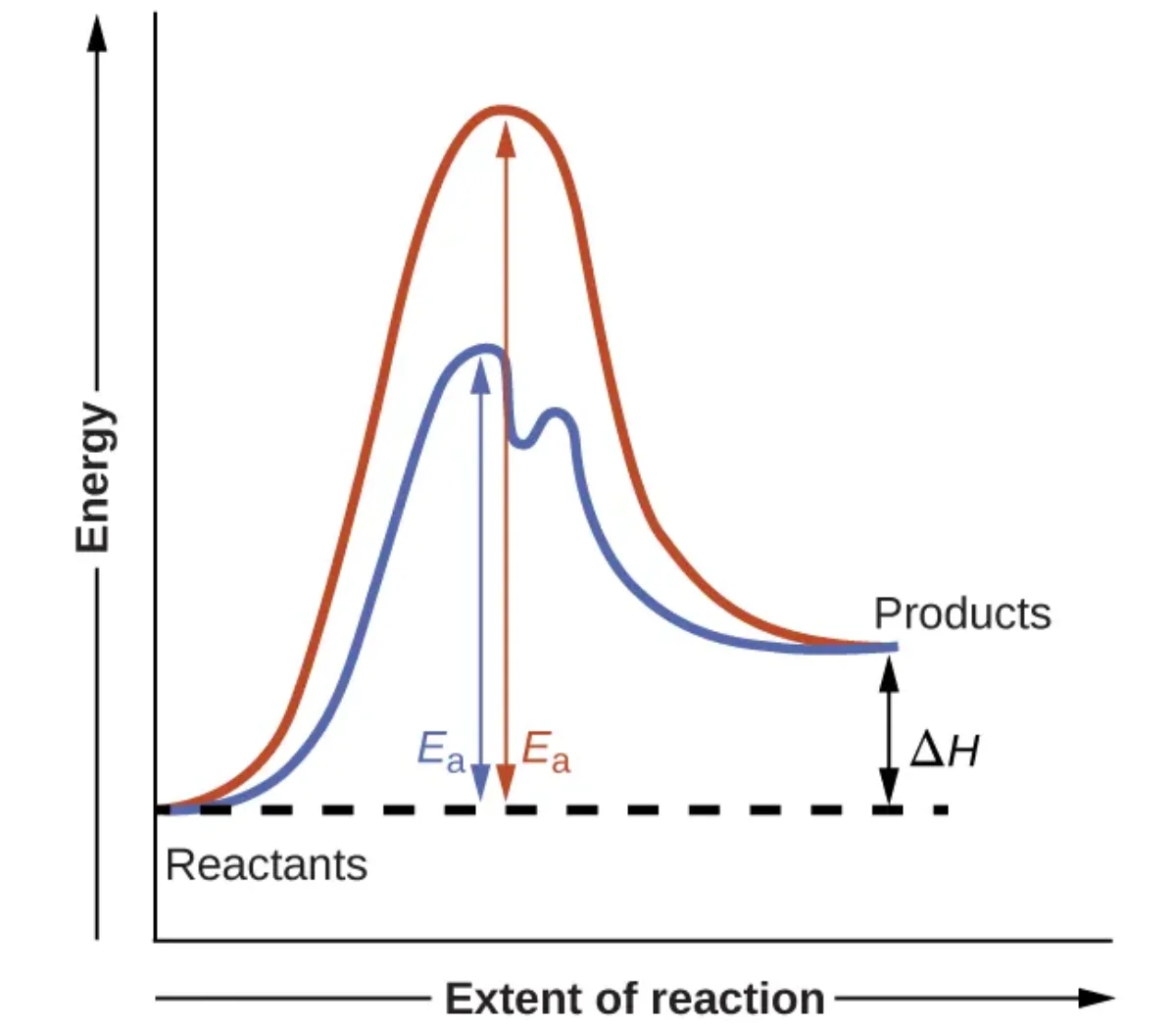
Catalysts lower the activation energy (Ea) of a reaction. They do this by providing an alternative reaction pathway - a different mechanism with a lower energy barrier.
What catalysts DO:
Lower Ea for both the forward AND reverse reactions (by the same amount)
Increase the rate constant k (because k depends on Ea through the Arrhenius equation)
Speed up the approach to equilibrium
Interact with reactants (through adsorption or intermediate formation), then are regenerated
What catalysts DO NOT do:
Change ΔG or ΔH of the reaction
Change the equilibrium position (Keq is unchanged)
Change the concentrations of reactants or products at equilibrium
Get consumed in the overall reaction
Types of Catalysts
Homogeneous Catalysis
In homogeneous catalysis, the catalyst is in the same phase as the reactants. For example, an acid catalyst dissolved in an aqueous solution with aqueous reactants.
Example: The decomposition of hydrogen peroxide (H₂O₂) is catalyzed by iodide ions (I⁻) in aqueous solution. Both the catalyst and reactant are dissolved in water.
Heterogeneous Catalysis
In heterogeneous catalysis, the catalyst is in a different phase from the reactants. The most common example is a solid catalyst with gaseous or liquid reactants.
Example: A catalytic converter in a car uses solid platinum and palladium metals to catalyze the conversion of toxic exhaust gases (CO, NO) into less harmful products (CO₂, N₂). The solid metal surface provides sites where gas molecules can adsorb, react, and then desorb as products.
Heterogeneous catalysts work through adsorption - reactant molecules bind to the surface of the catalyst, which weakens their bonds and brings them into close proximity, making it easier for them to react.
Enzymatic Catalysis
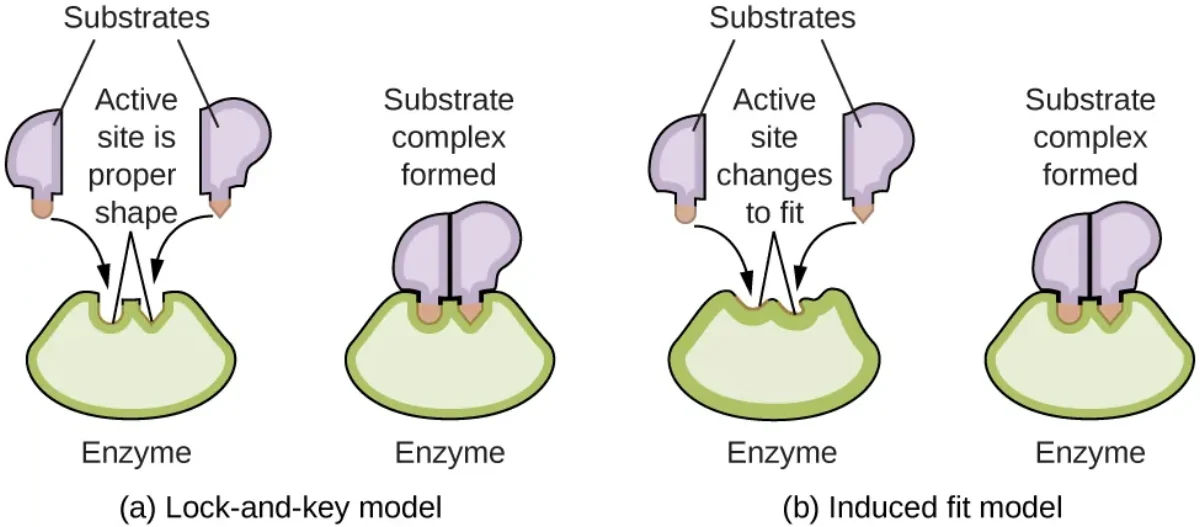
Enzymes are biological catalysts - proteins that catalyze specific reactions in living organisms. They are extraordinarily efficient, often increasing reaction rates by factors of 106 to 1012 compared to the uncatalyzed reaction.
Key enzyme concepts for kinetics:
Enzymes lower Ea by stabilizing the transition state
At saturation (all active sites occupied), enzyme-catalyzed reactions become zero-order with respect to substrate
Enzymes do not change ΔG - they only speed up reactions that are already thermodynamically favorable
Two models of enzyme-substrate binding. (a) Lock-and-key model: the substrate fits the active site exactly. (b) Induced fit model: the enzyme's active site changes shape upon substrate binding. The induced fit model is more accurate for most enzymes. Credit: OpenStax Chemistry 2e, CC BY 4.0
Catalyst Effect on Reaction Coordinate Diagrams
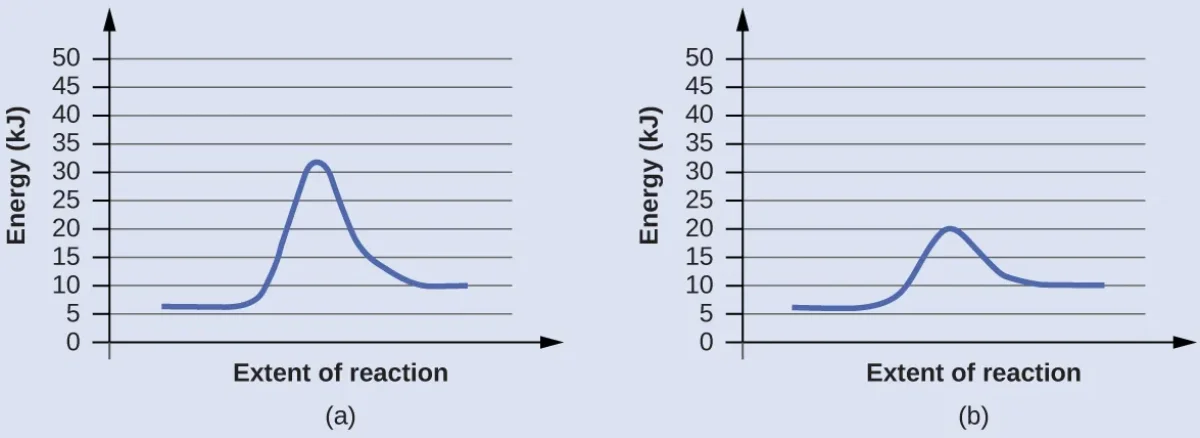
Comparison of catalyzed (blue) and uncatalyzed (red) reaction pathways. The catalyst provides an alternative pathway with lower activation energy (Ea) but does not change ΔH. Notice the catalyzed pathway may involve multiple steps (two peaks with an intermediate valley). Credit: OpenStax Chemistry 2e, CC BY 4.0(a) Uncatalyzed reaction with Ea of approximately 30 kJ. (b) The same reaction with a catalyst lowers Ea to approximately 20 kJ. The reactant and product energy levels are unchanged - only the barrier height decreases. Credit: OpenStax Chemistry 2e, CC BY 4.0
On a reaction coordinate diagram, adding a catalyst creates a new curve that:
Starts at the same energy level (same reactants)
Ends at the same energy level (same products)
Has a lower peak (reduced activation energy)
May have a different shape (different mechanism, possibly more steps)
The ΔG remains identical. Only the barrier height changes.
A catalyst is added to a reaction at equilibrium. What happens to the equilibrium concentrations?
Click to reveal answer
Nothing - the equilibrium concentrations do not change. A catalyst speeds up both the forward and reverse reactions equally, so Keq is unchanged. If the system is already at equilibrium, adding a catalyst has no effect on concentrations. It only matters if the system has not yet reached equilibrium (it gets there faster).
What is the difference between a homogeneous and heterogeneous catalyst?
Click to reveal answer
Phase. A homogeneous catalyst is in the same phase as the reactants (e.g., acid catalyst dissolved in aqueous solution). A heterogeneous catalyst is in a different phase (e.g., solid metal catalyzing a gas-phase reaction). Heterogeneous catalysts typically work through surface adsorption.