How much of a substance dissolves depends on more than just “like dissolves like.” Two physical conditions dramatically affect solubility: temperature and pressure. Understanding these factors is essential for interpreting solubility curves and predicting when gases come out of solution - both high-yield MCAT topics.
Effect of Temperature on Solid Solubility
For most solid solutes, solubility increases as temperature increases. Heating provides energy to break apart the crystal lattice, allowing more solute to dissolve.
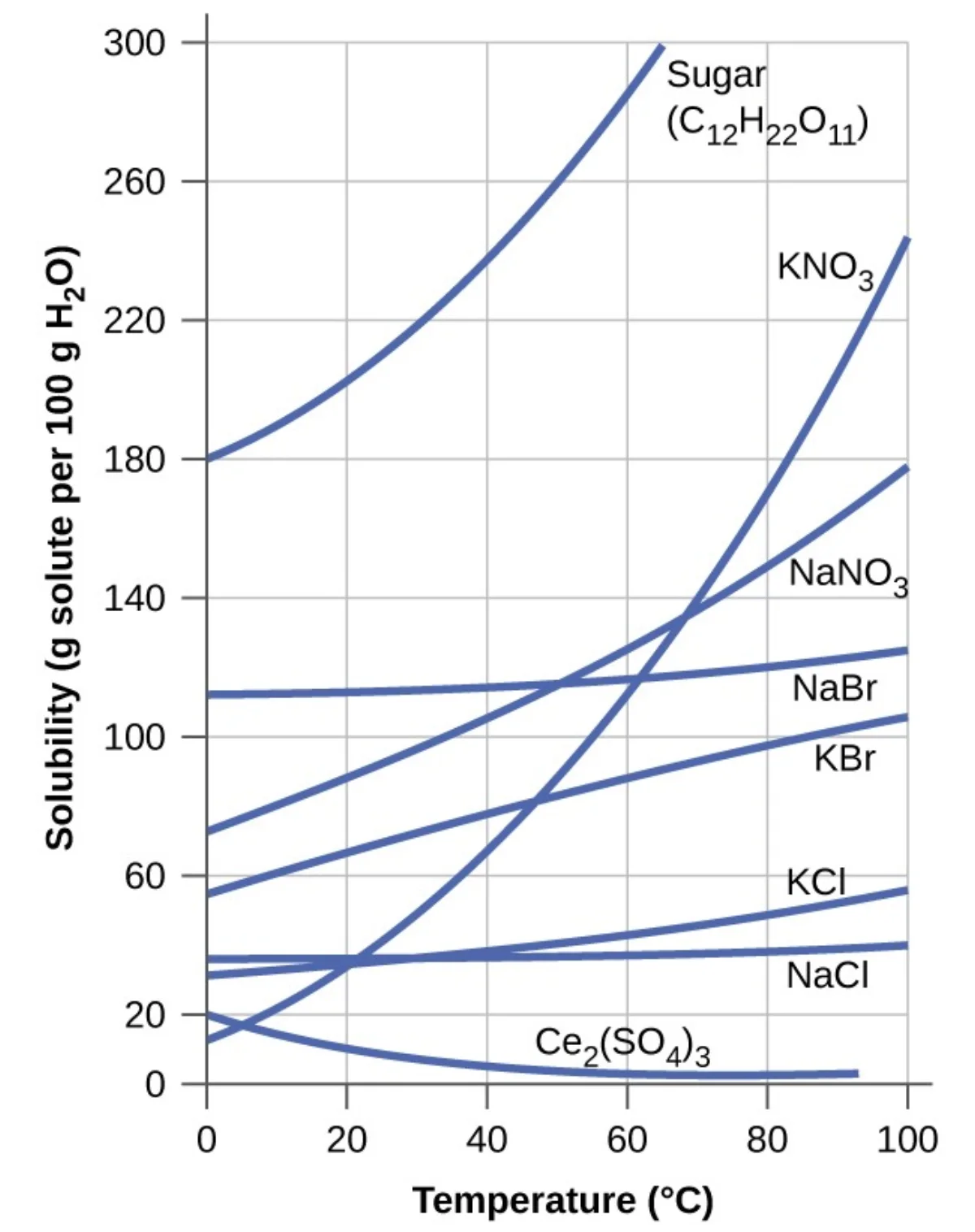
But there are exceptions. A few compounds, like Ce₂(SO₄)₃ and CaSO₄, have solubility that decreases with increasing temperature. Their dissolution is exothermic, so by Le Chatelier’s principle, adding heat (increasing temperature) shifts the equilibrium toward the undissolved solid.
The key to remembering which direction:
Endothermic dissolution (most solids): heat is a “reactant,” so adding heat shifts equilibrium toward more dissolving. Solubility increases with T.
Exothermic dissolution (some solids): heat is a “product,” so adding heat shifts equilibrium toward less dissolving. Solubility decreases with T.
Solubility Curves
A solubility curve plots the maximum amount of solute (in grams per 100 g water) that dissolves at each temperature. These graphs are MCAT favorites.
How to read them:
Points ON the curve represent saturated solutions
Points BELOW the curve represent unsaturated solutions (more could dissolve)
Points ABOVE the curve represent supersaturated solutions (unstable - more dissolved than the limit)
Solubility curves for common ionic compounds. Most solids become more soluble at higher temperatures (KNO₃ increases steeply), but a few like Ce₂(SO₄)₃ decrease. Points on the curve = saturated, below = unsaturated, above = supersaturated. Credit: OpenStax Chemistry 2e, CC BY 4.0
Effect of Temperature on Gas Solubility
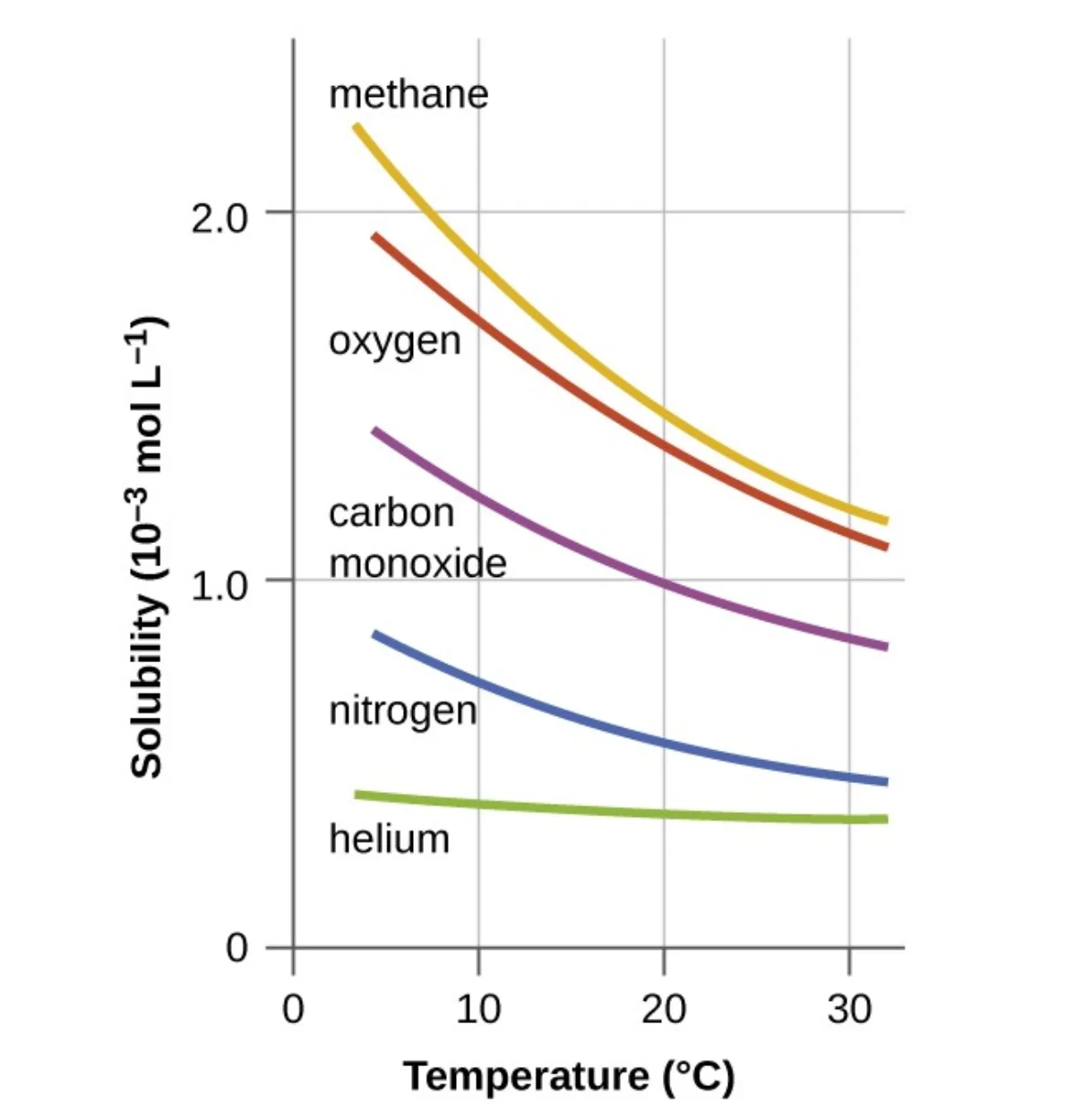
Gases are the opposite of solids: gas solubility decreases as temperature increases.
Think about it physically: gas molecules in solution are trapped by intermolecular forces with the solvent. Heating gives them more kinetic energy, making it easier to escape into the gas phase.
Gas solubility in water decreases as temperature increases - the opposite trend from most solids. This explains why warm lakes have less dissolved oxygen and why hot beverages lose carbonation faster. Credit: OpenStax Chemistry 2e, CC BY 4.0
Effect of Pressure on Gas Solubility - Henry’s Law
Pressure has virtually no effect on the solubility of solids and liquids (they are nearly incompressible). But for gases, pressure has a dramatic, direct effect.
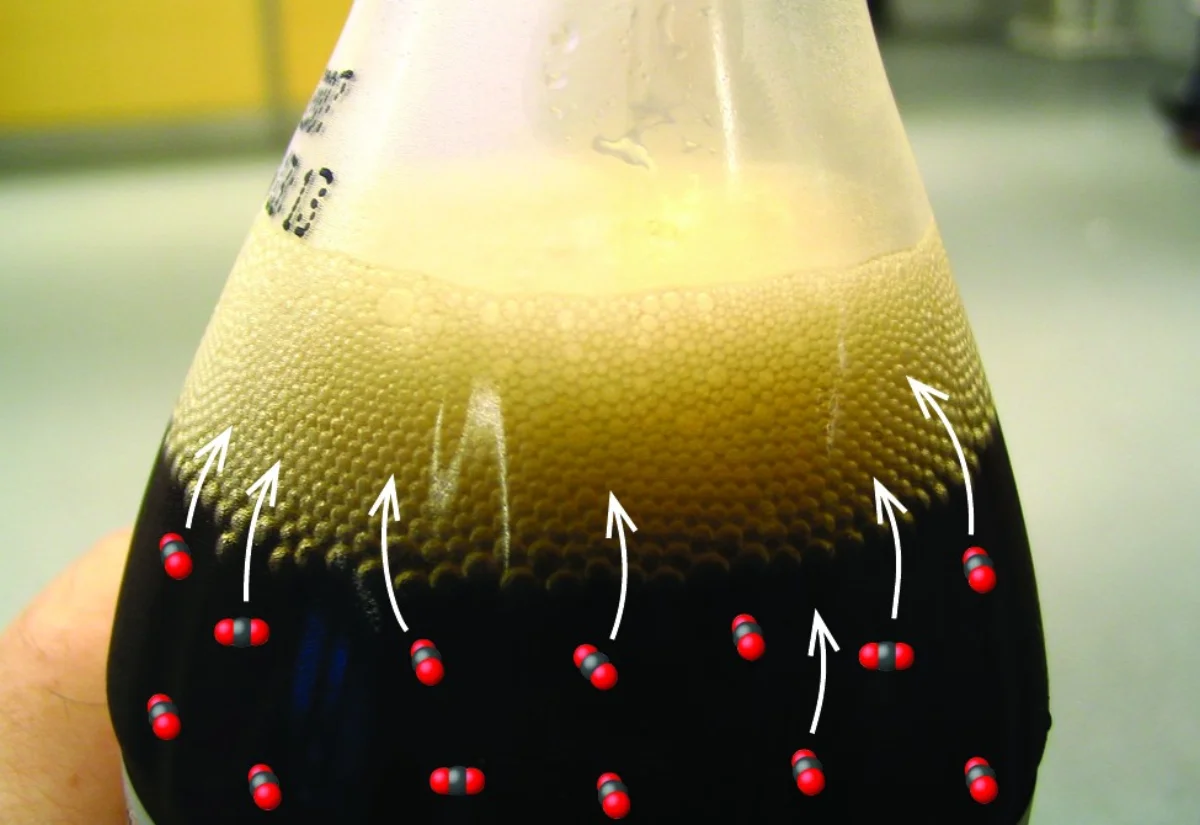
Double the pressure, double the amount of gas that dissolves. Halve the pressure, half the gas stays in solution - the rest escapes as bubbles.
Henry's law in action: CO₂ stays dissolved under high pressure in a sealed bottle. When the cap is removed, pressure drops and CO₂ escapes as bubbles because gas solubility is directly proportional to pressure (C = kH × P). Credit: OpenStax Chemistry 2e, CC BY 4.0
Summary: What Affects Solubility?
Factor
Effect on Solid Solubility
Effect on Gas Solubility
Increase temperature
Usually increases
Decreases
Increase pressure
No significant effect
Increases (Henry’s law)
Increase polarity match
Increases (“like dissolves like”)
Increases
A sealed container of carbonated water is opened at the top of a mountain (lower atmospheric pressure) versus at sea level. Where does the soda lose its fizz faster, and why?
Click to reveal answer
At the top of the mountain. Lower atmospheric pressure means lower partial pressure of CO₂ above the solution. By Henry's law (C = kH × P), lower pressure means lower gas solubility, so more CO₂ escapes from the solution. The soda goes flat faster at altitude.
The solubility of KNO₃ increases sharply with temperature, while the solubility of NaCl barely changes. Which one is more likely to form a supersaturated solution when cooled?
Click to reveal answer
KNO₃. Because its solubility changes dramatically with temperature, you can dissolve a large amount at high temperature and then cool the solution. The steep drop in solubility means the solution becomes supersaturated as it cools. NaCl's solubility barely changes with temperature, so cooling a saturated NaCl solution produces little excess dissolved solute and is unlikely to become supersaturated.