An alcohol is any organic molecule with a hydroxyl group (-OH) bonded to an sp³ carbon. That single structural requirement - sp³ C-OH - is what sets alcohols apart from enols (sp² C-OH) and phenols (aromatic ring C-OH), which have distinct reactivity profiles covered in Sections 5.13 and Chapter 7.
Every reaction in this chapter begins from a simple structural fact: the OH sits on a carbon surrounded by one, two, or three other carbons. Which class the alcohol belongs to changes everything - its acidity, its reactivity in substitution and elimination, and even what products its oxidation gives.
The Three Classifications
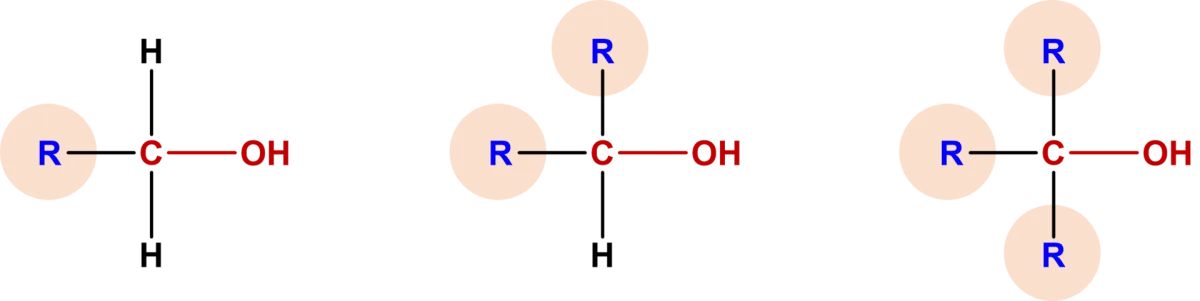
Alcohols are classified by how many carbons are attached to the C-OH carbon:
Primary (1°): one carbon attached to the C-OH carbon (plus the OH and at least one H). Examples: methanol (CH₃OH), ethanol (CH₃CH₂OH), 1-butanol.
Secondary (2°): two carbons attached to the C-OH carbon. Examples: isopropanol ((CH₃)₂CHOH), 2-butanol, cyclohexanol.
Tertiary (3°): three carbons attached to the C-OH carbon. Examples: tert-butanol ((CH₃)₃COH), 2-methyl-2-butanol.
Methanol (CH₃OH) is sometimes called a “zero-degree” alcohol because no carbons are attached to the C-OH carbon. It behaves like a 1° alcohol for most purposes.
Alcohol classification: 1° (one carbon on C-OH), 2° (two carbons), 3° (three carbons). The classification dictates reactivity patterns for SN1/SN2/E1/E2 and oxidation products. Credit: Wikimedia Commons, CC BY-SA
IUPAC Nomenclature of Alcohols
The rules extend what you learned in Chapter 1:
Find the longest carbon chain that INCLUDES the carbon bearing the -OH.
Number the chain to give the OH-bearing carbon the LOWEST possible locant.
Replace the final “-e” of the alkane name with “-ol”.
Add a locant number for the OH position just before “-ol”.
Handle substituents and multiple OH groups as usual (di-ol, tri-ol for multiples).
Examples:
CH₃CH(OH)CH₃: propan-2-ol (or 2-propanol). The OH is on C2 of a 3-carbon chain.
CH₃CH₂CH₂CH(OH)CH₃: pentan-2-ol. 5-carbon chain, OH on C2.
HOCH₂CH₂OH: ethane-1,2-diol (common name: ethylene glycol). Two OH groups, so “diol”.
The OH gets numbering priority over most substituents (halogens, alkyl groups) but is outranked by carboxylic acid, ester, amide, aldehyde, and ketone groups. If an alcohol coexists with a carboxylic acid, the carboxylic acid takes the suffix and the OH becomes “hydroxy-” as a prefix.
Common Names You Should Recognize
A handful of alcohols have common names the MCAT uses:
Common name
IUPAC
Structure
Methanol / wood alcohol
methanol
CH₃OH
Ethanol / grain alcohol
ethanol
CH₃CH₂OH
Isopropanol / rubbing alcohol
propan-2-ol
(CH₃)₂CHOH
tert-Butanol
2-methylpropan-2-ol
(CH₃)₃COH
Ethylene glycol
ethane-1,2-diol
HOCH₂CH₂OH
Glycerol / glycerin
propane-1,2,3-triol
HOCH₂CH(OH)CH₂OH
Glycerol is especially important because its three hydroxyl groups form the backbone of triglycerides and phospholipids in biology.
Functional Group Priority When Naming
When a molecule has multiple functional groups, IUPAC assigns the suffix to the highest-priority group. The order (highest to lowest):
Carboxylic acid (-oic acid)
Ester (-oate)
Amide (-amide)
Nitrile (-nitrile)
Aldehyde (-al)
Ketone (-one)
Alcohol (-ol)
Amine (-amine)
Ether (-oxy- prefix only, never a suffix)
Alkene/alkyne (-ene, -yne)
Alkane (-ane)
So an alcohol and a ketone together gives “-one” as the suffix, and the OH becomes “hydroxy-”. A molecule with both a carboxylic acid and an alcohol is named as the carboxylic acid with a hydroxy- prefix.
Ethers Are Not Alcohols
An ether (R-O-R’) looks superficially like an alcohol because both have a C-O bond. But ethers have no O-H and therefore do not participate in hydrogen bonding as donors, do not have acidity comparable to alcohols, and do not react in the same ways. Diethyl ether, for example, is relatively inert - a common solvent rather than a reactive substrate.
In nomenclature, ethers are named as alkoxy substituents (methoxy-, ethoxy-) on a larger parent chain. The common name “ethyl methyl ether” is also acceptable.
Glycols and Polyols
Molecules with two or more hydroxyl groups have special names:
Diol: two OH groups. Vicinal diol (1,2-diol) vs. geminal diol (both OH’s on the same carbon - unstable except for a few special cases).
Triol: three OH groups. Glycerol is the most famous example.
Polyol: four or more. Sugar alcohols like sorbitol fall here.
Vicinal diols have a chemistry of their own: they can be cleaved by periodic acid (HIO₄) or lead tetraacetate to give two carbonyls, which is useful in carbohydrate chemistry.
Classify each of the following as 1°, 2°, or 3° alcohol: (a) 2-methyl-2-butanol, (b) 2-pentanol, (c) 1-hexanol, (d) 2-methylcyclohexanol.
Click to reveal answer
(a) 3° - the OH-bearing carbon has three alkyl groups attached. (b) 2° - the OH-bearing carbon has two alkyl groups. (c) 1° - the OH-bearing carbon has one alkyl group. (d) 2° - the OH-bearing carbon is part of the ring (one ring carbon) plus has another ring carbon neighbor, so two carbons attached. Count the carbons directly bonded to the C-OH carbon.
Alcohols have dramatically higher boiling points and much greater water solubility than alkanes of comparable molecular weight. Both facts trace back to a single feature: the O-H group can form hydrogen bonds with its neighbors. Every physical property of alcohols - boiling point, density, solubility, viscosity - follows from this one detail.
Understanding alcohol physical properties also gives you a template for every polar functional group you will meet later. Amines, carboxylic acids, and amides all participate in hydrogen bonding, and their properties scale with the number and strength of H-bonds they form.
Hydrogen Bonding in Alcohols
A hydrogen bond is an electrostatic attraction between a hydrogen atom bonded to a highly electronegative atom (O, N, or F) and a lone pair on a nearby electronegative atom. Each alcohol molecule is both a hydrogen-bond donor (O-H) and an acceptor (lone pairs on O). In pure alcohol, every molecule is hydrogen-bonded to several neighbors at once, forming a dynamic network.
Hydrogen bonds are strong for an intermolecular force (about 5-30 kJ/mol per bond), though they are roughly a tenth the energy of a typical covalent bond. To boil the liquid, enough hydrogen bonds have to break to let molecules escape into the gas phase - which requires a lot of energy.
Boiling Points: Alcohols Beat Alkanes and Ethers
Compare the boiling points of molecules with similar molecular weight:
Compound
MW
Boiling point
IMF
Butane (C₄H₁₀)
58
−0.5°C
London only
Diethyl ether (C₂H₅OC₂H₅)
74
35°C
Dipole-dipole + London
1-Butanol (C₄H₉OH)
74
118°C
H-bond + dipole + London
Water (H₂O)
18
100°C
H-bond (very strong)
Butane has only London forces. Diethyl ether adds dipole-dipole (the C-O bonds are polar) - boiling point jumps by ~35°C. Butanol adds hydrogen bonding - boiling point leaps by another ~80°C. The OH group is the biggest single factor in raising boiling point per unit mass.
Boiling Point Trends Within Alcohols
Three structural features drive alcohol boiling point:
Chain length (MW): longer chain = more London forces = higher boiling point. Ethanol boils at 78°C; hexanol boils at 158°C.
Branching: branched alcohols have lower surface area contact and weaker London forces, so they boil lower than straight-chain isomers. n-Butanol (118°C) beats tert-butanol (82°C).
Number of OH groups: each additional OH adds more hydrogen-bonding capacity. Ethylene glycol (197°C) boils much higher than 1-butanol of similar MW, and glycerol (290°C) higher still.
Water Solubility: The Tail Wags the Dog
Short-chain alcohols (methanol, ethanol, propanol) are miscible with water in all proportions. Longer-chain alcohols become less water-soluble as the hydrophobic carbon chain outweighs the hydrophilic OH:
Alcohol
Water solubility
Methanol (C1)
Miscible (infinite)
Ethanol (C2)
Miscible
1-Propanol (C3)
Miscible
1-Butanol (C4)
80 g/L
1-Pentanol (C5)
25 g/L
1-Hexanol (C6)
6 g/L
1-Octanol (C8)
0.5 g/L
The rule of thumb: one OH group can solvate about 3-4 carbons of hydrophobic tail. Beyond that, the molecule starts to behave more like an alkane and less like an alcohol.
This trade-off - polar head vs. hydrophobic tail - is the exact same logic behind lipid structure. A long-chain fatty acid is essentially a fatty alcohol with a carboxylic acid head - the fatty acid’s polar end dissolves in water while the long hydrocarbon tail avoids it. That is why cell membranes form lipid bilayers.
Density
Short-chain alcohols are less dense than water (ethanol density ≈ 0.79 g/mL), so pure ethanol floats. Longer-chain alcohols approach 0.83 g/mL. Methanol, ethanol, and isopropanol all form azeotropes with water (constant-boiling mixtures that cannot be separated by simple distillation), which has practical consequences for purification.
Why Ethers Boil Lower Than Alcohols
Ethers (R-O-R’) have the same polar C-O bonds but no O-H bond. They can accept hydrogen bonds (via the oxygen’s lone pairs) but cannot donate them. The result: weaker aggregate intermolecular forces, lower boiling points, and lower solubility in water than similar-MW alcohols.
Diethyl ether (MW 74, b.p. 35°C) vs. 1-butanol (MW 74, b.p. 118°C) illustrates this gap. Ethers are still slightly soluble in water because they can accept H-bonds from water, but they are much less hygroscopic than alcohols.
Acidity Preview
Alcohols are weakly acidic, with pKa typically 16-18 (ethanol ≈ 16, methanol ≈ 15.5). The full acidity story is the subject of Section 5.3. For now, know that the O-H bond is the most acidic position in the molecule, and the conjugate base (alkoxide, RO⁻) is the reactive species in many subsequent reactions.
Rank 1-butanol, 1,4-butanediol, and diethyl ether by boiling point (highest first). All have similar molecular weight. Explain.
Click to reveal answer
1,4-butanediol (two OH groups, b.p. 235°C) > 1-butanol (one OH group, 118°C) > diethyl ether (no O-H, 35°C). Each additional H-bond donor (O-H) roughly doubles the boiling point penalty that must be overcome to vaporize the liquid. Diethyl ether has polar C-O bonds but no H-bond donors, so it boils lowest of the three.
The O-H bond of an alcohol is the most acidic position in the molecule. At pKa roughly 16 to 18, alcohols are about as acidic as water - far too weak to react with ordinary bases like hydroxide, but strong enough to be deprotonated by alkali metals (Na, K) and strong bases (NaH, NaNH₂). The conjugate base, an alkoxide (RO⁻), is the species that does most of the interesting chemistry in this chapter.
Understanding alcohol acidity is important for two reasons: (1) it tells you which base is strong enough to generate an alkoxide, and (2) it sets up the contrast with phenols, which are six pKa units more acidic and have a completely different reactivity profile.
Ethanol vs. Water
Ethanol (pKa 15.9) and water (pKa 15.7) are almost equally acidic. This makes sense: both have an O-H bond, and the conjugate bases (ethoxide and hydroxide) are both oxygen-centered anions. Ethoxide is slightly less stable than hydroxide because the alkyl group of ethanol donates electron density to the alkoxide oxygen via induction, which destabilizes the negative charge.
Larger alkyl groups destabilize the alkoxide more (more inductive donation), so tert-butanol (pKa 18) is less acidic than ethanol, which is less acidic than methanol (pKa 15.5). The trend is methanol > ethanol > isopropanol > tert-butanol in acidity.
Substituent Effects on Alcohol Acidity
Electron-withdrawing groups (EWGs) nearby stabilize the alkoxide by dispersing the negative charge via induction:
Alcohol
pKa
Methanol (CH₃OH)
15.5
2,2,2-Trifluoroethanol (CF₃CH₂OH)
12.5
Hexafluoroisopropanol ((CF₃)₂CHOH)
9.3
Three fluorines on the adjacent carbon lower the pKa by 3 units (a 1000-fold increase in Ka). Six fluorines lower it by another 3 units. This is purely inductive - electron density gets pulled toward the fluorines, away from the alkoxide oxygen, stabilizing the anion.
Electron-donating groups (alkyl groups, for the most part) raise pKa. Fluorinated alcohols like hexafluoroisopropanol are so acidic they approach the pKa of phenols.
Generating Alkoxides
To use an alcohol as a nucleophile or base in a reaction, you often need to deprotonate it to form the alkoxide. Common methods:
Alkali metals (Na, K): dissolve sodium metal in ethanol and you get sodium ethoxide plus H₂ gas. Widely used in lab.
Sodium hydride (NaH): deprotonates almost any alcohol cleanly; byproduct is H₂. Good for all alcohols.
Potassium hydride (KH): even more reactive than NaH, used when NaH is too slow.
Grignard reagents (R-MgX): deprotonate alcohols immediately - which is why you must keep Grignards away from protic solvents.
Hydroxide (NaOH, KOH) is roughly a 50-50 mix with alcohols at equilibrium (pKa of water ≈ pKa of alcohol), so it is not effective for fully deprotonating alcohols to alkoxides. Use NaH, NaK, or Na metal for a clean alkoxide.
Phenols: A Different Animal
Phenol (C₆H₅OH) is about a million times more acidic than ethanol (pKa 10 vs. 16). Same OH group, same oxygen, same alkyl/aryl framework at first glance. So why the huge difference?
Resonance. The phenoxide anion delocalizes the negative charge into the aromatic ring. Three resonance contributors place partial negative charge on the ortho and para positions of the ring. The negative charge is spread across four atoms instead of concentrated on one oxygen, which is much more stable.
Substituents on the phenol ring modulate acidity in predictable ways:
Phenol
pKa
Phenol
10.0
4-nitrophenol (-NO₂ para)
7.2
2,4-dinitrophenol
4.1
2,4,6-trinitrophenol (picric acid)
0.4
4-methylphenol (4-methyl)
10.3
4-methoxyphenol
10.2
Electron-withdrawing groups (especially at ortho/para via resonance stabilization of the anion) dramatically increase acidity. Picric acid is stronger than acetic acid. Electron-donating groups (methyl, methoxy) slightly decrease acidity by destabilizing the anion.
Section 5.13 covers phenols in much more depth.
Practical Consequence: Phenols React with NaOH, Alcohols Do Not
Because phenols are more acidic than water (pKa 10 vs. 15.7), they ARE fully deprotonated by NaOH. This gives a simple experimental test: add NaOH to an unknown compound. If it dissolves (because a soluble sodium salt forms), the compound is probably a phenol or a carboxylic acid. If it does not dissolve, it is probably an alcohol (or a non-polar compound).
Rank by increasing acidity: ethanol, phenol, 4-nitrophenol, tert-butanol, 2,4-dinitrophenol.
Click to reveal answer
Tert-butanol (pKa 18) < ethanol (16) < phenol (10) < 4-nitrophenol (7) < 2,4-dinitrophenol (4). Tert-butanol is least acidic (most alkyl donors destabilize alkoxide). Ethanol is next. Phenols are always more acidic than alcohols because phenoxide has resonance stabilization. Adding electron-withdrawing groups (NO₂) to the phenol makes it much more acidic because the anion gains extra stabilization. Two NO₂ groups make the phenol as acidic as a carboxylic acid.
An alcohol’s -OH is a terrible leaving group (hydroxide has pKa 15.7, so OH⁻ is a strong base that refuses to leave). To get any substitution or elimination chemistry from an alcohol, you usually have to convert the -OH into something that leaves easily. The two most common lab-scale options are mesylates (-OMs) and tosylates (-OTs), both sulfonate esters derived from strong sulfonic acids.
After mesylation or tosylation, the carbon that was once a terrible SN2 substrate becomes an excellent one. The -OMs and -OTs groups rank among the best leaving groups available to an organic chemist, alongside halides and triflates.
The tosyl (p-toluenesulfonyl) group. When attached to an alcohol oxygen, the result is a tosylate (R-OTs), an excellent leaving group in substitution and elimination reactions. Credit: Wikimedia Commons, CC BY-SA
The Conversion
A primary, secondary, or tertiary alcohol can be converted to a tosylate by reacting with tosyl chloride (TsCl) in the presence of a weak base like pyridine or triethylamine:
R-OH + TsCl + base → R-OTs + base-H⁺Cl⁻
The mechanism is straightforward: the alcohol’s oxygen attacks the electrophilic sulfur of tosyl chloride; chloride leaves; the base removes the proton that was on the alcohol’s oxygen. The net result is that the C-O bond of the alcohol is preserved and the H of the OH is replaced by a Ts group.
Mesylation works the same way with mesyl chloride (MsCl) and pyridine. Both reactions are fast, clean, and do not affect stereochemistry at the carbon bearing the OH because the C-O bond is never broken during the installation.
Why Sulfonates Are So Good as Leaving Groups
Sulfonate esters have three oxygens sharing the negative charge after departure, giving extensive resonance stabilization:
Mesylate anion (CH₃SO₃⁻): three equivalent resonance forms, charge spread over three oxygens. pKa of methanesulfonic acid is −2.
Tosylate anion (CH₃C₆H₄SO₃⁻): same resonance stabilization plus inductive effect from the aryl group. pKa of p-toluenesulfonic acid is −3.
Triflate anion (CF₃SO₃⁻): same resonance plus strong inductive effect from three fluorines. That makes triflic acid a superacid, stronger than water can measure, so no pKa is quoted for it next to −2 and −3. It is far and away the strongest of the three.
A critical feature: the C-O bond on the original alcohol’s carbon is NEVER broken during mesylation or tosylation. Only the O-H bond reacts. This means the stereochemistry at the carbon is preserved. If you started with (R)-2-butanol, you get (R)-2-butyl tosylate.
This stereochemical fidelity is why mesylates and tosylates are so useful in synthesis: you can set up a defined stereocenter with an alcohol, convert to the sulfonate, and then carry out a stereospecific SN2 with inversion to get the other configuration. Two steps, one defined stereochemical flip.
The Downstream Reactions
Once you have a mesylate or tosylate, it behaves exactly like an alkyl halide for all SN1/SN2/E1/E2 purposes. The choice of reaction depends on the substrate (1° vs. 2° vs. 3°), the nucleophile/base, and conditions. Two common sequences:
Net result: dehydration of the alcohol via clean E2 mechanism.
Mesylate vs. Tosylate: When to Use Which
Both are excellent leaving groups. Practical differences:
Tosylates are cheaper to make (TsCl is inexpensive) and give crystalline intermediates, which makes them easy to purify.
Mesylates are smaller and less bulky, which can matter if you are working with a sterically congested substrate.
Tosylates are more stable (can be stored for weeks); mesylates are somewhat more reactive.
On the MCAT, either abbreviation (OMs or OTs) signals “excellent leaving group” - you rarely need to distinguish them beyond that.
Alternatives: PBr₃, SOCl₂, HX
Sometimes you want to convert the alcohol all the way to a halide rather than a sulfonate. Three common reagents:
PBr₃: R-OH → R-Br via a cyclic mechanism. Good for 1° and 2° alcohols.
SOCl₂: R-OH → R-Cl. Byproducts are HCl and SO₂ gas, which leave easily.
HX (HCl, HBr, HI): R-OH + HX → R-X + H₂O. Good for 3° alcohols (goes through SN1). 1° and 2° can give mixtures or be too slow.
All of these convert the -OH into a halide leaving group, which then behaves like an alkyl halide in subsequent reactions. The sulfonate route is preferred when preserving stereochemistry; the halide route is preferred when cost or accessibility matters.
A chemist has (S)-2-pentanol and wants to convert it to (R)-2-cyanopentane in two steps. Design the synthesis.
Click to reveal answer
Step 1: treat with TsCl and pyridine to form (S)-2-pentyl tosylate (stereochemistry preserved because C-O bond is not broken). Step 2: treat with NaCN in DMSO (polar aprotic) to run SN2 - cyanide attacks backside, giving (R)-2-cyanopentane with inversion of configuration. Net result: (S) alcohol → (R) nitrile. The tosylate step preserves stereochemistry; the SN2 step inverts it. Two clean steps with no mixture.
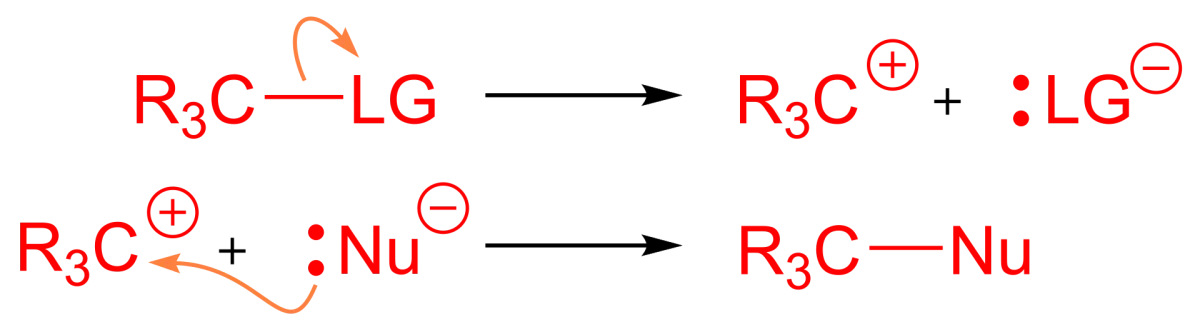
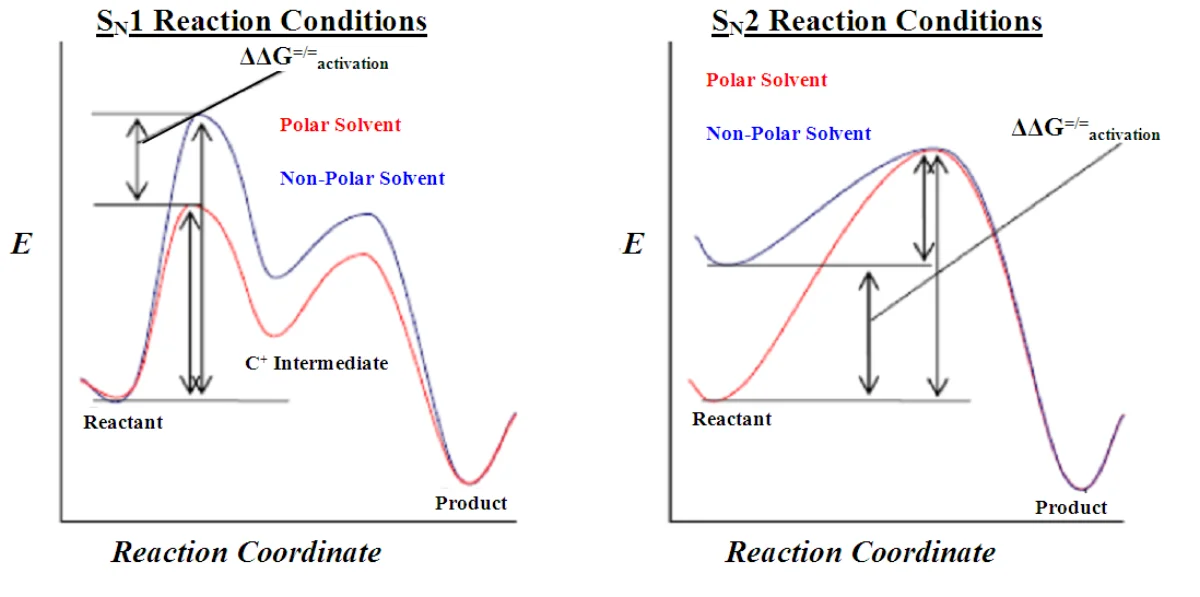
The SN1 reaction is a substitution where the rate depends on only ONE substrate concentration - hence the name (substitution, nucleophilic, unimolecular). The mechanism has two steps: first the leaving group departs to form a carbocation, then the nucleophile attacks. Because the cation intermediate is planar and can be attacked from either face, SN1 reactions cause racemization at the reacting carbon.
SN1 is the mechanism of choice for tertiary substrates under mild conditions with weak nucleophiles. It appears constantly in MCAT mechanism questions involving alcohols, alkyl halides, and alcohol-derived reactions like Fischer esterification (indirectly).
SN1 mechanism: Step 1 - leaving group departs to form a planar carbocation. Step 2 - nucleophile attacks the carbocation from either face. Credit: Wikimedia Commons, CC BY-SA
The Two-Step Mechanism
Step 1 (rate-limiting): ionization. The C-LG bond breaks heterolytically; the leaving group walks off with both bond electrons, leaving a carbocation behind. This step is slow because it requires overcoming the C-LG bond energy without any help from a nucleophile.
Arrows: one curved arrow from the C-LG bond to the leaving group.
Step 2 (fast): nucleophile attack. The carbocation (planar, sp²) is attacked by a nucleophile. Because the cation is planar, the nucleophile can approach from either face with roughly equal probability.
Arrows: one curved arrow from the nucleophile’s lone pair to the cationic carbon.
If the nucleophile is a neutral species (water, alcohol), a third step follows: deprotonation of the new O-H bond by any nearby base.
Rate Law: First Order
The rate law for SN1 is:
Rate = k [substrate]
The rate is INDEPENDENT of nucleophile concentration because the nucleophile is not involved in the rate-limiting step. Doubling nucleophile concentration does nothing to the rate. This is the kinetic signature of SN1 and an easy way to distinguish it from SN2 (which is second order).
Substrate Preference: 3° Dominates
Since the rate-limiting step is carbocation formation, SN1 depends strongly on carbocation stability. The trend is inverse to SN2:
3° >> 2° > 1° > methyl (SN1 essentially never happens for 1° or methyl)
3° substrate: forms a stable tertiary carbocation. SN1 is the preferred mechanism.
2° substrate: borderline. May be SN1 or SN2 depending on conditions; typically mixtures.
1° and methyl substrates: carbocation too unstable to form. SN1 does not happen; only SN2.
Resonance-stabilized substrates (allyl, benzyl) can do SN1 even at the primary level because the cation is stabilized by the adjacent pi system. Allyl bromide (CH₂=CH-CH₂-Br) does SN1 readily despite being a primary carbon.
Stereochemistry: Racemization
Because the carbocation intermediate is planar, the nucleophile can attack from either face. For a chiral substrate, the product is a roughly 50:50 mixture of R and S - a racemate.
In practice, perfect racemization is rare. Often there is a slight preference for attack from the face opposite to the departed leaving group (which is still partially shielding the other face just after ionization). This gives a slightly higher proportion of inverted product. The deviation from perfect racemization is called “partial racemization” or “preference for inversion.”
On the MCAT, “SN1 gives racemization” is the default expectation. If the product is not racemic, the mechanism might not be pure SN1.
Solvent Effects: Polar Protic Solvents Help
SN1 needs to stabilize the ionic intermediate (both the carbocation and the departed anion). Polar protic solvents (water, alcohols, carboxylic acids) do this via hydrogen bonding and dipole-dipole interactions. They dramatically speed up SN1 compared to nonpolar solvents.
Polar aprotic solvents (DMSO, DMF) can also stabilize cations via their oxygen lone pairs, but they do not stabilize anions as well (no H-bond donor). So SN1 is faster in protic solvents; SN2 prefers polar aprotic solvents.
Carbocation Rearrangements
Because the carbocation intermediate is a real, discrete species with a microsecond lifetime, it has time to rearrange if a more stable cation is accessible. Hydride shifts and methyl shifts are common.
Example: 3-chloro-2,2-dimethylbutane under SN1 conditions first ionizes to a 2° cation on C3, then immediately rearranges via a methyl shift from the adjacent quaternary C2, producing a 3° cation on C2 (and moving the methyl onto C3). The nucleophile then attacks the rearranged cation, not the original.
If the MCAT asks where the product ends up, always check for rearrangement when the initial cation is less than 3° and a shift is possible.
3° alcohol + HCl → 3° alkyl chloride + H₂O. The acid protonates the alcohol, then SN1 ionization and chloride attack.
Benzyl chloride + methanol → benzyl methyl ether. Benzyl cation is stabilized by resonance, so SN1 is fast even in a primary substrate.
Solvolysis reactions (the solvent itself is the nucleophile) are often SN1 because they use polar protic solvents and any substrate that can form a stable cation.
Predict the major product and its stereochemistry when (R)-3-chloro-3-methylhexane is dissolved in aqueous methanol (a polar protic solvent).
Click to reveal answer
The product is a roughly 50:50 mixture of (R)- and (S)-3-methoxy-3-methylhexane (and some 3-hydroxy-3-methylhexane from water as competing nucleophile). The substrate is 3°, so it ionizes to a planar cation under SN1 conditions. Methanol attacks from either face, giving racemization. Water is a competing nucleophile in the solvent mix. The starting chirality is LOST - SN1 of a chiral tertiary substrate always gives racemic products.
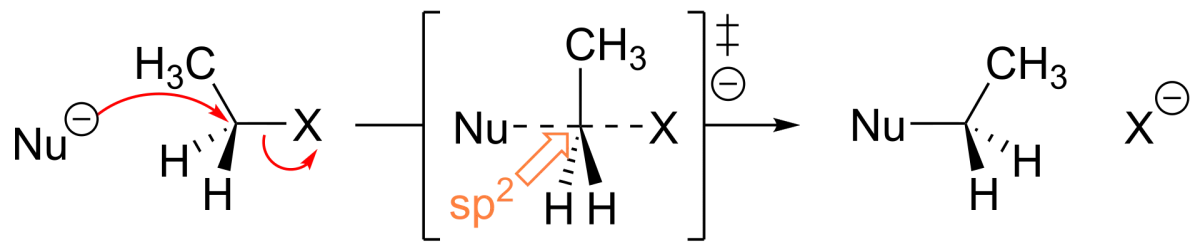
The SN2 reaction is a substitution where the nucleophile attacks the electrophilic carbon at the same moment the leaving group departs - both events in a single concerted step. No intermediate. The rate depends on both substrate AND nucleophile concentration, hence “2” for bimolecular. And because the nucleophile attacks from the side opposite the leaving group, SN2 always produces inversion of configuration at the reacting carbon.
Play the animation below to watch a Walden inversion unfold. Start with methyl bromide + hydroxide and scrub through the backside approach, the trigonal-bipyramidal transition state, and the umbrella flip. Switch the substrate to tert-butyl and the simulation shows the reaction being sterically blocked — this is why SN2 fails for 3° substrates.
SN2 Walden inversion
Interactive
SN2 is the mechanism of choice for methyl and primary substrates with strong nucleophiles in polar aprotic solvents. It is the fastest and cleanest substitution reaction available - no rearrangements, predictable stereochemistry, simple kinetics.
SN2 mechanism: nucleophile attacks from the backside while leaving group departs, in a single concerted step. The carbon inverts like an umbrella in a windstorm. Credit: Wikimedia Commons, CC BY-SA
The Concerted Mechanism
SN2 is ONE step. The transition state looks like:
Nucleophile coming in from behind, partial bond forming to the carbon.
Leaving group departing out the front, partial bond breaking.
All three happen simultaneously. After the transition state, the carbon has inverted like an umbrella in a windstorm: what was “up” is now “down,” and the nucleophile is on the opposite side from where the leaving group used to be.
Arrows: two arrows drawn together:
Nucleophile lone pair → carbon (forming new bond).
C-LG bond → LG (bond breaking).
Rate Law: Second Order
The rate law for SN2 is:
Rate = k [substrate][nucleophile]
Doubling either one doubles the rate; doubling both quadruples it. Any experimental observation that nucleophile concentration affects rate is a kinetic fingerprint of SN2 (vs. SN1, which is first order).
Steric hindrance is the rate-limiting factor. As the carbon becomes more substituted, it becomes harder for the nucleophile to approach from behind:
Methyl (CH₃-LG): no steric obstacles. Fastest SN2 substrate.
1° (R-CH₂-LG): one alkyl group offset from the attack path. Still fast.
2° (R₂CH-LG): two alkyl groups create significant hindrance. Much slower.
3° (R₃C-LG): three alkyl groups block the backside approach entirely. SN2 does not occur.
Neopentyl (R-C(CH₃)₃-CH₂-LG): the quaternary beta-carbon blocks backside attack even though the actual reacting carbon is 1°. SN2 is very slow.
Neopentyl-type substrates are a classic trap: despite being primary, they have severe steric hindrance from the adjacent quaternary carbon.
Stereochemistry: Walden Inversion
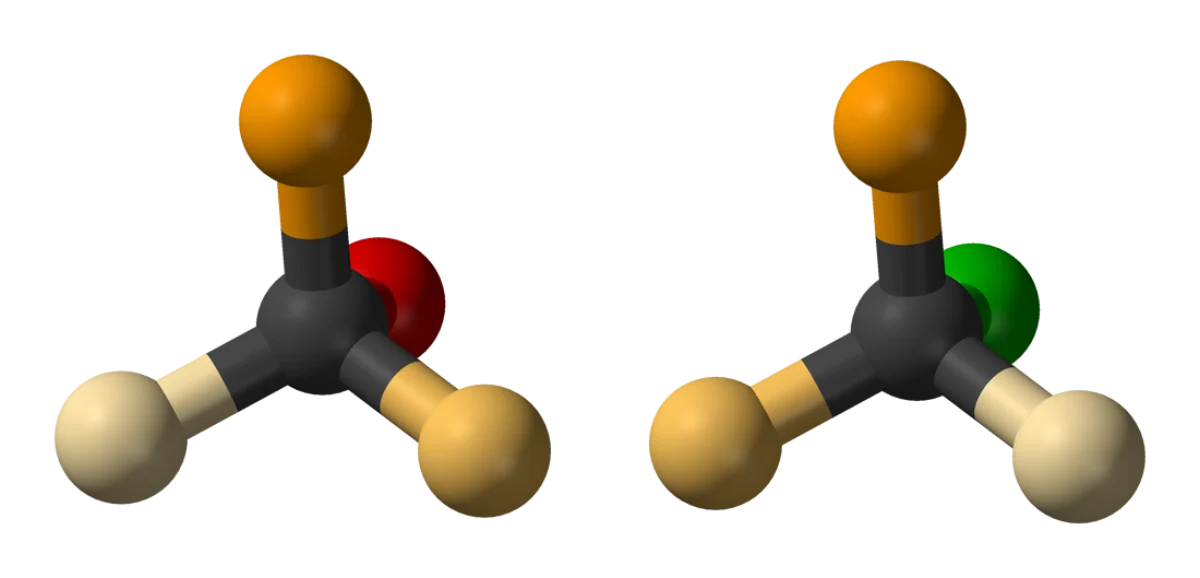
SN2 always produces inversion at the stereocenter - this is called Walden inversion after Paul Walden, who first demonstrated it. If the starting material is (R), the product is (S) (assuming priority does not change, which it can if the leaving group and nucleophile have different priorities).
Important subtlety: inversion describes the spatial relationship at the carbon, not the CIP label. Consider (R)-2-bromobutane reacting with NaOH via SN2. The bromine leaves from one face, the hydroxide enters from the opposite face. The physical geometry inverts. But because -OH has a different CIP priority than -Br, the CIP label of the product happens to still be (R) even though inversion occurred. Always re-assign R/S for the product based on the actual priorities of its substituents.
Walden inversion in SN2 viewed in 3D: the carbon’s three other substituents flip through a flat transition state as the nucleophile attacks from behind and the leaving group exits from the front. The stereochemistry at this carbon inverts completely. Credit: Wikimedia Commons, CC BY-SA
Nucleophile Strength Matters
Because the nucleophile is in the rate law, stronger nucleophiles give faster SN2 reactions. Rankings depend on solvent (see Section 4.4). In polar aprotic solvents like DMSO:
F⁻ > Cl⁻ > Br⁻ > I⁻ (basicity ranks; nucleophilicity tracks basicity when no solvent shell hides the charge)
In polar protic solvents like methanol:
I⁻ > Br⁻ > Cl⁻ > F⁻ (inverted - size and polarizability win when H-bonding solvates small anions)
Strong anionic nucleophiles (RO⁻, HS⁻, N₃⁻, RC≡C⁻, RNHR⁻) are all good SN2 nucleophiles. Neutral nucleophiles (alcohols, amines, water) can do SN2 but are slower - useful when you do not want to deprotonate first.
These solvents dissolve salts (via the cation) but leave the anion “naked” - no H-bonding to the nucleophile, so it is free to attack at full strength.
No Rearrangements
Unlike SN1, SN2 has no carbocation intermediate. The reaction goes straight from reactant through transition state to product. No rearrangements. What you start with is what you get (with the nucleophile replacing the leaving group with inversion).
1° tosylate + NaN₃ → 1° azide + NaOTs. Azides are common SN2 products because they are small, nucleophilic, and make clean products.
1° alkyl halide + alkoxide (Williamson ether synthesis) → ether + halide. Standard way to make ethers.
Rank these substrates from fastest to slowest in SN2 with NaI: CH₃Cl, (CH₃)₃CCl, (CH₃)₂CHCl, CH₃CH₂CH₂Cl.
Click to reveal answer
CH₃Cl (methyl) > CH₃CH₂CH₂Cl (1°) > (CH₃)₂CHCl (2°) >> (CH₃)₃CCl (3°, essentially no reaction). SN2 rate decreases with steric hindrance at the reacting carbon. Methyl has no alkyl obstructions. Primary has one alkyl group but on a different carbon, so only modestly slower. Secondary has two alkyls at the attack site - much slower. Tertiary blocks the backside completely - SN2 essentially does not occur.
You now know both SN1 (two-step, carbocation intermediate, racemization, fast for 3°) and SN2 (one-step, backside attack, inversion, fast for methyl/1°). The MCAT’s real question is: given a specific substrate + nucleophile + solvent, which mechanism wins? This section is the decision framework.
Leaving group quality (same for both; good LG is assumed)
Run through these in order and the winner becomes obvious.
Factor 1: Substrate Structure
This is the biggest single factor. Look at the carbon bearing the leaving group:
Methyl or 1°: SN2 only. The carbocation is too unstable for SN1. Even with a weak nucleophile, the reaction will either SN2 slowly or fail.
3° (alkyl): SN1 only. Steric hindrance blocks SN2 completely. Even a strong nucleophile cannot reach the backside.
2° (alkyl): both are possible. Which one wins depends on factors 2-4.
Allyl or benzyl: both work. The cation is resonance-stabilized (SN1 is fast), AND the backside is often accessible (SN2 also fast). Typically SN2 dominates with strong nucleophiles; SN1 dominates with weak nucleophiles.
Weak nucleophile (H₂O, ROH, RCOOH): favors SN1. Weak nucleophiles still work in SN1 because they do not need to do the rate-limiting step; they just have to attack whatever cation forms.
A very strong nucleophile on a 2° substrate almost always drives SN2. A weak nucleophile on a 2° substrate drives SN1.
Factor 3: Solvent Type
Polar aprotic (DMSO, DMF, acetone, acetonitrile): favors SN2. Leaves the nucleophile anion unsolvated and reactive.
Polar protic (water, methanol, ethanol, acetic acid): favors SN1. Stabilizes the ionic intermediate (both cation and anion) through H-bonding.
If a question specifies DMSO, expect SN2. If it specifies H₂O or MeOH, expect SN1 (or at least a strong push toward SN1).
Factor 4: Leaving Group Quality
A good leaving group (I⁻, Br⁻, OTs, OMs) is required for both SN1 and SN2. Bad leaving groups (OH⁻, RO⁻, NH₂⁻) do not allow either mechanism without activation (e.g., protonation or conversion to a tosylate).
Leaving group does not distinguish SN1 from SN2 - both want good leaving groups. This factor mainly tells you whether a reaction can happen at all.
SN1 vs. SN2 side-by-side comparison: SN2 is concerted with inversion of configuration and depends on [Nu]; SN1 goes through a planar carbocation intermediate, gives racemization, and depends only on [substrate]. Credit: Wikimedia Commons, CC BY-SA
The Decision Table
Substrate
Nucleophile
Solvent
Likely mechanism
Methyl
any
any
SN2
1°
strong
polar aprotic
SN2
1°
weak
polar protic
Very slow (no SN1 possible; SN2 slow without strong Nu)
2°
strong
polar aprotic
SN2
2°
weak
polar protic
SN1
2°
strong
polar protic
Mixed - typically SN2 wins
3°
strong
any
Usually E2 (elimination) - not substitution. See Section 5.9.
3°
weak
polar protic
SN1 (+ some E1)
Allyl/benzyl
any
any
Both possible; depends on conditions
Stereochemistry as a Diagnostic
If the MCAT asks about stereochemistry:
Inversion at the chiral center → SN2 (Walden inversion).
Racemization → SN1 (planar cation attacked from either face).
Retention (rare in simple cases) → often indicates neighboring group participation or a double-inversion mechanism.
Verdict: mixed, but SN2 typically wins because nucleophile strength usually dominates for 2° substrates. Some SN1 product (racemic) may appear alongside (inverted) SN2 product.
Example 4: Methyl iodide + AgNO₃ in water.
Substrate: methyl (SN2 only possible).
Nucleophile: NO₃⁻ is weak; H₂O is slightly stronger.
Silver ion: precipitates the iodide, pulling the reaction forward and generating a cation-like transition state.
Verdict: SN2, even though silver can promote some cation-like character. Product: methanol (and silver iodide precipitate).
Temperature Effect
Higher temperature generally favors elimination over substitution. Within substitution only, the SN1-vs-SN2 ratio does not shift dramatically with temperature since both are usually accessible in the relevant range. But heat PROMOTES E1 over SN1 (and E2 over SN2), covered in Sections 5.8 through 5.10.
A chemist reacts (R)-2-iodobutane with sodium ethoxide (NaOEt) in DMSO. Predict the major product and its stereochemistry, then explain why.
Click to reveal answer
The major product is (S)-2-ethoxybutane (some E2 alkene may also form). Mechanism: SN2. Substrate is 2° (could go either way). Nucleophile (EtO⁻) is strong. Solvent (DMSO) is polar aprotic. Both conditions favor SN2, so SN2 dominates. Backside attack gives inversion: (R) starting material → (S) product. Some E2 product (alkene) forms as a side reaction because ethoxide is also basic and can abstract a beta-proton; but substitution dominates here because ethoxide is not bulky.
E1 is an elimination reaction - one where a hydrogen AND a leaving group depart from adjacent carbons to form a new pi bond (an alkene). Like SN1, E1 proceeds through a carbocation intermediate. The two mechanisms share the same first step. The only difference is what happens second: in SN1, a nucleophile attacks the carbon; in E1, a base plucks a hydrogen from the adjacent carbon and the resulting electrons form the C=C pi bond.
Because SN1 and E1 share a rate-limiting step, they often happen together. Any 3° substrate under polar protic conditions will give a mix of SN1 and E1 products. The balance depends on temperature and how aggressive the nucleophile-vs-base character is.
The Two-Step Mechanism
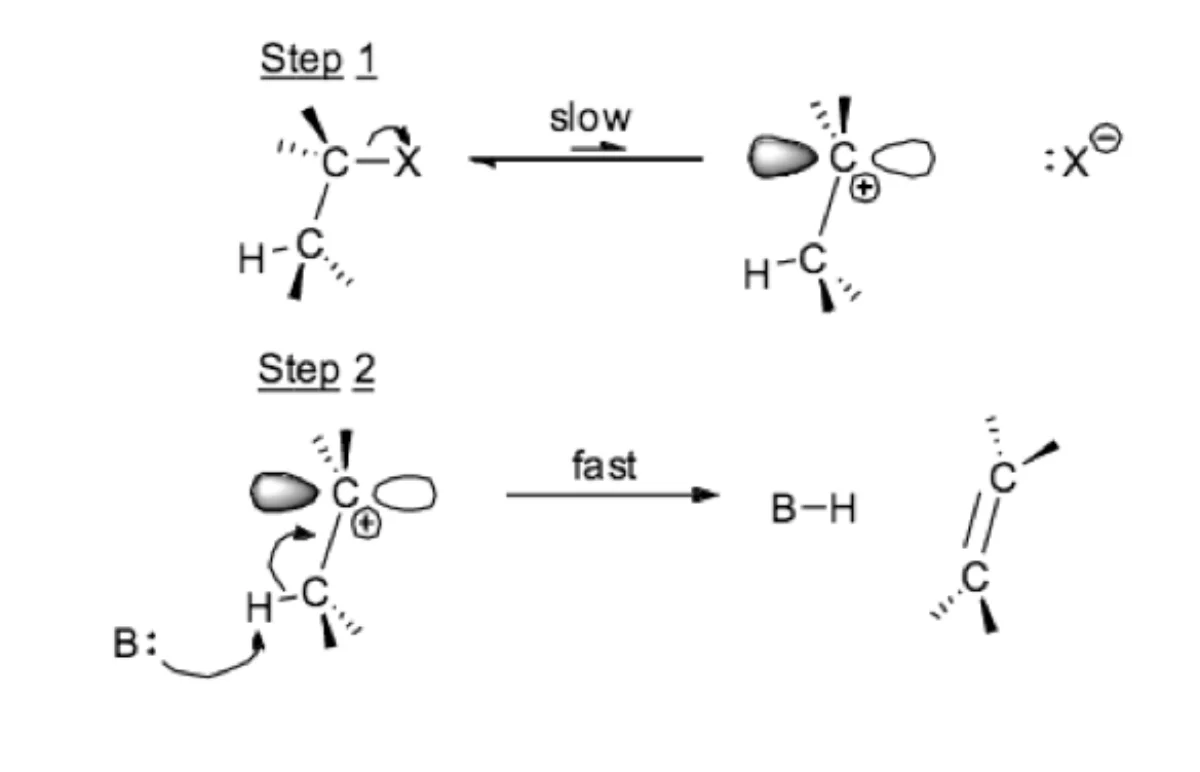
Step 1 (rate-limiting): ionization. Identical to SN1. The leaving group departs with both bond electrons, forming a carbocation. Slow step.
Step 2 (fast): proton loss. A base abstracts a hydrogen from a carbon adjacent to the carbocation (a “beta-hydrogen”). The electrons that were in the C-H bond flow into the C-C bond, forming the new pi bond.
Arrows for step 2: base’s lone pair attacks the beta-H (one arrow); the C-H bond electrons flow to the adjacent carbon to form the pi bond (a second arrow).
Overall result: the substrate loses an H from one beta-carbon and loses the LG from the central carbon, producing an alkene.
E1 mechanism: two steps via a carbocation intermediate. Step 1 - leaving group departs (rate-limiting). Step 2 - base removes a beta-hydrogen and the C=C forms. Credit: Wikimedia Commons, CC BY-SA
Rate Law: First Order
Rate = k [substrate]
Like SN1, the rate depends only on substrate concentration - the base is not in the rate law because it is not involved in the rate-limiting step. A mild base (water, alcohol, carboxylate) works fine. A strong base would probably push the mechanism toward E2 instead.
Substrate Preference: 3° > 2° >> 1°
Same as SN1: the carbocation must form. Tertiary substrates favor E1 most. Primary substrates essentially do not do E1 (the cation is too unstable).
Zaitsev’s Rule: The More Substituted Alkene Wins
When there are multiple possible beta-hydrogens, E1 gives the MORE SUBSTITUTED alkene as the major product. This is Zaitsev’s rule (sometimes spelled Saytzeff).
Example: 2-bromo-2-methylbutane under E1 conditions can lose H from either:
The methyl group adjacent to the central cation, giving 2-methyl-1-butene (monosubstituted alkene).
The methylene group further down, giving 2-methyl-2-butene (trisubstituted alkene).
Zaitsev predicts the trisubstituted alkene (2-methyl-2-butene) as the major product because it is the more stable alkene. More alkyl substituents on the C=C = more hyperconjugation = more stable.
Zaitsev's rule: when elimination has multiple options, the more substituted alkene is preferred because it is more stable. Credit: Wikimedia Commons, CC BY-SA
Why Zaitsev Works for E1
E1 has a late transition state in the proton-loss step - the pi bond is mostly formed at the TS. The energy of the forming alkene dominates the TS energy, so the more stable (more substituted) alkene forms through a lower-energy TS. This is Hammond’s postulate: for an endothermic step (or reaction), product stability controls rate.
Students sometimes assume E1 and E2 both give Zaitsev. E2 also usually gives Zaitsev, but there is an important exception with bulky bases (Hofmann product preferred - see Section 5.9).
Acid-Catalyzed Dehydration of Alcohols
The most common E1 reaction on the MCAT is the dehydration of a tertiary (or secondary) alcohol by concentrated acid:
R-OH + H₂SO₄ → alkene + H₂O
Mechanism:
Acid protonates the OH, converting it to H₂O (good leaving group).
Water leaves to form a carbocation (SLOW, rate-limiting).
Water (or the conjugate base of the acid) plucks a beta-H, forming the alkene.
The usual Zaitsev product dominates. If the initial cation can rearrange to a more stable cation before deprotonation, it will - so rearrangements are a real concern in E1 dehydration.
When E1 Beats SN1
Both SN1 and E1 go through the same cation. What happens next?
If a nucleophile is present and attacks the cation fast → SN1.
If a base grabs a beta-H fast → E1.
Heat shifts the balance toward E1 because elimination has a higher entropy change (one molecule becomes two - alkene + H-base), so the equilibrium and rate of elimination are enhanced at higher temperature.
High temp + weakly nucleophilic solvent (like hot sulfuric acid for alcohol dehydration) → E1 dominates.
E1 with Rearrangements
Just like SN1, E1 passes through a real carbocation that has time to rearrange. If a 2° cation is produced and an adjacent carbon has a hydrogen or alkyl group that could migrate to form a 3° cation, the rearrangement will happen. The alkene product will form from the rearranged cation.
Example: 3-methyl-2-butanol under acidic dehydration. Initial protonation/ionization would give a 2° cation on C2, but a 1,2-hydride shift from C3 produces a 3° cation. Elimination from the 3° cation gives 2-methyl-2-butene (Zaitsev, trisubstituted) as the major product - not the alkene that would have formed from the unrearranged 2° cation.
Stereochemistry: Cis/Trans and E/Z
When E1 generates an alkene with two different substituents on each alkene carbon, geometric isomers (E/Z) are possible. Usually the more stable (trans/E) isomer dominates because the TS for its formation has less steric crowding. But mixtures can occur, especially when the alkyl groups are small.
Predict the major alkene product when 2-methyl-2-butanol is treated with concentrated H₂SO₄ and heat. Use Zaitsev's rule.
Click to reveal answer
2-methyl-2-butene (trisubstituted alkene) is the major product. Mechanism: (1) H₂SO₄ protonates the OH, (2) water leaves to form a 3° carbocation, (3) a beta-H is removed to form the alkene. Two alkene products are possible: 2-methyl-1-butene (disubstituted) or 2-methyl-2-butene (trisubstituted). Zaitsev predicts the more substituted - 2-methyl-2-butene. Since the starting cation is already 3°, no rearrangement occurs.
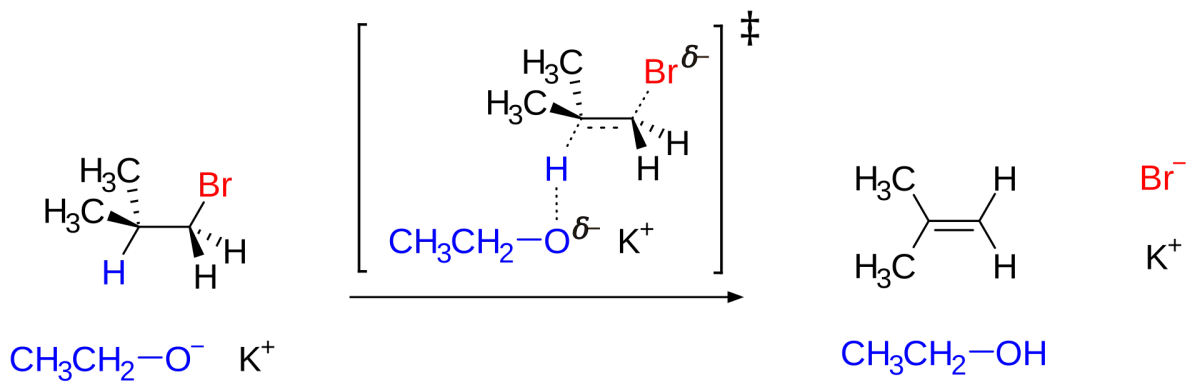
E2 is a concerted elimination reaction - a one-step mechanism where the base removes a beta-proton at the same time the leaving group departs from the adjacent carbon. Because all three events (base attack, C-H bond breaking, LG departure) happen simultaneously, there is a strict geometric requirement: the H and the LG must be anti-periplanar (180° dihedral angle) to each other.
E2 is the mechanism of choice for strong bases on 2° and 3° substrates. Unlike E1, E2 does not require a stable carbocation intermediate - the alkene forms directly from the starting material through a single transition state.
E2 mechanism: concerted removal of beta-H and departure of leaving group in a single step. The H and LG must be anti-periplanar. Credit: Wikimedia Commons, CC BY-SA
The Concerted Mechanism
E2 is ONE step with three arrows:
Arrow 1: base’s lone pair → beta-H (removing the proton).
Arrow 2: C-H bond electrons → C-C bond (forming the new pi bond).
Arrow 3: C-LG bond electrons → LG (breaking the C-LG bond).
All three arrows are drawn together. No intermediate.
Rate Law: Second Order
Rate = k [substrate][base]
Both substrate and base appear in the rate law. This is the kinetic signature of E2 - in contrast to E1 (first order).
The Anti-Periplanar Geometry Requirement
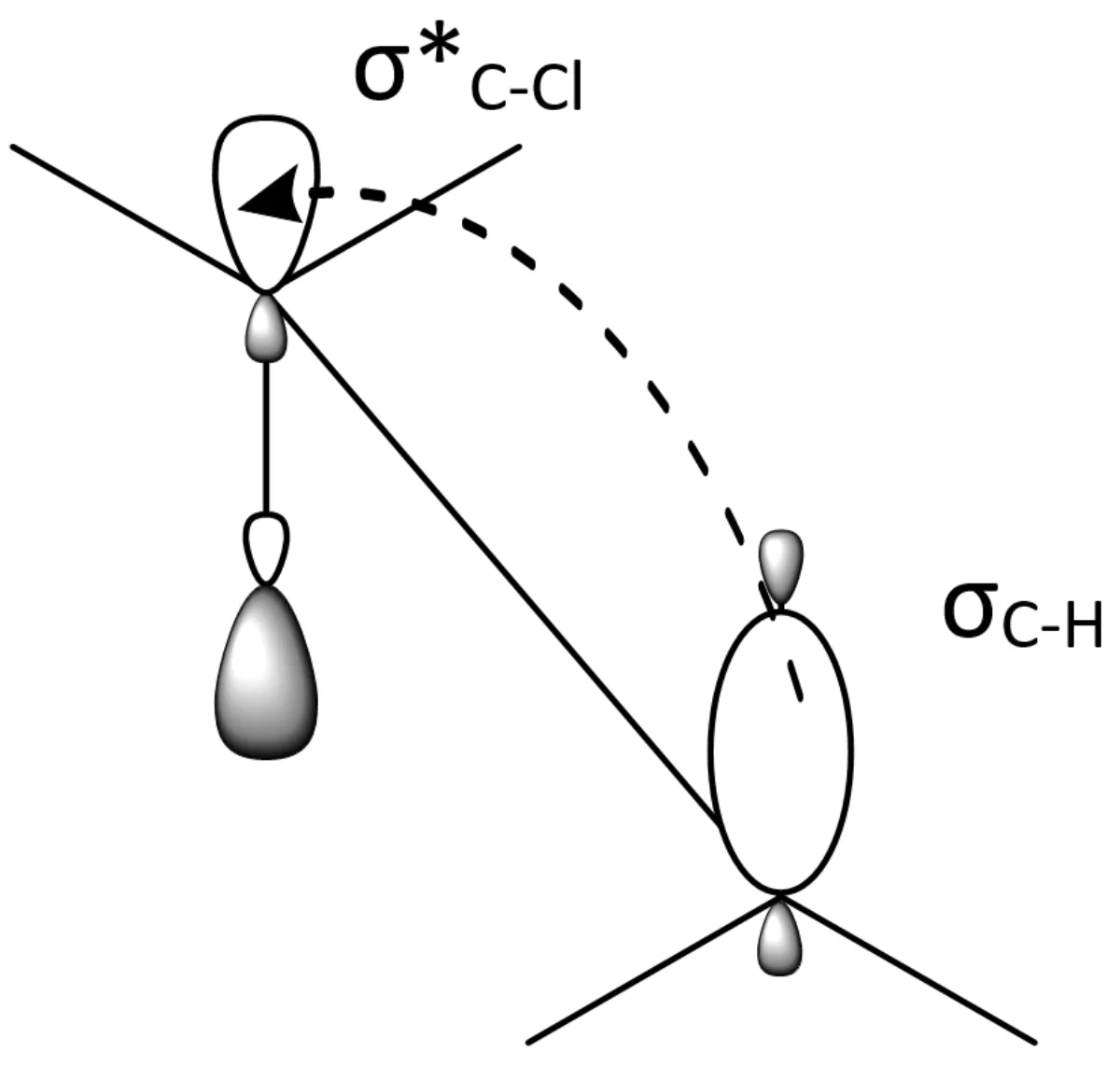
For the C-H bond and the C-LG bond to line up in the transition state so that the electrons can flow smoothly into a pi bond, they need to be on opposite sides of the C-C axis. In Newman projection terms, the H and LG are at 180° dihedral (anti), all four atoms (H, C, C, LG) lying in the same plane.
Why anti-periplanar and not syn-periplanar (0°, eclipsed)?
In the anti arrangement, the sigma orbitals of C-H and C-LG line up with the incipient pi bond’s p orbitals directly. Orbital overlap is excellent.
In the syn (eclipsed) arrangement, the two bonds are stacked on top of each other. Orbital overlap is possible in principle but steric clash of the adjacent groups makes the TS prohibitively high in energy.
Anti-periplanar geometry required for E2: the C-H sigma bond and C-LG sigma* antibonding orbital align at 180°, letting electrons flow directly from the breaking C-H bond into the new pi bond and out to the departing leaving group. Credit: Wikimedia Commons, CC BY-SA
For cyclic substrates, especially cyclohexanes, the anti-periplanar requirement translates into: both the H and the LG must be axial on the chair. If either is equatorial, E2 cannot proceed from that conformation.
Cyclohexane E2: The Chair Flip Matters
Consider cis-1-bromo-2-methylcyclohexane and trans-1-bromo-2-methylcyclohexane under E2 conditions:
cis-1-bromo-4-tert-butylcyclohexane (for clearer analysis): the tert-butyl group is anchored equatorial (always). The bromo group is axial. A beta-H on the adjacent carbon (C2) can be axial and anti-periplanar to the axial Br. E2 proceeds.
trans-1-bromo-4-tert-butylcyclohexane: tert-butyl equatorial, Br is now equatorial. No axial H on C2 can be anti-periplanar to the equatorial Br. To run E2, the ring must first flip to a higher-energy chair where Br is axial, which is energetically unfavorable because tert-butyl would be pushed axial. E2 is very slow.
This is a classic MCAT scenario: predicting E2 rates based on conformational analysis. The trans isomer is “locked” in a conformation where E2 is geometrically impossible.
Zaitsev vs. Hofmann Products in E2
E2 usually gives the Zaitsev product (more substituted alkene), same as E1. BUT when a bulky base is used, the product flips to Hofmann (less substituted alkene).
Why? The bulky base cannot reach the interior beta-Hs where the Zaitsev alkene would form. It can only access the more exposed, less-hindered beta-Hs on the periphery. Those less-hindered Hs are typically on less-substituted carbons - so removing them gives the Hofmann (terminal, less-substituted) alkene.
Common bulky bases:
tert-Butoxide (tBuO⁻): bulky enough to favor Hofmann for mildly hindered substrates.
LDA: very bulky; strongly favors Hofmann. Usually used for enolate chemistry rather than E2, but can do E2 on some substrates.
Normal (non-bulky) bases:
Ethoxide (EtO⁻), methoxide (MeO⁻): give Zaitsev product.
Hydroxide (OH⁻): gives Zaitsev product.
Stereospecificity of E2
E2 is stereospecific: the geometry of the starting material determines the geometry of the alkene product.
Example: (2R,3R)-2-bromo-3-phenylbutane and (2R,3S)-2-bromo-3-phenylbutane under E2 conditions give DIFFERENT alkene products:
(2R,3R) → (E)-alkene (Ph and CH₃ on opposite sides of the C=C)
(2R,3S) → (Z)-alkene (Ph and CH₃ on the same side)
Why? The anti-periplanar requirement forces a specific H-to-LG alignment. Once you fix the starting stereochemistry, the alkene’s geometry is determined by which face the anti-H had to come from.
E1 vs. E2: Key Distinctions
Feature
E1
E2
Steps
2 (cation intermediate)
1 (concerted)
Rate law
k[substrate]
k[substrate][base]
Base
Weak (H₂O, ROH)
Strong (EtO⁻, tBuO⁻, OH⁻, LDA)
Geometry
No requirement
Anti-periplanar H and LG
Substrate
3° > 2° (needs stable cation)
3° > 2° > 1° (no cation needed)
Rearrangements
Yes (cation can shift)
No (concerted)
Regiochemistry
Zaitsev (almost always)
Zaitsev with small bases; Hofmann with bulky bases
Nucleophile or Base? Same Molecule, Different Role
Alkoxides (EtO⁻, MeO⁻) are both nucleophiles and bases. Which role they play depends on the substrate:
On a methyl or 1° substrate → attack carbon (SN2 substitution).
On a 2° or 3° substrate → grab a beta-H (E2 elimination), often in competition with SN2.
Bulky strong bases like tBuO⁻ essentially cannot do SN2 (too hindered), so they only do E2. Non-bulky strong bases can do either depending on substrate.
2-bromo-2-methylbutane is treated with (a) KOEt in ethanol, and separately with (b) KOtBu in t-butanol. Predict the major alkene product in each case.
Click to reveal answer
(a) With KOEt: 2-methyl-2-butene (Zaitsev, trisubstituted). (b) With KOtBu: 2-methyl-1-butene (Hofmann, disubstituted). Ethoxide is small enough to access the interior beta-H that forms the Zaitsev alkene. tert-Butoxide is too bulky to reach that H and can only remove the peripheral methyl H's, giving the less substituted Hofmann alkene. Base size is the deciding factor for E2 regiochemistry.
This section is the single highest-yield MCAT organic chemistry skill in this book. Given any substrate, reagent, and conditions, you can predict the major product via SN1, SN2, E1, or E2 using a four-step flowchart. Get this right and you will handle almost every MCAT substitution/elimination question on test day.
Use the interactive predictor below to stress-test your intuition. Change one variable at a time — substrate, reagent, solvent, or temperature — and watch how the winning mechanism shifts. The rationale line explains why each combination lands where it does.
SN1 / SN2 / E1 / E2 Decision Predictor
Choose a substrate and conditions. The predictor applies the master decision framework
(substrate → reagent → solvent → temperature) to identify the dominant mechanism and
explain why.
Secondary (2°)
→
Strong small Nu
→
Aprotic
→
RT
⇒
SN2
SN2(minor: E2)mixed
2° substrate with a strong non-bulky Nu in polar aprotic solvent: SN2 wins with a minor E2 byproduct. Inversion at the reacting carbon.
Stereochemistry
inversion
Tip: change one variable at a time and watch how the mechanism shifts. Every combination
(252 total) follows an explicit rule.
The Flowchart
Ask these four questions in order. The first yes/no that decides the mechanism gives you the answer.
Step 1: What is the substrate?
Methyl or 1° (unhindered) → only SN2 or E2 possible (cation too unstable for SN1/E1).
3° (or 1° neopentyl-like) → only SN1 or E1 possible (SN2 blocked by steric bulk; 3° carbocation readily forms).
2° → all four mechanisms possible.
Allyl / benzyl → all four possible; both SN1 and SN2 are fast because the cation is stabilized AND the substrate is not hindered.
Step 2: What is the reagent - strong nucleophile, strong base, or both/neither?
Label the nucleophile/base (strong Nu? strong base? bulky base? weak?).
Label the solvent (polar aprotic? polar protic? nonpolar?).
Check the temperature (low? high?).
Use the flowchart. Decide on the mechanism. Draw the product with the appropriate stereochemistry (inversion for SN2, racemization for SN1, Zaitsev or Hofmann for E1/E2).
This routine takes 30-60 seconds once practiced. It answers a huge portion of MCAT organic chemistry in that time.
Predict the major product when (R)-2-chloro-2-methylpentane is treated with (a) NaOH in cold water, and (b) KOtBu in hot t-butanol.
Click to reveal answer
(a) With NaOH cold H₂O: 3° substrate, strong base/moderate nucleophile, polar protic, low T. Substrate is 3° so no SN2; OH is a decent base; cold water favors substitution. Mechanism: SN1. Product: 2-methyl-2-pentanol (racemic, but since the C attached to OH is already 3° and not chiral, no stereo issue). Some minor E1 product may appear.(b) With KOtBu hot tBuOH: 3° substrate, bulky strong base, polar protic, high T. Bulky base rules out SN2 and SN1. High temp favors elimination. Mechanism: E2 with Hofmann regiochemistry. Product: 2-methyl-1-pentene (terminal alkene, the Hofmann product, preferred because tBuO⁻ can only reach the peripheral terminal methyl Hs).
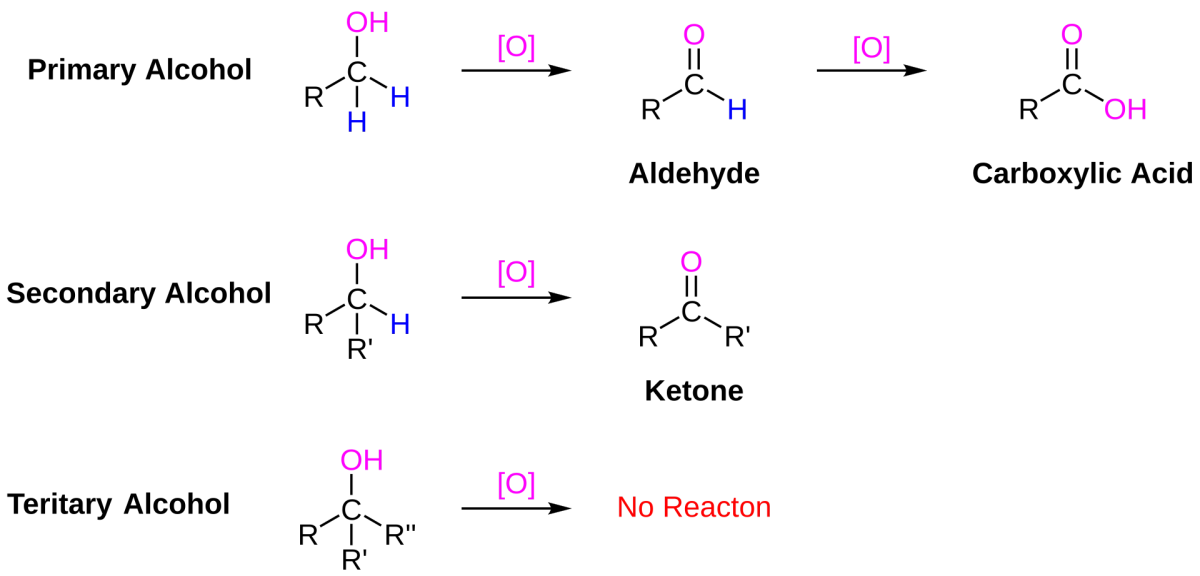
Alcohol oxidation is the most common way to convert a hydroxyl group into a carbonyl - an aldehyde, a ketone, or a carboxylic acid. Which product you get depends on two things: whether the alcohol is primary or secondary (tertiary alcohols cannot be oxidized without breaking a C-C bond), and which oxidant you use.
The central distinction on the MCAT is PCC vs. Jones reagent. PCC stops at the aldehyde. Jones goes all the way to the carboxylic acid. Knowing this one fact lets you answer a significant fraction of alcohol oxidation questions.
Alcohol oxidation products: 1° → aldehyde (or further to carboxylic acid); 2° → ketone; 3° does not oxidize without C-C bond breaking. Credit: Wikimedia Commons, CC BY-SA
What Oxidation Means for Alcohols
Formally, oxidation of an alcohol means removing two hydrogens (one from O, one from the C bearing the O) and converting the C-O single bond into a C=O double bond. The carbon goes up two oxidation state units:
1° alcohol → aldehyde (+2 oxidation state change at C).
Aldehyde → carboxylic acid (another +2, which is why 1° → carboxylic acid is a 4-electron oxidation).
2° alcohol → ketone (+2).
3° alcohol → no oxidation possible without breaking a C-C bond, because there is no C-H bond on the oxygenated carbon to remove.
PCC: The Mild, Selective Oxidant
Pyridinium chlorochromate (PCC) is the reagent of choice for stopping at the aldehyde (for 1° alcohols) or producing ketones (for 2° alcohols). The Cr(VI)-based reagent oxidizes alcohols via a chromate ester intermediate, then a concerted loss of CrO₃H⁻ and a proton from the alpha-carbon.
Key properties:
PCC in dichloromethane (CH₂Cl₂) or other inert solvent.
No water present → no over-oxidation (water is needed to convert the aldehyde to its hydrate, which is then oxidized further by Jones-type conditions).
1° alcohol → aldehyde (stops here).
2° alcohol → ketone.
3° alcohol → no reaction.
PCC is the textbook reagent when you need to convert an alcohol to an aldehyde WITHOUT going further.
Jones Reagent (CrO₃ / H₂SO₄ / acetone): The Strong Oxidant
Jones reagent uses chromium(VI) oxide in sulfuric acid and acetone, or chromic acid (H₂CrO₄) in acid. Unlike PCC, it contains water, which allows:
1° alcohol → aldehyde → hydrate (via water addition) → carboxylic acid (over-oxidation). Final product: carboxylic acid.
2° alcohol → ketone (stops here; no alpha-hydrogens available for further oxidation without extreme conditions).
3° alcohol → no reaction.
Jones reagent cannot be stopped at the aldehyde for 1° alcohols - the water in the reagent immediately hydrates any aldehyde to its gem-diol, which is re-oxidized to the carboxylic acid.
Dess-Martin Periodinane (DMP): The Modern Alternative
DMP is a chromium-free oxidant with the same selectivity as PCC:
1° alcohol → aldehyde.
2° alcohol → ketone.
3° alcohol → no reaction.
DMP is preferred in modern synthesis because chromium reagents are toxic and environmentally problematic. For MCAT purposes, DMP and PCC can be treated as equivalent.
Other Oxidants to Know
Reagent
Action
KMnO₄ (hot, concentrated)
Very harsh; 1° → carboxylic acid, 2° → ketone, but also cleaves alkenes
KMnO₄ (cold, dilute, basic)
Converts alkenes to vicinal diols (not alcohol oxidation but related)
Ag(NH₃)₂⁺ (Tollens’ reagent)
Specifically oxidizes aldehydes to carboxylic acids with silver mirror formation; does not touch alcohols
H₂CrO₄ / acetone (Swern, Jones variants)
Similar to Jones, goes to carboxylic acid from 1°
NAD⁺ (biological)
Oxidizes alcohols to aldehydes/ketones in enzymes
The Biological Story: NAD⁺ and Alcohol Metabolism
In the body, alcohol metabolism mirrors the Jones sequence:
Alcohol dehydrogenase (ADH) + NAD⁺ oxidizes ethanol to acetaldehyde. NAD⁺ accepts a hydride, becoming NADH.
Aldehyde dehydrogenase + NAD⁺ oxidizes acetaldehyde to acetate (conjugate base of acetic acid). Another NADH formed.
Net result: ethanol → acetic acid (via acetaldehyde), consuming two NAD⁺ molecules and producing two NADH. This is why drinking alcohol depletes NAD⁺ and disrupts other NAD⁺-dependent pathways in the liver.
The liver’s aldehyde dehydrogenase has a common mutation (especially in East Asian populations) that reduces activity, causing acetaldehyde accumulation and the classic “alcohol flush” response.
Why 3° Alcohols Do Not Oxidize
A 3° alcohol has the structure R₃C-OH with no C-H bond on the oxygenated carbon. Oxidation requires removing one H from the C-OH carbon, but there is none available. So oxidation to a carbonyl is impossible without breaking one of the C-C bonds first. Under very harsh conditions (high temperature + strong oxidant), this can happen as a degradation (producing ketone + other fragments), but it is not a normal lab outcome.
Practical Summary
Starting alcohol
PCC product
Jones product
NAD⁺ product
1° (R-CH₂-OH)
Aldehyde (R-CHO)
Carboxylic acid (R-COOH)
Aldehyde (R-CHO)
2° (R₂CH-OH)
Ketone (R₂C=O)
Ketone (R₂C=O)
Ketone (R₂C=O)
3° (R₃C-OH)
No reaction
No reaction
No reaction
You have 1-butanol and need to prepare butanal (the aldehyde) without over-oxidizing to butanoic acid. Which reagent do you use, and why?
Click to reveal answer
PCC in dichloromethane. PCC is a chromium(VI) oxidant but crucially lacks water, so the aldehyde formed is not hydrated and re-oxidized. PCC stops at the aldehyde stage. Jones reagent (H₂CrO₄/H₂SO₄/acetone) contains water and would over-oxidize to butanoic acid. Dess-Martin periodinane (DMP) would also work. The key word is "water-free."
A Grignard reagent (R-MgX) is a carbon-magnesium bond so polarized that the carbon behaves like a carbanion. This makes Grignards the most versatile C-C bond-forming reagents in undergraduate organic chemistry - they attack aldehydes, ketones, esters, epoxides, and CO₂, creating new alcohols (or carboxylic acids from CO₂) with an extended carbon chain.
The MCAT loves Grignard synthesis because it combines mechanism, stereochemistry, and multi-step reasoning into one compact problem. Know the reagent, know the substrate, and you can predict the product every time.
Grignard mechanism: the carbanionic carbon of R-MgX attacks the electrophilic carbonyl carbon, pushing the pi electrons onto oxygen. Acidic workup gives the alcohol product. Credit: Wikimedia Commons, CC BY-SA
Formation of a Grignard Reagent
To make a Grignard, you combine an alkyl (or aryl) halide with magnesium metal in dry ether:
R-X + Mg⁰ → R-Mg-X (in ether or THF)
Works for most halides (Cl, Br, I; F is too unreactive).
Works for 1°, 2°, 3° alkyl groups and aryl halides.
Solvent MUST be dry (water-free) ether, tetrahydrofuran (THF), or similar aprotic ether.
Any water, alcohol, or acidic proton will destroy the Grignard before it can react with the intended substrate.
The magnesium inserts into the C-X bond, giving an organomagnesium halide. The C-Mg bond is highly polarized (carbon is δ⁻, magnesium is δ⁺), so the carbon behaves like a carbanion.
The Core Reaction: Attack on Carbonyls
Grignards attack carbonyls (C=O) in a simple two-step process:
Step 1: The carbanionic carbon of R-MgX attacks the electrophilic carbonyl carbon. The C=O pi bond breaks, electrons flow to oxygen. Result: a magnesium alkoxide intermediate.
Step 2 (workup): Acidic aqueous workup (dilute HCl, NH₄Cl, or H₂O) protonates the alkoxide to give the alcohol product. Magnesium halide salt is a byproduct.
What You Get from Each Carbonyl
The product of a Grignard addition depends on which carbonyl you attack:
Esters (and acid halides, anhydrides) react with TWO equivalents of Grignard reagent because the initial addition produces a tetrahedral alkoxide that can eject the OR’ (or Cl) leaving group, forming an intermediate ketone. That ketone then accepts a second Grignard addition, giving the final 3° alcohol.
On the MCAT, if you see an ester + excess Grignard, the product is a 3° alcohol with two identical R groups from the Grignard on the carbonyl carbon.
Ring Opening of Epoxides
Grignards attack epoxides at the less substituted carbon (backside-attack-like, SN2-style) due to steric considerations. The epoxide O becomes an alkoxide, which gives an alcohol on workup.
CH₃MgBr + ethylene oxide (CH₂CH₂O as a 3-membered ring) → CH₃CH₂CH₂O⁻MgBr⁺ → CH₃CH₂CH₂OH after workup.
This is a powerful C-C bond forming method with a built-in two-carbon extender (the epoxide) - often easier than double-Grignard or Wittig alternatives.
Why Grignards Are Destroyed by Water
A Grignard has a carbanionic carbon. That carbon is intensely basic - the pKa of an alkane C-H is about 50, so the corresponding carbanion is an extremely strong base. Any acidic proton - water (pKa 15.7), alcohol (pKa 16), carboxylic acid (pKa 4-5), amine N-H (pKa 38), terminal alkyne (pKa 25) - will donate a proton to the Grignard immediately, converting R-MgX to R-H.
Practical consequences:
Reaction mixtures must be completely dry before Grignard formation or use.
If the substrate itself has an acidic proton (a hydroxyl, amine, or terminal alkyne), it will quench the Grignard. You need to protect those groups first.
Workup with water is done AT THE END, after the Grignard has added to the intended carbonyl.
Organolithium Reagents: The Grignard’s Cousin
R-Li (organolithium) reagents behave similarly to Grignards but are even more reactive. They are made by reacting alkyl halides with lithium metal:
R-X + 2 Li → R-Li + LiX
n-Butyllithium (n-BuLi) is a common strong base in synthesis. Because it is an even stronger base than a Grignard, it can deprotonate terminal alkynes, amines, and similar weakly acidic species - useful when you need to generate a specific anion.
Other key organometallics:
Gilman reagents (R₂CuLi): softer nucleophiles, do 1,4-conjugate addition on enones (Michael addition). Covered in Ch 7.
Lithium diisopropylamide (LDA): a strong bulky base used for enolate formation. Not a nucleophile itself (too bulky).
Design a synthesis of 2-methyl-2-butanol starting from 2-butanone and a Grignard reagent. Show the required Grignard reagent.
Click to reveal answer
Use methylmagnesium bromide (CH₃MgBr) with 2-butanone (CH₃COCH₂CH₃). Methyl Grignard attacks the ketone's carbonyl carbon, forming a 3° alkoxide. Workup (aqueous acid) gives 2-methyl-2-butanol ((CH₃)₂C(OH)CH₂CH₃). The new C-C bond is between the Grignard's methyl and the original carbonyl carbon. Starting from a ketone + Grignard always gives a 3° alcohol. To make 2-methyl-2-butanol, you also could use ethyl Grignard + acetone or propyl Grignard + a different ketone; all give the same 3° alcohol.
A phenol is a hydroxyl group (-OH) attached to an aromatic ring. That single structural change - moving the OH from an sp³ carbon (alcohol) to an sp² aromatic carbon (phenol) - completely transforms the reactivity. Phenols are roughly a million times more acidic than alcohols, and they participate in two-electron biological redox reactions that regular alcohols never see.
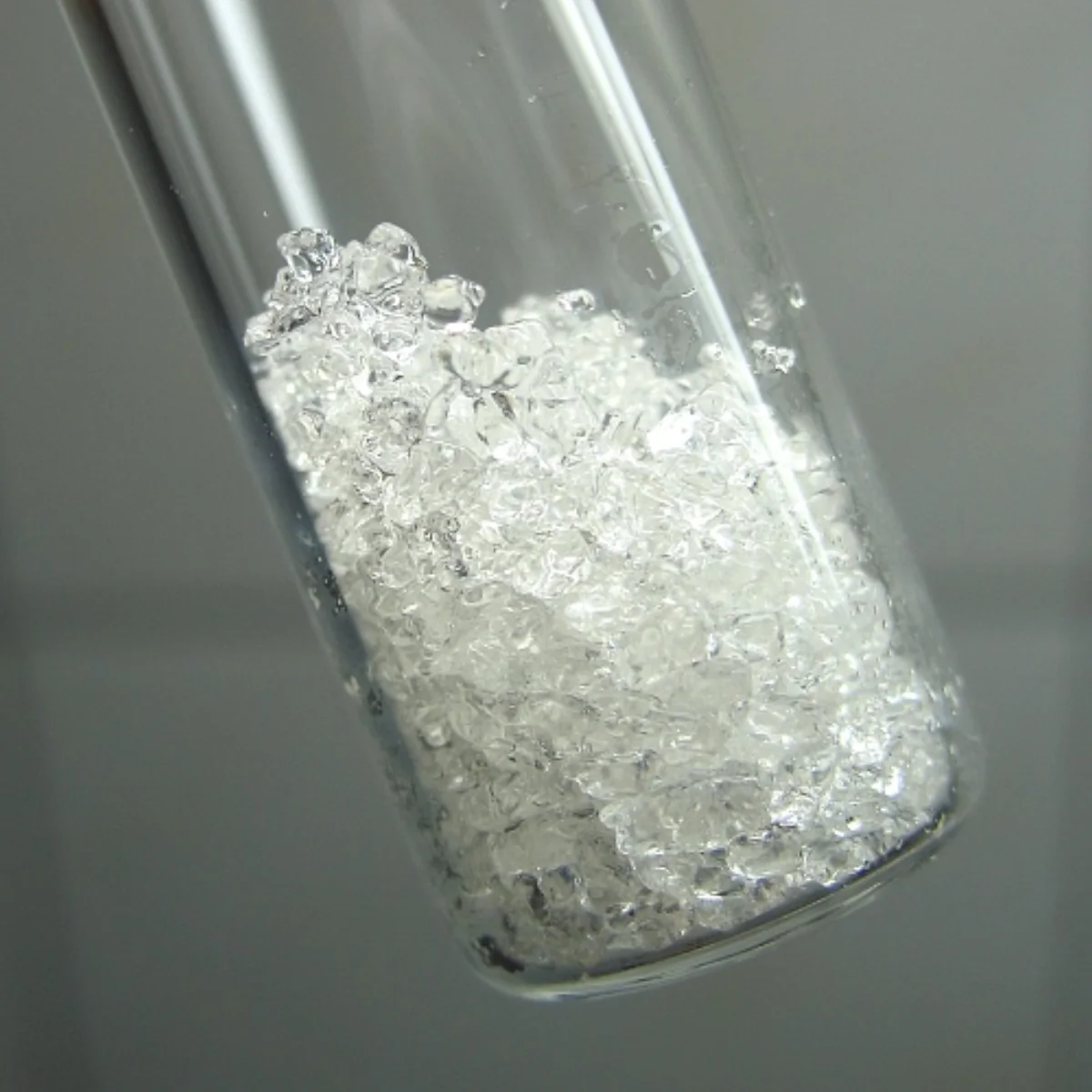
Phenol as a solid: colorless crystals with a sharp, medicinal odor. Phenol's acidity and antibacterial properties made it the first widely used surgical antiseptic in the 1860s. Credit: Wikimedia Commons, CC BY-SA
Why Phenols Are Much More Acidic Than Alcohols
Phenol has pKa 10. Ethanol has pKa 16. That six-unit gap means phenol is about a million times more acidic (factor of 10⁶ in Ka).
The reason: phenoxide (the conjugate base) has resonance stabilization that alkoxide lacks. The negative charge on phenoxide oxygen can delocalize into the aromatic ring, placing partial negative charge on the ortho and para positions. Four resonance structures total, each contributing to stabilization.
Ethoxide has no such option - the alkyl group has no pi system. The negative charge is localized on one oxygen.
More stable conjugate base = stronger acid. Phenol is much more acidic as a result.
Substituent Effects on Phenol Acidity
Electron-withdrawing groups on the ring stabilize the phenoxide anion (extra delocalization) and lower the pKa:
Phenol
pKa
Phenol
10.0
4-chlorophenol
9.4
4-nitrophenol
7.2
2,4-dinitrophenol
4.1
2,4,6-trinitrophenol (picric acid)
0.4
Nitro groups are especially strong electron-withdrawers because they can accept resonance electron density from the phenoxide - the negative charge delocalizes into the nitro oxygens, spreading the charge across SIX atoms total (O, four ring carbons, nitro O). Three nitro groups (picric acid) gives a phenol more acidic than carboxylic acids.
Electron-donating groups (methyl, methoxy) slightly decrease acidity by pushing electron density into the ring, destabilizing the anion.
Nomenclature of Phenols
Phenols are named with the OH group getting locant 1, and ring substituents getting the lowest locants. Common names are often used:
Hydroquinone has two hydroxyls on a benzene ring (1,4-). Oxidation removes two H atoms (one proton + one electron each), converting both OHs into C=O carbonyls and changing the benzene ring into a cyclohexadiene (1,4-benzoquinone).
This 2-electron, 2-proton redox cycle is the mechanism by which phenolic compounds serve as electron carriers in biology.
Ubiquinone (Coenzyme Q) in the ETC
Ubiquinone (CoQ, Coenzyme Q) is a lipid-soluble phenol derivative with a long hydrophobic isoprenoid tail (CoQ10 in humans). Its core is 1,4-benzoquinone; the tail anchors it in the inner mitochondrial membrane of the electron transport chain (ETC).
CoQ cycles between its quinone (oxidized) and hydroquinone (reduced, “ubiquinol”) forms as it shuttles electrons from Complex I and Complex II to Complex III:
This is one of the key two-electron redox steps in cellular respiration. The AAMC explicitly lists “Phenols: Oxidation and reduction (e.g., hydroquinones, ubiquinones): biological 2e- redox centers” in the organic chemistry content outline, so recognize this context on passages.
Vitamin E and K: Phenol-Based Antioxidants
Vitamin E (α-tocopherol) is a phenol with a phytol tail. Its phenol -OH donates a hydrogen atom to lipid peroxyl radicals, quenching radical chain reactions in cell membranes. The resulting tocopheroxyl radical is stabilized by resonance into the chroman ring, preventing it from continuing the radical chain.
Vitamin K has a naphthoquinone structure (two fused aromatic rings with a 1,4-quinone on one of them). It cycles between quinone and hydroquinone forms in the blood clotting cascade - specifically in the gamma-carboxylation of glutamate residues in clotting factors.
Both vitamins leverage the same phenol-to-quinone two-electron redox chemistry you just learned.
Phenol as a Disinfectant
Phenol (carbolic acid) was the first effective surgical antiseptic, introduced by Joseph Lister in the 1860s. Its acidity and ability to denature proteins make it bactericidal. Modern phenol derivatives (triclosan, thymol, eugenol) are used in toothpastes, mouthwashes, and household disinfectants.
Reactions of Phenols
Unlike alcohols, phenols:
Do NOT undergo SN1 or SN2 - you cannot substitute the OH with a halide easily because the aromatic ring stabilizes the phenol OH in place. (The C-O bond of a phenol is actually more like a C=O-ish partial double bond due to resonance, making it much stronger.)
DO undergo electrophilic aromatic substitution on the ring (not covered in detail on the MCAT - AAMC removed EAS from the content outline).
Can be oxidized to quinones - the key redox transformation.
Can be deprotonated by NaOH - because their pKa is 10, less than water’s 15.7.
Distinguishing Phenols from Alcohols
A simple lab test: add NaHCO₃ (sodium bicarbonate) and then NaOH.
Phenol: NaHCO₃ does NOT dissolve it (phenol is not acidic enough - pKa 10, carbonic acid pKa 6.35). NaOH DOES dissolve it (forms soluble sodium phenoxide).
Alcohol: neither dissolves it (pKa 16 is too high).
Carboxylic acid: both dissolve it (pKa 4.8 is below carbonic acid pKa).
This acid-base extraction sequence separates phenols from alcohols from carboxylic acids - a classic lab technique discussed in Ch 12.
Explain why 4-nitrophenol is much more acidic than phenol, and why 4-methylphenol is slightly less acidic than phenol.
Click to reveal answer
The nitro group (-NO₂) is a strong electron-withdrawing group and can accept resonance electron density from the phenoxide anion. With the nitro group para, the negative charge on phenoxide can delocalize onto the nitro oxygens (6-atom delocalization), strongly stabilizing the anion and lowering pKa from 10 to 7.2. The methyl group (-CH₃) is electron-donating via hyperconjugation and induction. It destabilizes the anion slightly, raising pKa from 10 to 10.3. Substituent effects on phenol pKa are dominated by how well the substituent stabilizes the negative charge on the phenoxide.