
SN2 Reactions
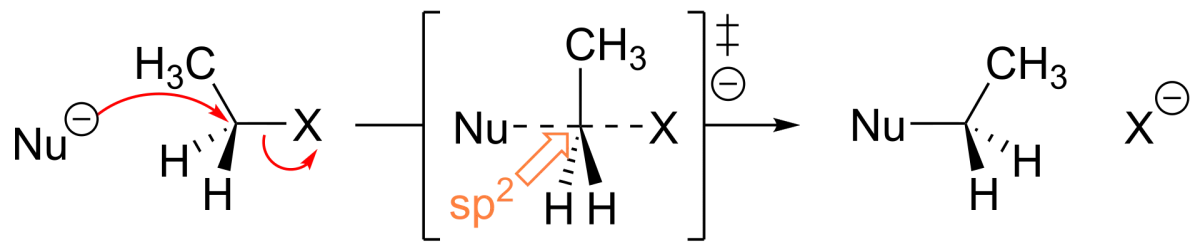
The SN2 reaction is a substitution where the nucleophile attacks the electrophilic carbon at the same moment the leaving group departs - both events in a single concerted step. No intermediate. The rate depends on both substrate AND nucleophile concentration, hence “2” for bimolecular. And because the nucleophile attacks from the side opposite the leaving group, SN2 always produces inversion of configuration at the reacting carbon.
Play the animation below to watch a Walden inversion unfold. Start with methyl bromide + hydroxide and scrub through the backside approach, the trigonal-bipyramidal transition state, and the umbrella flip. Switch the substrate to tert-butyl and the simulation shows the reaction being sterically blocked — this is why SN2 fails for 3° substrates.
SN2 Walden inversion
SN2 is the mechanism of choice for methyl and primary substrates with strong nucleophiles in polar aprotic solvents. It is the fastest and cleanest substitution reaction available - no rearrangements, predictable stereochemistry, simple kinetics.
The Concerted Mechanism
SN2 is ONE step. The transition state looks like:
- Nucleophile coming in from behind, partial bond forming to the carbon.
- Carbon transitioning from sp³ tetrahedral toward planar (three non-leaving-group substituents flatten out).
- Leaving group departing out the front, partial bond breaking.
All three happen simultaneously. After the transition state, the carbon has inverted like an umbrella in a windstorm: what was “up” is now “down,” and the nucleophile is on the opposite side from where the leaving group used to be.
Arrows: two arrows drawn together:
- Nucleophile lone pair → carbon (forming new bond).
- C-LG bond → LG (bond breaking).
Rate Law: Second Order
The rate law for SN2 is:
Rate = k [substrate][nucleophile]
Doubling either one doubles the rate; doubling both quadruples it. Any experimental observation that nucleophile concentration affects rate is a kinetic fingerprint of SN2 (vs. SN1, which is first order).
Substrate Preference: Methyl > 1° > 2° >> 3° (SN2 Basically Fails at 3°)
Steric hindrance is the rate-limiting factor. As the carbon becomes more substituted, it becomes harder for the nucleophile to approach from behind:
- Methyl (CH₃-LG): no steric obstacles. Fastest SN2 substrate.
- 1° (R-CH₂-LG): one alkyl group offset from the attack path. Still fast.
- 2° (R₂CH-LG): two alkyl groups create significant hindrance. Much slower.
- 3° (R₃C-LG): three alkyl groups block the backside approach entirely. SN2 does not occur.
- Neopentyl (R-C(CH₃)₃-CH₂-LG): the quaternary beta-carbon blocks backside attack even though the actual reacting carbon is 1°. SN2 is very slow.
Neopentyl-type substrates are a classic trap: despite being primary, they have severe steric hindrance from the adjacent quaternary carbon.
Stereochemistry: Walden Inversion
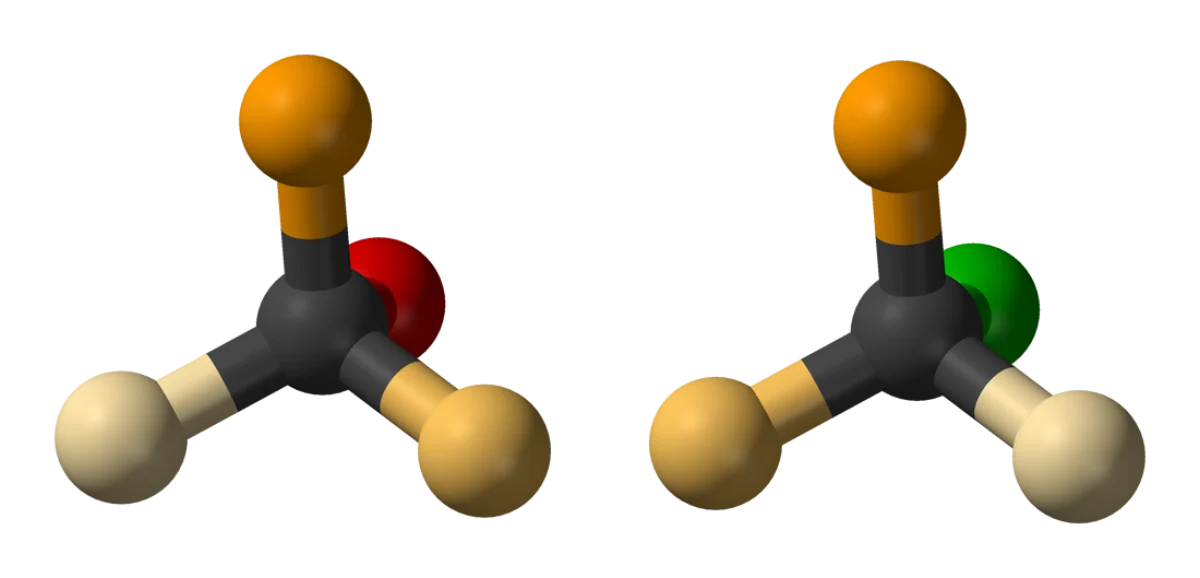
SN2 always produces inversion at the stereocenter - this is called Walden inversion after Paul Walden, who first demonstrated it. If the starting material is (R), the product is (S) (assuming priority does not change, which it can if the leaving group and nucleophile have different priorities).
Important subtlety: inversion describes the spatial relationship at the carbon, not the CIP label. Consider (R)-2-bromobutane reacting with NaOH via SN2. The bromine leaves from one face, the hydroxide enters from the opposite face. The physical geometry inverts. But because -OH has a different CIP priority than -Br, the CIP label of the product happens to still be (R) even though inversion occurred. Always re-assign R/S for the product based on the actual priorities of its substituents.
Nucleophile Strength Matters
Because the nucleophile is in the rate law, stronger nucleophiles give faster SN2 reactions. Rankings depend on solvent (see Section 4.4). In polar aprotic solvents like DMSO:
F⁻ > Cl⁻ > Br⁻ > I⁻ (basicity ranks; nucleophilicity tracks basicity when no solvent shell hides the charge)
In polar protic solvents like methanol:
I⁻ > Br⁻ > Cl⁻ > F⁻ (inverted - size and polarizability win when H-bonding solvates small anions)
Strong anionic nucleophiles (RO⁻, HS⁻, N₃⁻, RC≡C⁻, RNHR⁻) are all good SN2 nucleophiles. Neutral nucleophiles (alcohols, amines, water) can do SN2 but are slower - useful when you do not want to deprotonate first.
Solvent Choice: Polar Aprotic Wins
SN2 runs fastest in polar aprotic solvents:
- DMSO (dimethyl sulfoxide): (CH₃)₂S=O
- DMF (dimethylformamide): HCON(CH₃)₂
- Acetone: (CH₃)₂C=O
- Acetonitrile: CH₃CN
- HMPA (hexamethylphosphoric triamide): (CH₃)₂N-P(O)-N(CH₃)₂
These solvents dissolve salts (via the cation) but leave the anion “naked” - no H-bonding to the nucleophile, so it is free to attack at full strength.
No Rearrangements
Unlike SN1, SN2 has no carbocation intermediate. The reaction goes straight from reactant through transition state to product. No rearrangements. What you start with is what you get (with the nucleophile replacing the leaving group with inversion).
Practical SN2 Examples
- Methyl iodide + hydroxide → methanol + iodide. Classic textbook example.
- (S)-2-bromobutane + NaCN (DMSO) → (R)-2-cyanobutane + NaBr. Stereospecific inversion, C-C bond formation.
- 1° tosylate + NaN₃ → 1° azide + NaOTs. Azides are common SN2 products because they are small, nucleophilic, and make clean products.
- 1° alkyl halide + alkoxide (Williamson ether synthesis) → ether + halide. Standard way to make ethers.
CH₃Cl (methyl) > CH₃CH₂CH₂Cl (1°) > (CH₃)₂CHCl (2°) >> (CH₃)₃CCl (3°, essentially no reaction). SN2 rate decreases with steric hindrance at the reacting carbon. Methyl has no alkyl obstructions. Primary has one alkyl group but on a different carbon, so only modestly slower. Secondary has two alkyls at the attack site - much slower. Tertiary blocks the backside completely - SN2 essentially does not occur.