
Structure, Classification, Nomenclature
An alcohol is any organic molecule with a hydroxyl group (-OH) bonded to an sp³ carbon. That single structural requirement - sp³ C-OH - is what sets alcohols apart from enols (sp² C-OH) and phenols (aromatic ring C-OH), which have distinct reactivity profiles covered in Sections 5.13 and Chapter 7.
Every reaction in this chapter begins from a simple structural fact: the OH sits on a carbon surrounded by one, two, or three other carbons. Which class the alcohol belongs to changes everything - its acidity, its reactivity in substitution and elimination, and even what products its oxidation gives.
The Three Classifications
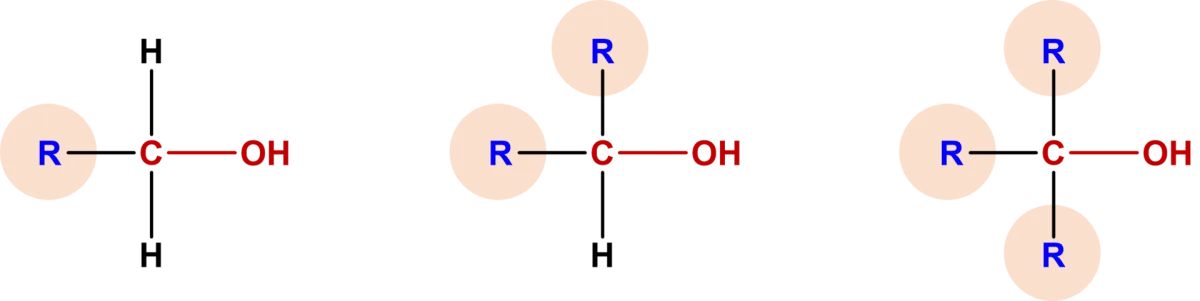
Alcohols are classified by how many carbons are attached to the C-OH carbon:
- Primary (1°): one carbon attached to the C-OH carbon (plus the OH and at least one H). Examples: methanol (CH₃OH), ethanol (CH₃CH₂OH), 1-butanol.
- Secondary (2°): two carbons attached to the C-OH carbon. Examples: isopropanol ((CH₃)₂CHOH), 2-butanol, cyclohexanol.
- Tertiary (3°): three carbons attached to the C-OH carbon. Examples: tert-butanol ((CH₃)₃COH), 2-methyl-2-butanol.
Methanol (CH₃OH) is sometimes called a “zero-degree” alcohol because no carbons are attached to the C-OH carbon. It behaves like a 1° alcohol for most purposes.
IUPAC Nomenclature of Alcohols
The rules extend what you learned in Chapter 1:
- Find the longest carbon chain that INCLUDES the carbon bearing the -OH.
- Number the chain to give the OH-bearing carbon the LOWEST possible locant.
- Replace the final “-e” of the alkane name with “-ol”.
- Add a locant number for the OH position just before “-ol”.
- Handle substituents and multiple OH groups as usual (di-ol, tri-ol for multiples).
Examples:
- CH₃CH(OH)CH₃: propan-2-ol (or 2-propanol). The OH is on C2 of a 3-carbon chain.
- CH₃CH₂CH₂CH(OH)CH₃: pentan-2-ol. 5-carbon chain, OH on C2.
- HOCH₂CH₂OH: ethane-1,2-diol (common name: ethylene glycol). Two OH groups, so “diol”.
The OH gets numbering priority over most substituents (halogens, alkyl groups) but is outranked by carboxylic acid, ester, amide, aldehyde, and ketone groups. If an alcohol coexists with a carboxylic acid, the carboxylic acid takes the suffix and the OH becomes “hydroxy-” as a prefix.
Common Names You Should Recognize
A handful of alcohols have common names the MCAT uses:
| Common name | IUPAC | Structure |
|---|---|---|
| Methanol / wood alcohol | methanol | CH₃OH |
| Ethanol / grain alcohol | ethanol | CH₃CH₂OH |
| Isopropanol / rubbing alcohol | propan-2-ol | (CH₃)₂CHOH |
| tert-Butanol | 2-methylpropan-2-ol | (CH₃)₃COH |
| Ethylene glycol | ethane-1,2-diol | HOCH₂CH₂OH |
| Glycerol / glycerin | propane-1,2,3-triol | HOCH₂CH(OH)CH₂OH |
Glycerol is especially important because its three hydroxyl groups form the backbone of triglycerides and phospholipids in biology.
Functional Group Priority When Naming
When a molecule has multiple functional groups, IUPAC assigns the suffix to the highest-priority group. The order (highest to lowest):
- Carboxylic acid (-oic acid)
- Ester (-oate)
- Amide (-amide)
- Nitrile (-nitrile)
- Aldehyde (-al)
- Ketone (-one)
- Alcohol (-ol)
- Amine (-amine)
- Ether (-oxy- prefix only, never a suffix)
- Alkene/alkyne (-ene, -yne)
- Alkane (-ane)
So an alcohol and a ketone together gives “-one” as the suffix, and the OH becomes “hydroxy-”. A molecule with both a carboxylic acid and an alcohol is named as the carboxylic acid with a hydroxy- prefix.
Ethers Are Not Alcohols
An ether (R-O-R’) looks superficially like an alcohol because both have a C-O bond. But ethers have no O-H and therefore do not participate in hydrogen bonding as donors, do not have acidity comparable to alcohols, and do not react in the same ways. Diethyl ether, for example, is relatively inert - a common solvent rather than a reactive substrate.
In nomenclature, ethers are named as alkoxy substituents (methoxy-, ethoxy-) on a larger parent chain. The common name “ethyl methyl ether” is also acceptable.
Glycols and Polyols
Molecules with two or more hydroxyl groups have special names:
- Diol: two OH groups. Vicinal diol (1,2-diol) vs. geminal diol (both OH’s on the same carbon - unstable except for a few special cases).
- Triol: three OH groups. Glycerol is the most famous example.
- Polyol: four or more. Sugar alcohols like sorbitol fall here.
Vicinal diols have a chemistry of their own: they can be cleaved by periodic acid (HIO₄) or lead tetraacetate to give two carbonyls, which is useful in carbohydrate chemistry.