
Oxidation of Alcohols
Alcohol oxidation is the most common way to convert a hydroxyl group into a carbonyl - an aldehyde, a ketone, or a carboxylic acid. Which product you get depends on two things: whether the alcohol is primary or secondary (tertiary alcohols cannot be oxidized without breaking a C-C bond), and which oxidant you use.
The central distinction on the MCAT is PCC vs. Jones reagent. PCC stops at the aldehyde. Jones goes all the way to the carboxylic acid. Knowing this one fact lets you answer a significant fraction of alcohol oxidation questions.
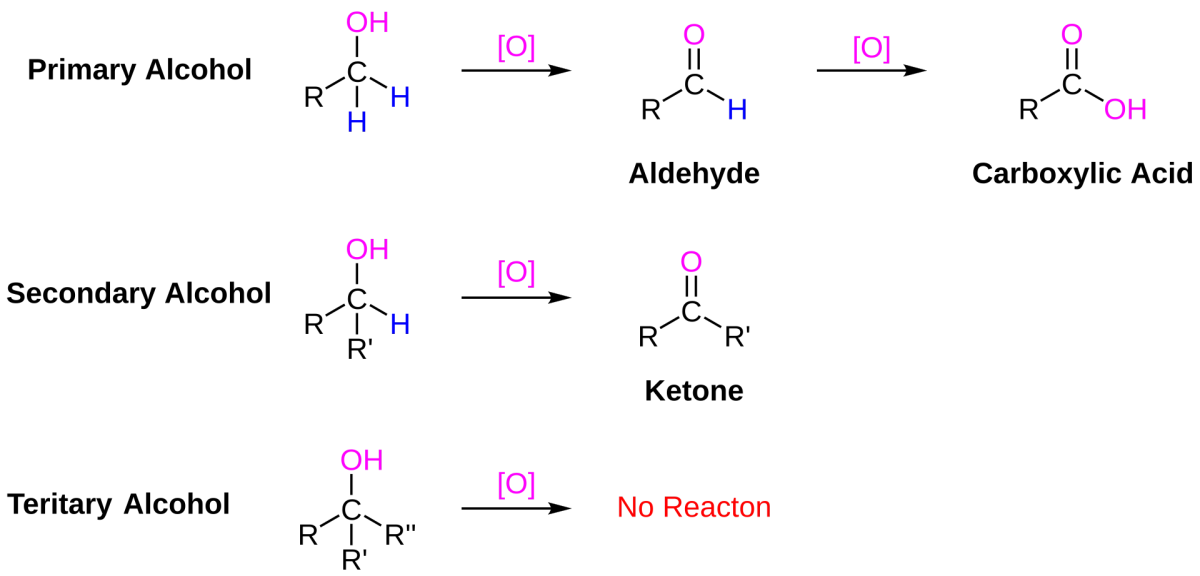
What Oxidation Means for Alcohols
Formally, oxidation of an alcohol means removing two hydrogens (one from O, one from the C bearing the O) and converting the C-O single bond into a C=O double bond. The carbon goes up two oxidation state units:
- 1° alcohol → aldehyde (+2 oxidation state change at C).
- Aldehyde → carboxylic acid (another +2, which is why 1° → carboxylic acid is a 4-electron oxidation).
- 2° alcohol → ketone (+2).
- 3° alcohol → no oxidation possible without breaking a C-C bond, because there is no C-H bond on the oxygenated carbon to remove.
PCC: The Mild, Selective Oxidant
Pyridinium chlorochromate (PCC) is the reagent of choice for stopping at the aldehyde (for 1° alcohols) or producing ketones (for 2° alcohols). The Cr(VI)-based reagent oxidizes alcohols via a chromate ester intermediate, then a concerted loss of CrO₃H⁻ and a proton from the alpha-carbon.
Key properties:
- PCC in dichloromethane (CH₂Cl₂) or other inert solvent.
- No water present → no over-oxidation (water is needed to convert the aldehyde to its hydrate, which is then oxidized further by Jones-type conditions).
- 1° alcohol → aldehyde (stops here).
- 2° alcohol → ketone.
- 3° alcohol → no reaction.
PCC is the textbook reagent when you need to convert an alcohol to an aldehyde WITHOUT going further.
Jones Reagent (CrO₃ / H₂SO₄ / acetone): The Strong Oxidant
Jones reagent uses chromium(VI) oxide in sulfuric acid and acetone, or chromic acid (H₂CrO₄) in acid. Unlike PCC, it contains water, which allows:
- 1° alcohol → aldehyde → hydrate (via water addition) → carboxylic acid (over-oxidation). Final product: carboxylic acid.
- 2° alcohol → ketone (stops here; no alpha-hydrogens available for further oxidation without extreme conditions).
- 3° alcohol → no reaction.
Jones reagent cannot be stopped at the aldehyde for 1° alcohols - the water in the reagent immediately hydrates any aldehyde to its gem-diol, which is re-oxidized to the carboxylic acid.
Dess-Martin Periodinane (DMP): The Modern Alternative
DMP is a chromium-free oxidant with the same selectivity as PCC:
- 1° alcohol → aldehyde.
- 2° alcohol → ketone.
- 3° alcohol → no reaction.
DMP is preferred in modern synthesis because chromium reagents are toxic and environmentally problematic. For MCAT purposes, DMP and PCC can be treated as equivalent.
Other Oxidants to Know
| Reagent | Action |
|---|---|
| KMnO₄ (hot, concentrated) | Very harsh; 1° → carboxylic acid, 2° → ketone, but also cleaves alkenes |
| KMnO₄ (cold, dilute, basic) | Converts alkenes to vicinal diols (not alcohol oxidation but related) |
| Ag(NH₃)₂⁺ (Tollens’ reagent) | Specifically oxidizes aldehydes to carboxylic acids with silver mirror formation; does not touch alcohols |
| H₂CrO₄ / acetone (Swern, Jones variants) | Similar to Jones, goes to carboxylic acid from 1° |
| NAD⁺ (biological) | Oxidizes alcohols to aldehydes/ketones in enzymes |
The Biological Story: NAD⁺ and Alcohol Metabolism
In the body, alcohol metabolism mirrors the Jones sequence:
- Alcohol dehydrogenase (ADH) + NAD⁺ oxidizes ethanol to acetaldehyde. NAD⁺ accepts a hydride, becoming NADH.
- Aldehyde dehydrogenase + NAD⁺ oxidizes acetaldehyde to acetate (conjugate base of acetic acid). Another NADH formed.
Net result: ethanol → acetic acid (via acetaldehyde), consuming two NAD⁺ molecules and producing two NADH. This is why drinking alcohol depletes NAD⁺ and disrupts other NAD⁺-dependent pathways in the liver.
The liver’s aldehyde dehydrogenase has a common mutation (especially in East Asian populations) that reduces activity, causing acetaldehyde accumulation and the classic “alcohol flush” response.
Why 3° Alcohols Do Not Oxidize
A 3° alcohol has the structure R₃C-OH with no C-H bond on the oxygenated carbon. Oxidation requires removing one H from the C-OH carbon, but there is none available. So oxidation to a carbonyl is impossible without breaking one of the C-C bonds first. Under very harsh conditions (high temperature + strong oxidant), this can happen as a degradation (producing ketone + other fragments), but it is not a normal lab outcome.
Practical Summary
| Starting alcohol | PCC product | Jones product | NAD⁺ product |
|---|---|---|---|
| 1° (R-CH₂-OH) | Aldehyde (R-CHO) | Carboxylic acid (R-COOH) | Aldehyde (R-CHO) |
| 2° (R₂CH-OH) | Ketone (R₂C=O) | Ketone (R₂C=O) | Ketone (R₂C=O) |
| 3° (R₃C-OH) | No reaction | No reaction | No reaction |