
SN1 vs SN2 Decision
You now know both SN1 (two-step, carbocation intermediate, racemization, fast for 3°) and SN2 (one-step, backside attack, inversion, fast for methyl/1°). The MCAT’s real question is: given a specific substrate + nucleophile + solvent, which mechanism wins? This section is the decision framework.
The four factors that decide SN1 vs. SN2:
- Substrate structure (methyl, 1°, 2°, 3°, allyl/benzyl)
- Nucleophile strength (strong or weak?)
- Solvent type (polar aprotic vs. polar protic)
- Leaving group quality (same for both; good LG is assumed)
Run through these in order and the winner becomes obvious.
Factor 1: Substrate Structure
This is the biggest single factor. Look at the carbon bearing the leaving group:
- Methyl or 1°: SN2 only. The carbocation is too unstable for SN1. Even with a weak nucleophile, the reaction will either SN2 slowly or fail.
- 3° (alkyl): SN1 only. Steric hindrance blocks SN2 completely. Even a strong nucleophile cannot reach the backside.
- 2° (alkyl): both are possible. Which one wins depends on factors 2-4.
- Allyl or benzyl: both work. The cation is resonance-stabilized (SN1 is fast), AND the backside is often accessible (SN2 also fast). Typically SN2 dominates with strong nucleophiles; SN1 dominates with weak nucleophiles.
Mnemonic map: primary → SN2, tertiary → SN1, secondary → it depends.
Factor 2: Nucleophile Strength
A strong nucleophile speeds up SN2 (which depends on [Nu]) but does not affect SN1 rate. So:
- Strong nucleophile (HO⁻, RO⁻, NH₂⁻, CN⁻, HS⁻, RS⁻, RC≡C⁻): favors SN2.
- Weak nucleophile (H₂O, ROH, RCOOH): favors SN1. Weak nucleophiles still work in SN1 because they do not need to do the rate-limiting step; they just have to attack whatever cation forms.
A very strong nucleophile on a 2° substrate almost always drives SN2. A weak nucleophile on a 2° substrate drives SN1.
Factor 3: Solvent Type
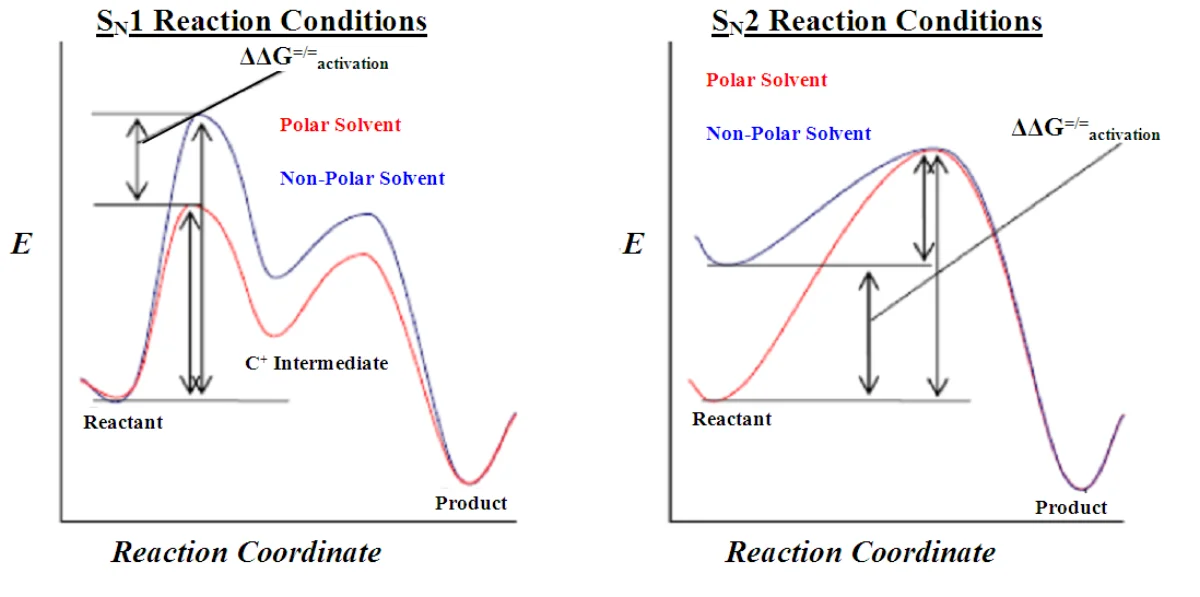
- Polar aprotic (DMSO, DMF, acetone, acetonitrile): favors SN2. Leaves the nucleophile anion unsolvated and reactive.
- Polar protic (water, methanol, ethanol, acetic acid): favors SN1. Stabilizes the ionic intermediate (both cation and anion) through H-bonding.
If a question specifies DMSO, expect SN2. If it specifies H₂O or MeOH, expect SN1 (or at least a strong push toward SN1).
Factor 4: Leaving Group Quality
A good leaving group (I⁻, Br⁻, OTs, OMs) is required for both SN1 and SN2. Bad leaving groups (OH⁻, RO⁻, NH₂⁻) do not allow either mechanism without activation (e.g., protonation or conversion to a tosylate).
Leaving group does not distinguish SN1 from SN2 - both want good leaving groups. This factor mainly tells you whether a reaction can happen at all.
The Decision Table
| Substrate | Nucleophile | Solvent | Likely mechanism |
|---|---|---|---|
| Methyl | any | any | SN2 |
| 1° | strong | polar aprotic | SN2 |
| 1° | weak | polar protic | Very slow (no SN1 possible; SN2 slow without strong Nu) |
| 2° | strong | polar aprotic | SN2 |
| 2° | weak | polar protic | SN1 |
| 2° | strong | polar protic | Mixed - typically SN2 wins |
| 3° | strong | any | Usually E2 (elimination) - not substitution. See Section 5.9. |
| 3° | weak | polar protic | SN1 (+ some E1) |
| Allyl/benzyl | any | any | Both possible; depends on conditions |
Stereochemistry as a Diagnostic
If the MCAT asks about stereochemistry:
- Inversion at the chiral center → SN2 (Walden inversion).
- Racemization → SN1 (planar cation attacked from either face).
- Retention (rare in simple cases) → often indicates neighboring group participation or a double-inversion mechanism.
Example Walkthroughs
Example 1: (S)-2-bromobutane + NaCN in DMSO.
- Substrate: 2° (ambiguous between SN1/SN2).
- Nucleophile: CN⁻ is a strong nucleophile.
- Solvent: DMSO is polar aprotic (favors SN2).
- Verdict: SN2. Product: (R)-2-cyanobutane (inverted).
Example 2: tert-butyl bromide + methanol (solvent and nucleophile combined).
- Substrate: 3° (SN1 preferred, SN2 blocked).
- Nucleophile: methanol is a weak, neutral nucleophile.
- Solvent: methanol is polar protic (favors SN1).
- Verdict: SN1. Product: tert-butyl methyl ether. Racemization not relevant since tert-butyl is not a stereocenter.
Example 3: 2-bromobutane + NaOMe in methanol.
- Substrate: 2°.
- Nucleophile: MeO⁻ is a strong nucleophile.
- Solvent: methanol is polar protic (pro-SN1).
- Pull: strong nucleophile pushes SN2, protic solvent pushes SN1.
- Verdict: mixed, but SN2 typically wins because nucleophile strength usually dominates for 2° substrates. Some SN1 product (racemic) may appear alongside (inverted) SN2 product.
Example 4: Methyl iodide + AgNO₃ in water.
- Substrate: methyl (SN2 only possible).
- Nucleophile: NO₃⁻ is weak; H₂O is slightly stronger.
- Silver ion: precipitates the iodide, pulling the reaction forward and generating a cation-like transition state.
- Verdict: SN2, even though silver can promote some cation-like character. Product: methanol (and silver iodide precipitate).
Temperature Effect
Higher temperature generally favors elimination over substitution. Within substitution only, the SN1-vs-SN2 ratio does not shift dramatically with temperature since both are usually accessible in the relevant range. But heat PROMOTES E1 over SN1 (and E2 over SN2), covered in Sections 5.8 through 5.10.