
E2 Elimination
E2 is a concerted elimination reaction - a one-step mechanism where the base removes a beta-proton at the same time the leaving group departs from the adjacent carbon. Because all three events (base attack, C-H bond breaking, LG departure) happen simultaneously, there is a strict geometric requirement: the H and the LG must be anti-periplanar (180° dihedral angle) to each other.
E2 is the mechanism of choice for strong bases on 2° and 3° substrates. Unlike E1, E2 does not require a stable carbocation intermediate - the alkene forms directly from the starting material through a single transition state.
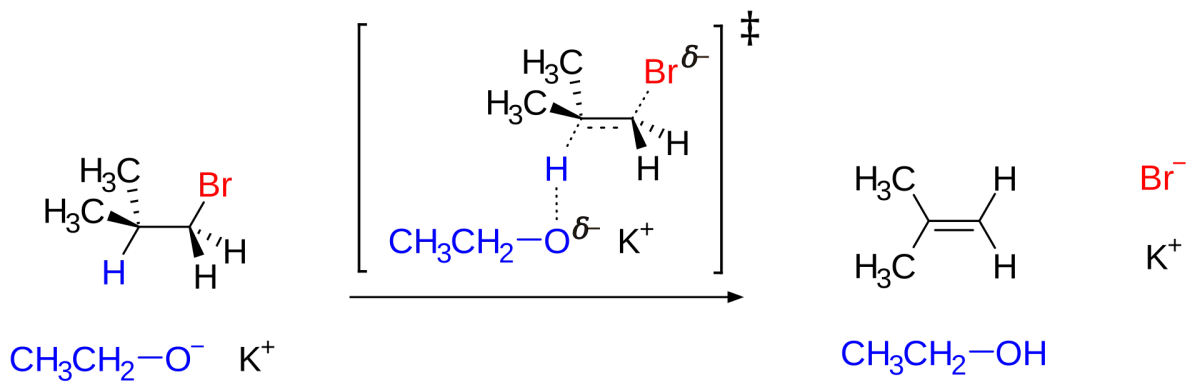
The Concerted Mechanism
E2 is ONE step with three arrows:
- Arrow 1: base’s lone pair → beta-H (removing the proton).
- Arrow 2: C-H bond electrons → C-C bond (forming the new pi bond).
- Arrow 3: C-LG bond electrons → LG (breaking the C-LG bond).
All three arrows are drawn together. No intermediate.
Rate Law: Second Order
Rate = k [substrate][base]
Both substrate and base appear in the rate law. This is the kinetic signature of E2 - in contrast to E1 (first order).
The Anti-Periplanar Geometry Requirement
For the C-H bond and the C-LG bond to line up in the transition state so that the electrons can flow smoothly into a pi bond, they need to be on opposite sides of the C-C axis. In Newman projection terms, the H and LG are at 180° dihedral (anti), all four atoms (H, C, C, LG) lying in the same plane.
Why anti-periplanar and not syn-periplanar (0°, eclipsed)?
- In the anti arrangement, the sigma orbitals of C-H and C-LG line up with the incipient pi bond’s p orbitals directly. Orbital overlap is excellent.
- In the syn (eclipsed) arrangement, the two bonds are stacked on top of each other. Orbital overlap is possible in principle but steric clash of the adjacent groups makes the TS prohibitively high in energy.
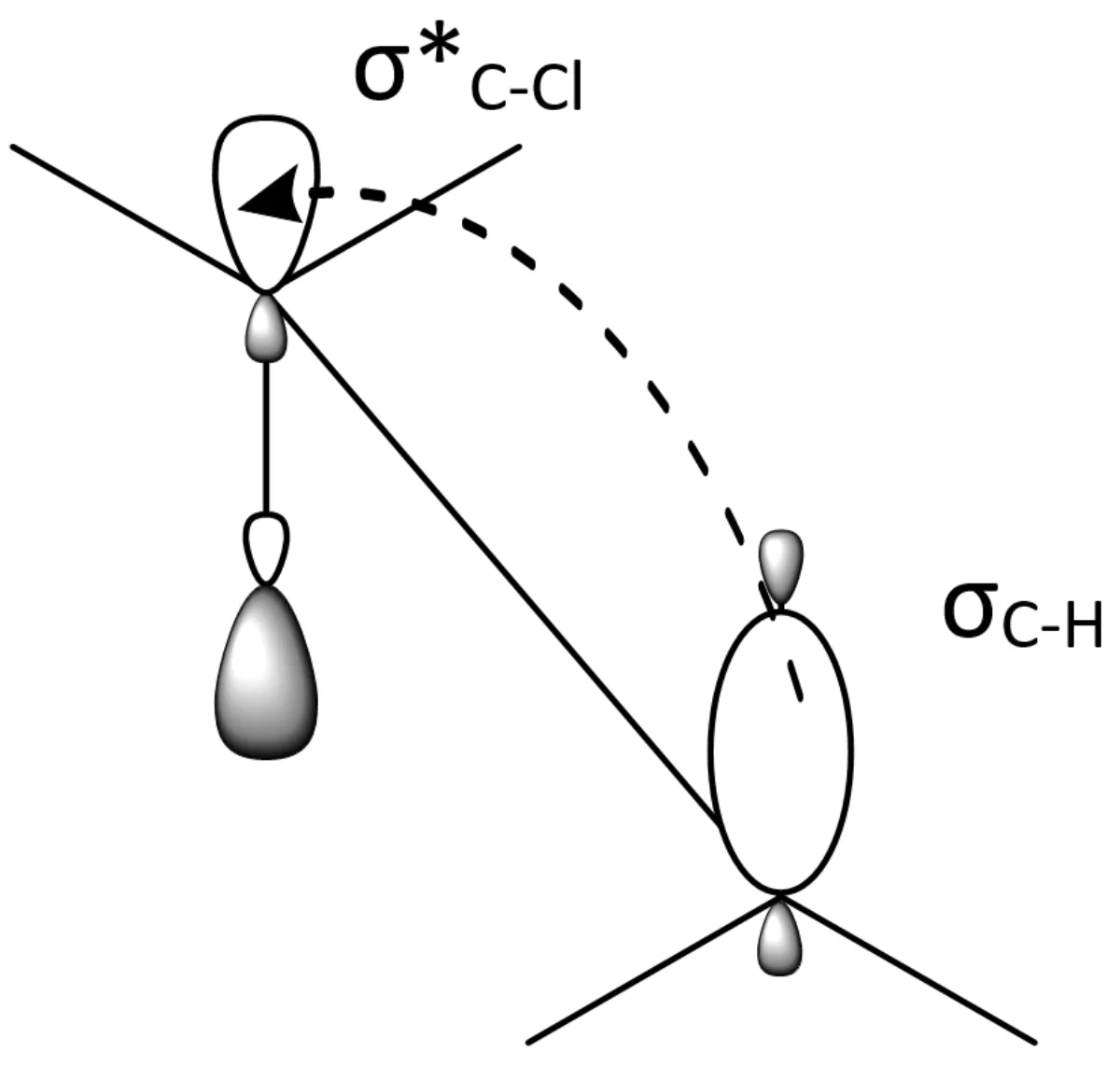
For cyclic substrates, especially cyclohexanes, the anti-periplanar requirement translates into: both the H and the LG must be axial on the chair. If either is equatorial, E2 cannot proceed from that conformation.
Cyclohexane E2: The Chair Flip Matters
Consider cis-1-bromo-2-methylcyclohexane and trans-1-bromo-2-methylcyclohexane under E2 conditions:
- cis-1-bromo-4-tert-butylcyclohexane (for clearer analysis): the tert-butyl group is anchored equatorial (always). The bromo group is axial. A beta-H on the adjacent carbon (C2) can be axial and anti-periplanar to the axial Br. E2 proceeds.
- trans-1-bromo-4-tert-butylcyclohexane: tert-butyl equatorial, Br is now equatorial. No axial H on C2 can be anti-periplanar to the equatorial Br. To run E2, the ring must first flip to a higher-energy chair where Br is axial, which is energetically unfavorable because tert-butyl would be pushed axial. E2 is very slow.
This is a classic MCAT scenario: predicting E2 rates based on conformational analysis. The trans isomer is “locked” in a conformation where E2 is geometrically impossible.
Zaitsev vs. Hofmann Products in E2
E2 usually gives the Zaitsev product (more substituted alkene), same as E1. BUT when a bulky base is used, the product flips to Hofmann (less substituted alkene).
Why? The bulky base cannot reach the interior beta-Hs where the Zaitsev alkene would form. It can only access the more exposed, less-hindered beta-Hs on the periphery. Those less-hindered Hs are typically on less-substituted carbons - so removing them gives the Hofmann (terminal, less-substituted) alkene.
Common bulky bases:
- tert-Butoxide (tBuO⁻): bulky enough to favor Hofmann for mildly hindered substrates.
- LDA: very bulky; strongly favors Hofmann. Usually used for enolate chemistry rather than E2, but can do E2 on some substrates.
Normal (non-bulky) bases:
- Ethoxide (EtO⁻), methoxide (MeO⁻): give Zaitsev product.
- Hydroxide (OH⁻): gives Zaitsev product.
Stereospecificity of E2
E2 is stereospecific: the geometry of the starting material determines the geometry of the alkene product.
Example: (2R,3R)-2-bromo-3-phenylbutane and (2R,3S)-2-bromo-3-phenylbutane under E2 conditions give DIFFERENT alkene products:
- (2R,3R) → (E)-alkene (Ph and CH₃ on opposite sides of the C=C)
- (2R,3S) → (Z)-alkene (Ph and CH₃ on the same side)
Why? The anti-periplanar requirement forces a specific H-to-LG alignment. Once you fix the starting stereochemistry, the alkene’s geometry is determined by which face the anti-H had to come from.
E1 vs. E2: Key Distinctions
| Feature | E1 | E2 |
|---|---|---|
| Steps | 2 (cation intermediate) | 1 (concerted) |
| Rate law | k[substrate] | k[substrate][base] |
| Base | Weak (H₂O, ROH) | Strong (EtO⁻, tBuO⁻, OH⁻, LDA) |
| Geometry | No requirement | Anti-periplanar H and LG |
| Substrate | 3° > 2° (needs stable cation) | 3° > 2° > 1° (no cation needed) |
| Rearrangements | Yes (cation can shift) | No (concerted) |
| Regiochemistry | Zaitsev (almost always) | Zaitsev with small bases; Hofmann with bulky bases |
Nucleophile or Base? Same Molecule, Different Role
Alkoxides (EtO⁻, MeO⁻) are both nucleophiles and bases. Which role they play depends on the substrate:
- On a methyl or 1° substrate → attack carbon (SN2 substitution).
- On a 2° or 3° substrate → grab a beta-H (E2 elimination), often in competition with SN2.
Bulky strong bases like tBuO⁻ essentially cannot do SN2 (too hindered), so they only do E2. Non-bulky strong bases can do either depending on substrate.