
E1 Elimination
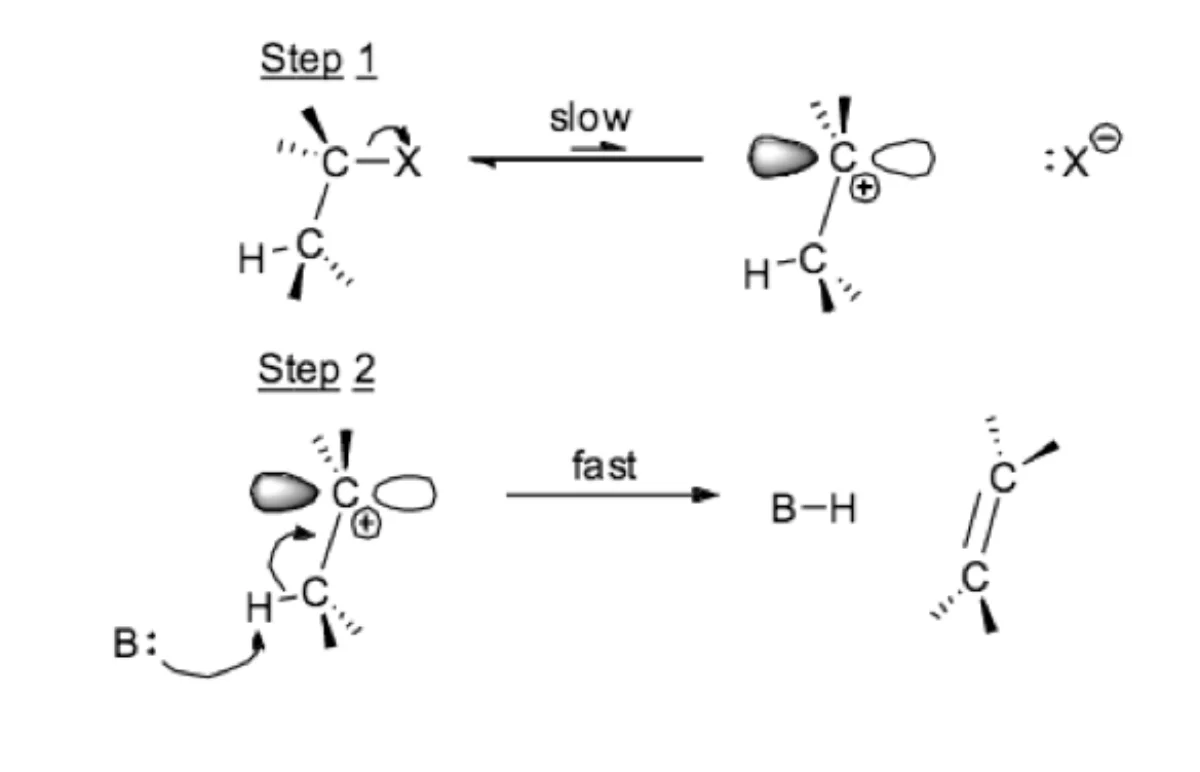
E1 is an elimination reaction - one where a hydrogen AND a leaving group depart from adjacent carbons to form a new pi bond (an alkene). Like SN1, E1 proceeds through a carbocation intermediate. The two mechanisms share the same first step. The only difference is what happens second: in SN1, a nucleophile attacks the carbon; in E1, a base plucks a hydrogen from the adjacent carbon and the resulting electrons form the C=C pi bond.
Because SN1 and E1 share a rate-limiting step, they often happen together. Any 3° substrate under polar protic conditions will give a mix of SN1 and E1 products. The balance depends on temperature and how aggressive the nucleophile-vs-base character is.
The Two-Step Mechanism
Step 1 (rate-limiting): ionization. Identical to SN1. The leaving group departs with both bond electrons, forming a carbocation. Slow step.
Step 2 (fast): proton loss. A base abstracts a hydrogen from a carbon adjacent to the carbocation (a “beta-hydrogen”). The electrons that were in the C-H bond flow into the C-C bond, forming the new pi bond.
Arrows for step 2: base’s lone pair attacks the beta-H (one arrow); the C-H bond electrons flow to the adjacent carbon to form the pi bond (a second arrow).
Overall result: the substrate loses an H from one beta-carbon and loses the LG from the central carbon, producing an alkene.
Rate Law: First Order
Rate = k [substrate]
Like SN1, the rate depends only on substrate concentration - the base is not in the rate law because it is not involved in the rate-limiting step. A mild base (water, alcohol, carboxylate) works fine. A strong base would probably push the mechanism toward E2 instead.
Substrate Preference: 3° > 2° >> 1°
Same as SN1: the carbocation must form. Tertiary substrates favor E1 most. Primary substrates essentially do not do E1 (the cation is too unstable).
Zaitsev’s Rule: The More Substituted Alkene Wins
When there are multiple possible beta-hydrogens, E1 gives the MORE SUBSTITUTED alkene as the major product. This is Zaitsev’s rule (sometimes spelled Saytzeff).
Example: 2-bromo-2-methylbutane under E1 conditions can lose H from either:
- The methyl group adjacent to the central cation, giving 2-methyl-1-butene (monosubstituted alkene).
- The methylene group further down, giving 2-methyl-2-butene (trisubstituted alkene).
Zaitsev predicts the trisubstituted alkene (2-methyl-2-butene) as the major product because it is the more stable alkene. More alkyl substituents on the C=C = more hyperconjugation = more stable.

Why Zaitsev Works for E1
E1 has a late transition state in the proton-loss step - the pi bond is mostly formed at the TS. The energy of the forming alkene dominates the TS energy, so the more stable (more substituted) alkene forms through a lower-energy TS. This is Hammond’s postulate: for an endothermic step (or reaction), product stability controls rate.
Students sometimes assume E1 and E2 both give Zaitsev. E2 also usually gives Zaitsev, but there is an important exception with bulky bases (Hofmann product preferred - see Section 5.9).
Acid-Catalyzed Dehydration of Alcohols
The most common E1 reaction on the MCAT is the dehydration of a tertiary (or secondary) alcohol by concentrated acid:
R-OH + H₂SO₄ → alkene + H₂O
Mechanism:
- Acid protonates the OH, converting it to H₂O (good leaving group).
- Water leaves to form a carbocation (SLOW, rate-limiting).
- Water (or the conjugate base of the acid) plucks a beta-H, forming the alkene.
The usual Zaitsev product dominates. If the initial cation can rearrange to a more stable cation before deprotonation, it will - so rearrangements are a real concern in E1 dehydration.
When E1 Beats SN1
Both SN1 and E1 go through the same cation. What happens next?
- If a nucleophile is present and attacks the cation fast → SN1.
- If a base grabs a beta-H fast → E1.
Heat shifts the balance toward E1 because elimination has a higher entropy change (one molecule becomes two - alkene + H-base), so the equilibrium and rate of elimination are enhanced at higher temperature.
In practice:
- Low temp + nucleophilic solvent (like cold methanol) → SN1 dominates.
- High temp + weakly nucleophilic solvent (like hot sulfuric acid for alcohol dehydration) → E1 dominates.
E1 with Rearrangements
Just like SN1, E1 passes through a real carbocation that has time to rearrange. If a 2° cation is produced and an adjacent carbon has a hydrogen or alkyl group that could migrate to form a 3° cation, the rearrangement will happen. The alkene product will form from the rearranged cation.
Example: 3-methyl-2-butanol under acidic dehydration. Initial protonation/ionization would give a 2° cation on C2, but a 1,2-hydride shift from C3 produces a 3° cation. Elimination from the 3° cation gives 2-methyl-2-butene (Zaitsev, trisubstituted) as the major product - not the alkene that would have formed from the unrearranged 2° cation.
Stereochemistry: Cis/Trans and E/Z
When E1 generates an alkene with two different substituents on each alkene carbon, geometric isomers (E/Z) are possible. Usually the more stable (trans/E) isomer dominates because the TS for its formation has less steric crowding. But mixtures can occur, especially when the alkyl groups are small.