Every aldehyde and ketone begins with the same feature: a carbon double-bonded to an oxygen (C=O), called a carbonyl group. The entire chemistry of this chapter flows from one fact about that bond: oxygen is much more electronegative than carbon, so the bonding electrons are pulled toward oxygen, leaving carbon partially positive. That partial positive carbon is the target of every nucleophilic attack to come.
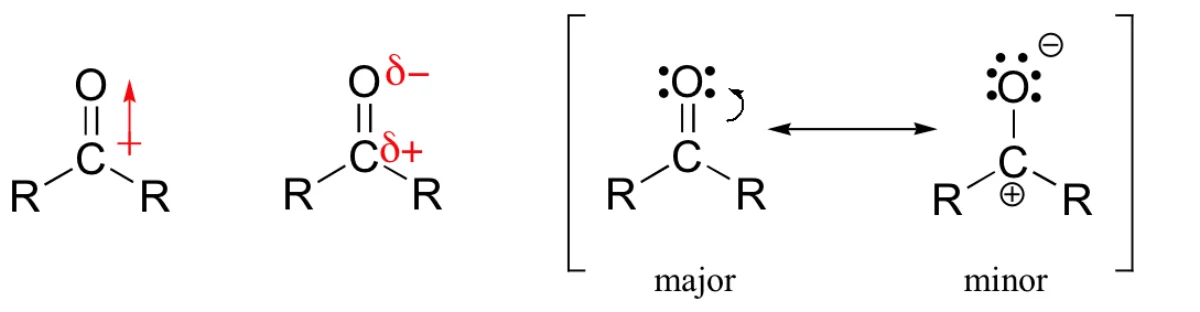
The carbonyl group: carbon is sp² hybridized and bonded by one sigma + one pi bond to oxygen. Oxygen pulls pi density toward itself, leaving carbon partially positive (δ⁺) and oxygen partially negative (δ⁻). Credit: Wikimedia Commons, CC BY-SA
Geometry and Hybridization
The carbonyl carbon is sp² hybridized: three sp² orbitals form sigma bonds (two to neighbors, one to oxygen), and the remaining p orbital forms the pi bond with oxygen. The result is a trigonal planar geometry with 120° bond angles around the carbon.
Oxygen in the carbonyl is also sp² hybridized. Two of its sp² orbitals hold lone pairs; the third forms the sigma bond to carbon. The remaining p orbital forms the pi bond.
The C=O bond length is about 1.22 Å - shorter than a C-O single bond (1.43 Å) and consistent with a double bond that also has partial ionic character.
The Polarized C=O Bond
Oxygen’s electronegativity (3.44 on the Pauling scale) is significantly higher than carbon’s (2.55). In the C=O bond, both the sigma and pi electron densities are pulled toward oxygen. Resonance structures make this explicit:
Major contributor: C=O neutral (double bond, no formal charges).
Minor contributor: C⁺−O⁻ (single bond, positive on C, negative on O).
The minor contributor is what gives carbonyl carbons their electrophilic character. Nucleophiles see the carbon as being partially positive (δ⁺), and the oxygen as being partially negative (δ⁻).
Resonance on the carbonyl: the minor contributor (C⁺−O⁻) shows why carbon is electrophilic. Nucleophiles attack at the δ⁺ carbon; the pi electrons flow onto oxygen. Credit: Wikimedia Commons, CC BY-SA
Dipole Moment
The C=O bond has a large dipole moment - about 2.3 to 2.7 D for typical aldehydes and ketones, compared to about 1.7 D for a C-O single bond. This dipole:
Makes carbonyls quite polar - they dissolve moderately in water and other polar solvents.
Raises boiling points of aldehydes and ketones above those of comparable alkanes or ethers (but below alcohols, which can H-bond).
Influences intermolecular interactions - carbonyls align partially in the pure liquid, with δ⁺ C aligning with δ⁻ O of a neighbor.
Why Aldehydes Are More Electrophilic Than Ketones
Recall from Chapter 4 that the electrophilicity of a carbonyl depends on what else is attached. Aldehydes have one alkyl group and one H. Ketones have two alkyl groups. Alkyl groups are weakly electron-donating (via induction and hyperconjugation), so they decrease the δ⁺ on the carbonyl carbon.
Aldehyde: 1 alkyl donor → moderate δ⁺.
Ketone: 2 alkyl donors → smaller δ⁺.
Consequence: aldehydes react faster than ketones with most nucleophiles. The same logic extends to the full reactivity ladder in Chapter 9 (acyl halides > anhydrides > aldehydes > ketones > esters > amides).
Steric Differences: Aldehyde vs. Ketone
Electronics aside, steric access to the carbonyl carbon also matters. Ketones have two bulky alkyl groups flanking the electrophilic carbon; aldehydes have one alkyl and one tiny H. Nucleophiles can approach an aldehyde’s carbonyl more easily, especially bulky nucleophiles like Grignards or hydride from LiAlH₄.
So aldehydes win on both counts - more electrophilic AND more accessible - and react faster than ketones in essentially every nucleophilic addition.
Acid Activation Amplifies Electrophilicity
Protonation of the carbonyl oxygen in acidic conditions dramatically increases the electrophilicity of the carbon. The protonated carbonyl (RR’C=OH⁺) has a full positive charge on oxygen, which pulls even more electron density off the carbon through the pi bond. The oxocarbenium-like resonance contributor becomes significant:
R₂C=O + H⁺ → R₂C=OH⁺ ↔ R₂C⁺−OH
Now the carbon is essentially a carbocation, and any weakly nucleophilic species (water, alcohol, amine) can attack it easily. This is why many carbonyl reactions are acid-catalyzed: the acid activates the electrophile.
The Universal Nucleophilic Addition Pattern
Every reaction in Chapter 6 follows the same three-step template:
Nucleophile attacks the carbonyl carbon. Arrow: Nu lone pair → C. Pi bond breaks, electrons flow to oxygen. Result: tetrahedral alkoxide intermediate.
Protonation of the alkoxide. The alkoxide oxygen picks up an H⁺ from solvent or added acid, giving a neutral alcohol or diol.
In some cases, subsequent steps (like acetal formation, imine dehydration, or further oxidation). These are the reaction-specific extras.
Steps 1 and 2 are universal. That is why all of this chapter’s reactions share the same opening arrows - just the nucleophile and the follow-up chemistry changes.
Why is the carbonyl carbon electrophilic, and why do nucleophiles attack there rather than at oxygen?
Click to reveal answer
The C=O bond is polarized because oxygen is much more electronegative (3.44) than carbon (2.55), pulling bond electrons toward oxygen. This leaves the carbon partially positive (δ⁺) and the oxygen partially negative (δ⁻). Nucleophiles attack at the carbon because that is where the empty/electron-poor site is. Oxygen already has the electrons it wants - a nucleophile attacking oxygen would just pile more negative charge onto an electron-rich atom, which is electrostatically unfavorable.
Both aldehydes and ketones have a C=O group, but they differ in what is attached to the carbonyl carbon. An aldehyde has at least one hydrogen on the carbonyl carbon (R-CHO). A ketone has two non-H substituents on the carbonyl carbon (R-CO-R’). The naming rules reflect this structural distinction with different suffixes.
Aldehyde Naming: -al Suffix
Aldehydes use the suffix “-al” replacing the final “-e” of the parent alkane name. Because the carbonyl carbon is always at the end of the chain (it has an H attached, so it must be terminal), the carbonyl carbon is automatically numbered 1.
CH₃CHO = ethanal (formerly acetaldehyde, a common name still used).
CH₃CH₂CHO = propanal.
CH₃CH₂CH₂CHO = butanal.
HCHO = methanal (common name: formaldehyde).
Since the aldehyde carbon is always C1, you do not need a locant number for the carbonyl position. Other substituents get numbered starting from C1 as usual.
Example: 3-methylbutanal is (CH₃)₂CHCH₂CHO. The aldehyde carbon is C1, the methyl branch is at C3.
Ketone Naming: -one Suffix
Ketones use the suffix “-one” replacing the final “-e” of the parent alkane name. Unlike aldehydes, ketones need a locant to specify where the C=O sits, because the carbonyl can be at various positions within the chain (though never at the end - that would be an aldehyde).
Numbering rules: give the carbonyl the lowest locant possible. If there are ties, use substituent priorities as usual.
Common Names You Should Know
A handful of carbonyl common names appear regularly:
Common name
IUPAC
Formaldehyde
methanal (HCHO)
Acetaldehyde
ethanal (CH₃CHO)
Benzaldehyde
benzaldehyde (C₆H₅CHO) - retained in IUPAC
Propionaldehyde
propanal
Acetone
propan-2-one
Methyl ethyl ketone (MEK)
butan-2-one
Acetophenone
1-phenylethanone or phenyl methyl ketone (C₆H₅COCH₃)
Benzophenone
diphenylmethanone (C₆H₅COC₆H₅)
Formaldehyde is especially common as the 37% aqueous solution called formalin - used as a tissue preservative and in histology.
When Carbonyl Coexists with Higher-Priority Groups
If a molecule has a functional group higher in priority (carboxylic acid, ester, amide), the aldehyde or ketone becomes a prefix rather than a suffix:
Aldehyde as prefix: -CHO in the middle of a chain is called “oxo-” (for the =O substituent) or “formyl-” when attached at the terminal position.
Ketone as prefix: =O in a chain becomes “oxo-” followed by the locant.
Example: HOOC-CH₂-CO-CH₃ is 3-oxobutanoic acid (carboxylic acid is the highest priority group, so -oic acid is the suffix; the ketone becomes 3-oxo-).
Cyclic Ketones
Cyclic ketones are named by placing the carbonyl carbon at C1 of the ring:
Cyclohexan-1-one: cyclohexane with a ketone at C1. Usually written “cyclohexanone.”
2-methylcyclopentan-1-one: cyclopentanone with a methyl at C2.
Dialdehydes and Diketones
Multiple carbonyls get multiplier prefixes:
Propanedial = OHC-CH₂-CHO.
Hexane-2,5-dione = CH₃-CO-CH₂-CH₂-CO-CH₃.
Pentane-2,4-dione (a classic 1,3-diketone, key substrate for Ch 7 enolate chemistry).
Stereo Prefixes for Conjugated Carbonyls
An alpha-beta unsaturated aldehyde or ketone (C=C-C=O) is called an enone. Example: but-3-en-2-one (methyl vinyl ketone, MVK) is CH₂=CH-CO-CH₃. This is the workhorse Michael acceptor in Ch 7.
Geometric (E/Z) isomerism of the C=C bond can be specified the usual way:
(E)-4-methylpent-3-en-2-one = (E)-mesityl oxide.
Give the IUPAC name for (CH₃)₂CH-CH₂-CHO and for cyclohexyl methyl ketone (cyclohexane with a -COCH₃ attached).
Click to reveal answer
(CH₃)₂CH-CH₂-CHO = 3-methylbutanal. The CHO is at C1 (automatically, since it's an aldehyde), and the methyl branch is at C3. Cyclohexyl methyl ketone = 1-cyclohexylethan-1-one (or 1-cyclohexylethanone), naming the 2-carbon ethanone chain as the parent and the cyclohexyl group as a substituent on C1.
Aldehydes and ketones have physical properties that sit between alkanes/ethers and alcohols. They do not have O-H bonds, so they cannot donate hydrogen bonds - but they have strong dipoles and can accept H-bonds from protic solvents. The result is boiling points higher than alkanes and ethers but lower than alcohols of similar molecular weight.
Boiling Points
Compare molecules of similar MW (≈ 72-74):
Compound
Structure
MW
Boiling point
Pentane
CH₃(CH₂)₃CH₃
72
36°C
Diethyl ether
CH₃CH₂OCH₂CH₃
74
35°C
Butanal
CH₃CH₂CH₂CHO
72
75°C
Butan-2-one
CH₃COCH₂CH₃
72
80°C
1-butanol
CH₃(CH₂)₃OH
74
118°C
The carbonyl dipole raises the boiling point by about 40°C above the alkane/ether. Alcohols (H-bond donors) add another 40°C on top of that.
Water Solubility
Short-chain aldehydes and ketones are water-soluble because the carbonyl oxygen’s lone pairs can accept H-bonds from water:
Acetone (propan-2-one): miscible with water in all proportions. Commonly used as a polar aprotic-ish solvent (technically it can accept H-bonds but not donate).
Formaldehyde (in 37% water = formalin): very soluble.
Butanone (MEK): fully miscible.
Larger ketones (e.g., 2-octanone): sparingly soluble - the hydrophobic tail overpowers the polar carbonyl.
The same rule of thumb as alcohols: one polar group can solvate ~3-5 carbons of hydrophobic tail. Beyond that, water solubility drops sharply.
The Carbonyl as a Hydrogen-Bond Acceptor
The carbonyl oxygen has two lone pairs available to accept H-bonds. This lets aldehydes and ketones dissolve in water and other protic solvents, and it makes acetone a versatile co-solvent for many polar reactions.
Note: aldehydes and ketones cannot donate H-bonds (they have no O-H or N-H bond). So in PURE aldehyde or ketone liquid, there are no H-bonds at all - just dipole-dipole interactions, London forces, and the weak C-H…O interaction.
Acidity of Alpha-Hydrogens
A specific physical/chemical property preview: the C-H bonds on carbons directly next to a carbonyl (the alpha-carbons) are much more acidic than regular C-H bonds. Alpha-H pKa is about 17-20 for aldehydes and ketones, versus ~50 for ordinary alkane C-H bonds. This is because the conjugate base (the enolate) is resonance-stabilized onto the carbonyl oxygen.
Alpha-acidity is the gateway to Chapter 7’s enolate chemistry: aldol condensations, Claisen condensations, Michael additions, and alpha-alkylations. Preview for now; deep dive next chapter.
Acetone (propan-2-one) is miscible with water in all proportions. Why, and how does this compare with hexan-2-one?
Click to reveal answer
Acetone is fully miscible because its polar carbonyl can accept H-bonds from water, and its small size (3 carbons) means the hydrophobic tail is short - the polar carbonyl dominates. Hexan-2-one has 6 carbons; the hydrophobic tail is much larger relative to the single carbonyl group. Water solubility drops to about 14 g/L (limited). The rule of thumb: one polar group solvates about 3-5 carbons; beyond that, the molecule behaves more like an alkane.
Every reaction of aldehydes and ketones with nucleophiles in this chapter follows the same mechanistic template. Once you know this template, the rest of the chapter is just learning which specific nucleophiles attack and what additional steps follow. Sections 6.5 through 6.10 all apply the template with different nucleophiles. Knowing the template is 80% of the work.
The Universal Three-Step Template
Step 1: Nucleophile attacks the carbonyl carbon. The nucleophile’s lone pair (or bond electrons for anionic reagents like hydride) flows to the electrophilic C. The pi bond of the C=O breaks, and the electrons flow onto the oxygen, making it an alkoxide (negatively charged oxygen).
Arrows: one from Nu’s lone pair → C, one from the C=O pi bond → O.
Result: a tetrahedral alkoxide intermediate - the carbon is now sp³ with four bonds (two original R groups, the new bond to Nu, and the O⁻).
Step 2: Protonation. The alkoxide oxygen picks up a proton from wherever one is available (solvent, acid catalyst, conjugate acid of the nucleophile).
Arrow: from alkoxide’s lone pair → H.
Result: a neutral tetrahedral alcohol with Nu attached to what was the carbonyl carbon.
Step 3 (reaction-specific): further transformations. Some additions stop here (hydride, Grignard). Others go further (hemiacetal → acetal, hemiaminal → imine, cyanohydrin stays as an alcohol-nitrile).
Watch the addition play out below. The Bürgi-Dunitz trajectory (107° from the C=O axis) is the canonical approach angle. Switch between nucleophiles to see how hydride, Grignard, alkoxide, water, and amines each take the same template to a different product.
Carbonyl nucleophilic addition
Interactive
Under Base Catalysis
When the nucleophile is already a good anion (hydroxide, alkoxide, hydride from NaBH₄, carbanion from Grignard), no acid is needed. The neutral nucleophile attacks, oxygen picks up a proton from solvent during aqueous workup, and you are done.
Base catalysis essentially means: use an already-activated anionic nucleophile. The mechanism: attack → alkoxide → protonation on workup.
Under Acid Catalysis
When the nucleophile is weak and neutral (water, alcohol, amine), acid catalysis speeds up the reaction dramatically. The mechanism shifts to:
Step 1a: Protonate the carbonyl oxygen. The oxygen’s lone pair accepts an H⁺, forming a protonated carbonyl (C=OH⁺). This gives the carbon even more δ⁺ character (essentially an oxocarbenium ion), making it a stronger electrophile.
Step 1b: Neutral nucleophile attacks the activated carbonyl. Weak nucleophiles can now attack because the electrophile is much stronger. The pi bond breaks, oxygen becomes neutral (it already accepted a proton, so now after pi collapse it is a neutral O-H).
Step 2: Deprotonation of the Nu. The newly-added nucleophile carries a proton that needs to leave. A water molecule or other base removes it.
Acid catalysis is essential for water addition to carbonyls, hemiacetal/acetal formation, imine formation, and most equilibrium-driven carbonyl reactions.
Why Addition Is Favorable
The net reaction converts a C=O pi bond (~180 kJ/mol) into a new C-Nu sigma bond (~350 kJ/mol) and a C-OH single bond (~360 kJ/mol after protonation). We trade one pi bond (~180 kJ/mol) for two sigma bonds (~700 kJ/mol combined). That is a large exothermic shift.
The reaction is reversible if the nucleophile is a good leaving group and conditions permit reversal. Water addition to aldehydes, for example, is reversible and generally lies toward the starting materials for most ketones (see Section 6.5).
Kinetics and Substrate Preference
Aldehydes react faster than ketones because:
Aldehydes are more electrophilic (one alkyl donor vs. two).
Aldehydes are less hindered sterically (one H + one R vs. two R).
Rate order: formaldehyde > aldehyde > ketone.
Within ketones, smaller ketones react faster than larger ones (less steric hindrance). Acetone is faster than di-isopropyl ketone.
Stereochemistry of Addition
If the nucleophile attacks a flat carbonyl (sp² carbon), it approaches from either face. For a prochiral ketone (two different alkyl groups plus two different faces), this produces a racemic mixture - equal amounts of each stereoisomer.
To get a single stereoisomer, you need either:
A pre-existing chiral environment in the substrate (diastereotopic faces).
A chiral nucleophile or a chiral catalyst (asymmetric synthesis, usually beyond MCAT scope).
For achiral substrates with achiral nucleophiles, expect racemic product mixtures. This is why Grignard additions to ketones usually yield racemic tertiary alcohols.
The Tetrahedral Intermediate and Its Fate
The tetrahedral alkoxide intermediate is the key branch point:
If it protonates cleanly → you get the alcohol product (most Grignard, hydride additions).
If a leaving group is attached to it (like an OR or Cl) → it can collapse to kick out the leaving group and re-form a new carbonyl. This is the pattern for carboxylic acid derivatives (Ch 9) - aldehydes and ketones do not have this option because they have no good leaving group.
If water is lost → gives an imine (when amine is nucleophile) or an enol (when another oxygen is in the mix). This is the pattern for imine formation and acetal formation.
Keeping track of whether the tetrahedral intermediate keeps all its attachments, loses water, or ejects a leaving group is the key to reading any carbonyl mechanism.
In the base-catalyzed addition of a Grignard reagent to a ketone, what is the role of the aqueous acidic workup at the end?
Click to reveal answer
The acidic workup protonates the magnesium alkoxide intermediate (the tetrahedral intermediate with O⁻ after Grignard attack) to give the final neutral alcohol product. Before workup, the product is a magnesium salt (R-O-MgBr). The acid supplies H⁺ to convert the alkoxide to the alcohol (R-OH). Water alone would work, but mild acid (dilute HCl or NH₄Cl) speeds up protonation and solubilizes the magnesium salts so they can be washed away.
Adding water across a C=O bond gives a gem-diol (a geminal diol): two -OH groups attached to the same carbon. These are also called hydrates. The reaction is an equilibrium - for most aldehydes and ketones, the equilibrium strongly favors the free carbonyl (no hydrate), but for a few specific substrates, the hydrate dominates.
Hydration is the simplest nucleophilic addition to cover because the only thing attacking the carbonyl is water. Understanding when hydrates are stable helps you recognize anomalies on the MCAT (like why “formalin” is a 37% aqueous solution of formaldehyde, which is really almost entirely methanediol).
The Mechanism (Acid-Catalyzed)
Protonation of carbonyl. H⁺ (from catalyst) protonates the carbonyl oxygen, activating the electrophile.
Water attacks. Water’s lone pair attacks the protonated carbonyl carbon. Pi bond breaks, electrons flow to oxygen (which was already protonated, so now it’s O-H neutral). Now a tetrahedral oxocarbenium (really a neutral alcohol with a positively charged oxygen, which is water attached via its oxygen).
Deprotonation. Water removes a proton from the added oxygen, giving the neutral gem-diol.
Net result: R₂C=O + H₂O → R₂C(OH)₂ (gem-diol).
The Hydration Equilibrium
The equilibrium constant for carbonyl + water ⇌ gem-diol depends heavily on the substrate:
Substrate
Keq (hydrate : carbonyl)
% hydrate in water
Formaldehyde (HCHO)
~2000
>99%
Acetaldehyde (CH₃CHO)
~1
~50%
Acetone ((CH₃)₂CO)
~0.002
<0.1%
Chloral (Cl₃CCHO)
~10⁴ (order of magnitude; sources vary)
>99% (stable solid: chloral hydrate)
Benzaldehyde (PhCHO)
very low
essentially carbonyl only
Two factors determine the equilibrium position:
Electronic effect (inductive): electron-withdrawing groups nearby (chlorine, fluorine) stabilize the gem-diol (they reduce the partial positive character on the carbon when it has two electron-donating OH groups vs. a carbonyl). So chloral (CCl₃CHO) has a stable hydrate.
Steric effect: bulky alkyl groups destabilize the gem-diol (crowding around the sp³ tetrahedral carbon). So acetone and larger ketones have very low hydrate concentrations.
Resonance/other effects: aromatic substituents (like in benzaldehyde) stabilize the carbonyl side through resonance with the ring, disfavoring the hydrate.
Why Formaldehyde Is Mostly Hydrated in Water
Formaldehyde has:
Two hydrogens (minimum steric hindrance on the sp³ tetrahedral diol form).
No electron donor groups (the partial positive on C in the carbonyl is high, so water is eager to add).
Small substrate (no resonance help for the C=O side).
Result: aqueous formaldehyde is almost entirely methanediol (H₂C(OH)₂), which is in equilibrium with a small amount of free HCHO. “Formalin” (37% HCHO in water) is technically a solution of the hydrate, but the equilibrium constantly regenerates HCHO, which is what fixes tissues (by reacting with amines in proteins).
Chloral Hydrate: The Famous Case
Chloral (CCl₃CHO) has three chlorines strongly withdrawing electrons from the carbonyl carbon. When water adds, the tetrahedral gem-diol is more stable than the parent carbonyl because the C is no longer excessively electrophilic. Chloral hydrate (CCl₃CH(OH)₂) is a stable crystalline solid that was used historically as a sedative.
Kinetics: Slow Without Catalyst
Water addition to carbonyls is slow at neutral pH. Acid catalysis speeds it up (protonates the carbonyl) and base catalysis speeds it up (generates hydroxide, a much stronger nucleophile than water).
Hydration in Biochemistry
In glycolysis and the TCA cycle, several enzymes add water across a carbonyl or enol intermediate. Fumarase adds water to fumarate to give malate. Aconitase isomerizes citrate via a dehydration-rehydration sequence. These enzymes handle the kinetics (which would otherwise be slow) by precise positioning of general acids and bases in the active site.
Carbonyl Hydration as a Model for Other Additions
The hydration equilibrium gives you a mental model for other nucleophilic additions. Conditions that stabilize the carbonyl-form (bulky alkyls, aromatic substituents, electron-donating groups) will disfavor ALL nucleophilic additions. Conditions that destabilize the carbonyl (electron-withdrawing groups, small substituents) will favor ALL nucleophilic additions.
So aldehydes react faster than ketones not just with water but with alcohols, amines, hydride, and Grignards. The hydration equilibrium is a good proxy for general carbonyl reactivity.
Why is chloral (CCl₃CHO) present almost entirely as its hydrate (chloral hydrate, CCl₃CH(OH)₂) in water, while acetone is barely hydrated at all?
Click to reveal answer
Chloral's three chlorines strongly withdraw electrons from the carbonyl carbon, making it extremely electrophilic. Water adds readily, and the resulting gem-diol is more stable than the free carbonyl because two -OH groups reduce the excess positive character. Acetone has two methyl donors that reduce electrophilicity AND create steric crowding on the tetrahedral sp³ form, so the equilibrium strongly favors the carbonyl. Electron-withdrawing substituents + small substrate = stable hydrate. Electron-donating substituents + bulky substrate = hydration unfavorable.
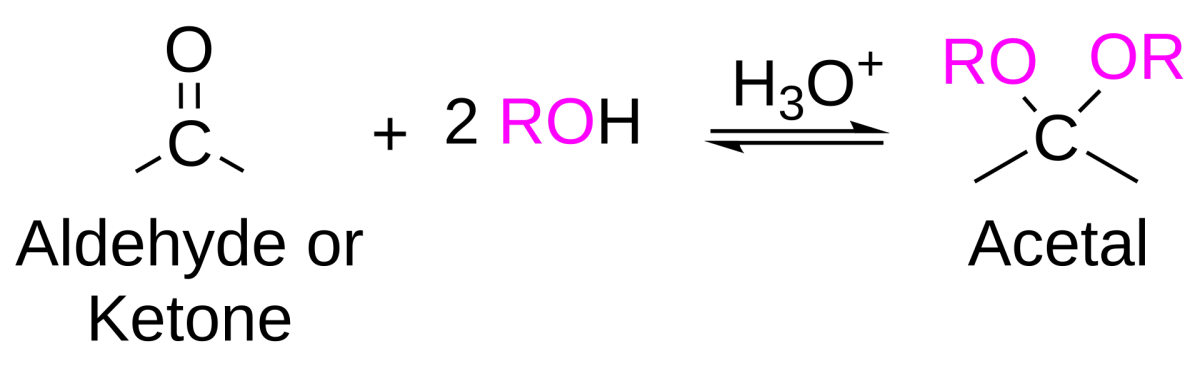
When an alcohol adds to an aldehyde or ketone, you get a hemiacetal (half-acetal: one OR and one OH on the same carbon). Add a second alcohol and you get an acetal (two OR groups on the same carbon, no free OH). These additions are acid-catalyzed, reversible, and critically important in both synthesis (as protecting groups) and biology (the cyclic forms of sugars are intramolecular hemiacetals).
Hemiacetal formation: alcohol adds to an aldehyde under acid catalysis to give a hemiacetal (one OR, one OH on the same carbon). Credit: Wikimedia Commons, CC BY-SA
Hemiacetal Formation (Step 1)
The mechanism is the standard acid-catalyzed addition:
Protonation of carbonyl oxygen (H⁺ on carbonyl O).
Alcohol’s lone pair attacks the activated carbonyl carbon.
Deprotonation of the OR group on the tetrahedral intermediate.
Net: R-OH + R’-CO-R” → R’-C(OH)(OR)-R”. The carbon now has one -OH and one -OR.
Hemiacetals are usually UNSTABLE as isolated compounds - they exist in equilibrium with the open-chain carbonyl + alcohol. There are two important exceptions:
Cyclic hemiacetals in sugars - when the alcohol and carbonyl are on the same molecule (intramolecular), the cyclic hemiacetal can be quite stable. This is why glucose is mostly in its pyranose (six-membered cyclic hemiacetal) form in solution.
Lactols - cyclic hemiacetals of 4- or 5-ring size are isolable and sometimes useful.
Acetal Formation (Step 2)
In the presence of excess alcohol and acid, the hemiacetal loses water and reacts with a second alcohol to give an acetal:
Protonation of the hemiacetal OH.
Loss of water (the protonated OH leaves as water), giving an oxocarbenium ion (R’-C⁺(OR)-R”).
Second alcohol attacks the oxocarbenium.
Deprotonation gives the neutral acetal.
Net: hemiacetal + R-OH → acetal + H₂O.
The acetal has two OR groups on the same carbon, no free OH, and no carbonyl. It looks like a “diether” at that carbon.
Acetal formation: the hemiacetal loses water to form an oxocarbenium intermediate, then a second alcohol adds to give the acetal. The overall reaction is acid-catalyzed and reversible. Credit: Wikimedia Commons, CC BY-SA
Driving the Equilibrium
Acetal formation is reversible. To push the equilibrium toward the acetal, chemists use:
Excess alcohol (Le Chatelier: more reactant drives forward).
Water removal (Dean-Stark trap, molecular sieves) to prevent the reverse reaction.
Cyclic diols (ethylene glycol, propane-1,3-diol) to form cyclic acetals, which are entropically favored (one molecule forms instead of two).
Conversely, to hydrolyze an acetal back to the carbonyl, you use excess water and catalytic acid - the reverse conditions.
Why Acetals Are Great Protecting Groups
Acetals are stable under basic conditions but cleave cleanly in acid. This selective stability makes them ideal protecting groups for carbonyls.
Typical use: you have a molecule with both an ester and a ketone. You want to reduce the ester to an alcohol using LiAlH₄, but LiAlH₄ also reduces ketones. Solution:
Convert the ketone to a cyclic acetal (with ethylene glycol + acid catalyst + water removal).
Run LiAlH₄ on the ester (the acetal is stable under these conditions - no water, no acid).
Hydrolyze the acetal back to the ketone (aqueous acid).
This three-step sequence selectively reduces the ester while leaving the ketone intact.
Sugars as Intramolecular Hemiacetals
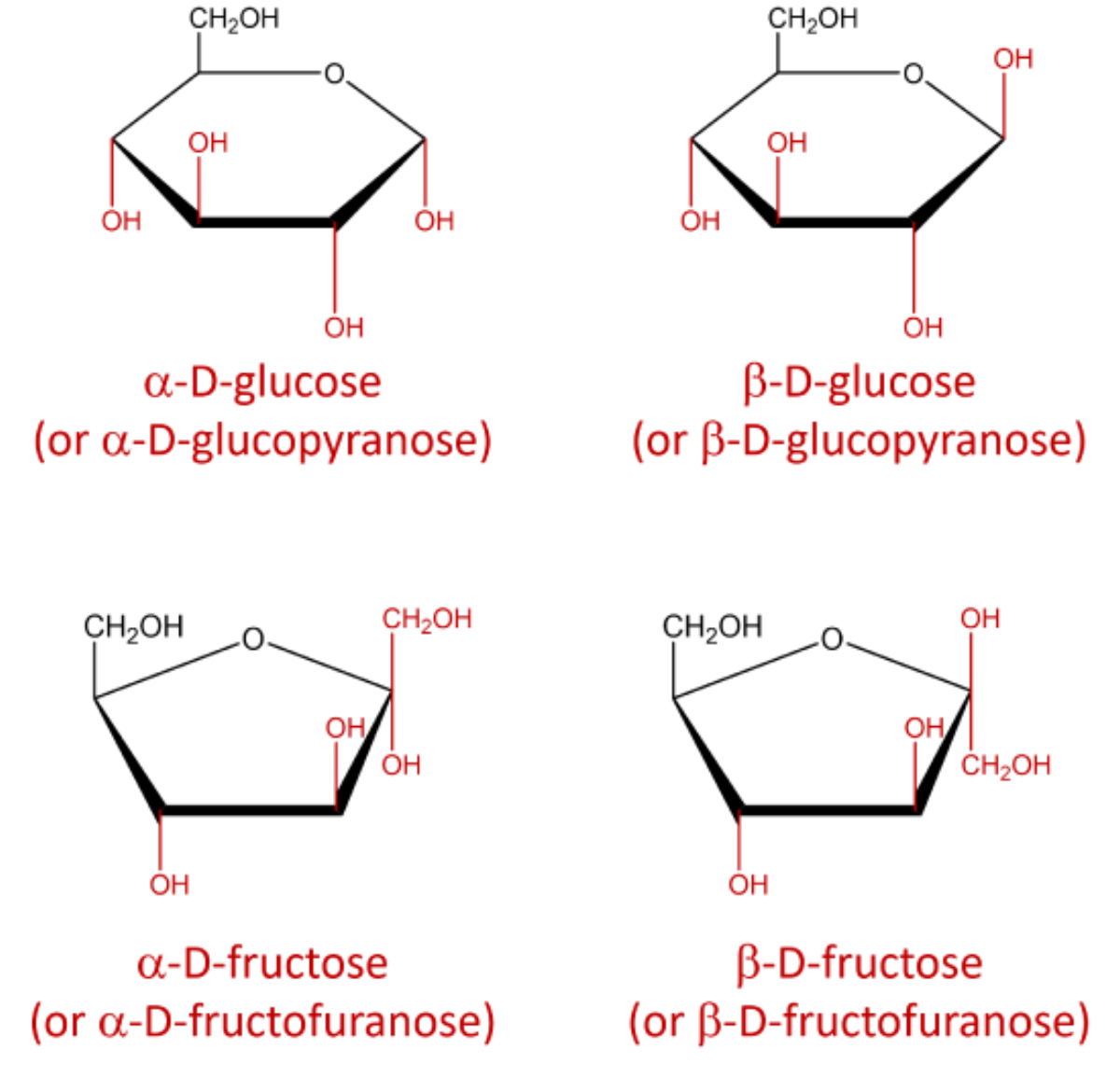
Glucose is drawn in organic chemistry textbooks as an open-chain aldehyde with five OH groups. But in water, glucose exists >99% as a six-membered cyclic hemiacetal (the pyranose form). The OH on C5 attacks the aldehyde carbonyl on C1 to form a new C-O bond, closing the ring.
The carbon bearing the new OH group (C1 in glucose) is called the anomeric carbon. It can be either alpha (OH axial, down) or beta (OH equatorial, up) depending on which face of the open aldehyde was attacked. These two anomers interconvert through the open-chain form - a process called mutarotation.
Fructose forms a furanose (5-membered) ring via intramolecular hemiacetal of its C2 ketone carbonyl with the C5 OH.
Haworth projections: glucose cyclizes to a 6-membered pyranose via intramolecular hemiacetal formation between C1 (aldehyde) and C5 (-OH). Fructose cyclizes to a 5-membered furanose via C2 (ketone) + C5 (-OH). Both are the dominant forms in aqueous solution. Credit: Wikimedia Commons, CC BY-SA
Disaccharides (like sucrose and lactose) contain a glycosidic bond - an acetal linkage between the anomeric carbon of one sugar and a hydroxyl of another. Sucrose, for example, has an acetal linkage because BOTH anomeric carbons are tied up in the bond.
The Acetal in Biochemistry
The glycosidic bonds that connect sugars in polysaccharides (starch, glycogen, cellulose) are acetals. They are stable enough to form the structural backbone of these biomolecules but can be hydrolyzed back to glucose by enzymes (amylase, cellulase). The same acid-labile, base-stable pattern from lab synthesis appears in biology.
A chemist wants to reduce an ester selectively without touching a ketone in the same molecule using LiAlH₄. Outline the three-step strategy.
Click to reveal answer
Step 1: Protect the ketone as a cyclic acetal (treat with ethylene glycol + acid catalyst, removing water). Step 2: Reduce the ester using LiAlH₄. The acetal is stable under basic/neutral conditions and tolerates the hydride. Step 3: Hydrolyze the acetal back to the ketone with aqueous acid. Net result: the ester became a 1° alcohol, while the ketone was restored unchanged. This protect-react-deprotect sequence is a standard move in multi-step synthesis.
When cyanide (CN⁻) attacks an aldehyde or ketone, the product is a cyanohydrin - a molecule with both a hydroxyl group (-OH) and a nitrile group (-CN) on the same carbon. Cyanide is a classic small nucleophile that adds cleanly to most aldehydes and ketones, and cyanohydrins serve as versatile intermediates in synthesis because the nitrile can be hydrolyzed to a carboxylic acid or reduced to an amine.
The Mechanism
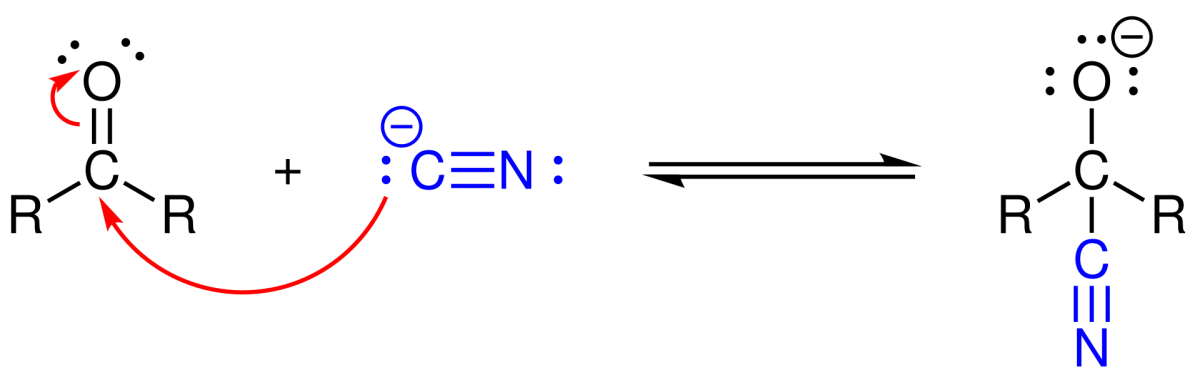
Cyanohydrin formation is a textbook base-catalyzed addition:
Generation of cyanide. HCN is weakly acidic (pKa ~9.2), so a mild base (KCN, NaCN, or even K₂CO₃ + HCN) gives cyanide ion.
Cyanide attacks the carbonyl carbon. The carbon of CN⁻ is the nucleophilic atom (not the nitrogen, because the sp-hybridized carbon has the exposed lone pair). Attack on the C of the aldehyde/ketone gives a tetrahedral alkoxide intermediate.
Protonation. The alkoxide is protonated by HCN or by solvent to give the neutral cyanohydrin.
Cyanohydrin formation: cyanide's carbon (the nucleophilic atom) attacks the carbonyl carbon. The pi bond electrons flow onto oxygen; protonation of the alkoxide gives the neutral cyanohydrin with both -OH and -CN on the former carbonyl carbon. Credit: Wikimedia Commons, CC BY-SA
Reversibility and Equilibrium
Cyanohydrin formation is reversible. Under basic conditions (or with excess HCN), the equilibrium favors the cyanohydrin. Under aqueous neutral conditions, the balance shifts depending on substrate:
Aldehydes: equilibrium favors the cyanohydrin (aldehydes are reactive electrophiles).
Ketones: equilibrium is less favorable, often roughly 50-50 for simple ketones.
Sterically hindered ketones (di-tert-butyl ketone): equilibrium far to the left, cyanohydrin minimal.
Aromatic ketones: equilibrium toward carbonyl (resonance stabilizes the starting material).
The same steric + electronic logic from carbonyl hydration (Section 6.5) applies here.
Why the C of Cyanide Attacks, Not the N
Cyanide has lone pairs on both carbon and nitrogen, but only the CARBON end has an sp hybrid orbital holding a free lone pair. The nitrogen’s lone pair is in the pi system of the triple bond and is not available for bonding (using it would disrupt the triple bond).
In effect, CN⁻ behaves as a carbon nucleophile with nitrogen as a spectator. The new C-C bond in the cyanohydrin is between the old carbonyl carbon and the cyanide carbon.
Strecker Synthesis of Amino Acids
Cyanide addition to aldehydes combined with ammonia (or an amine) is the Strecker synthesis of alpha-amino acids, a classic textbook reaction:
Aldehyde + NH₃ → imine (Section 6.8).
Imine + HCN → alpha-aminonitrile.
Hydrolysis of the nitrile (with H₃O⁺) → alpha-amino acid.
Net: RCHO + NH₃ + HCN → R-CH(NH₂)-COOH.
Strecker synthesis is explicitly listed on the AAMC outline. It is one of the two main ways to make alpha-amino acids in the lab (the other is Gabriel synthesis via phthalimide; see Ch 10).
Downstream Chemistry: What Cyanohydrins Can Become
The nitrile group (-CN) in a cyanohydrin is a versatile functional group that can be transformed several ways:
Acid hydrolysis (H₂O / H₂SO₄ / heat) → alpha-hydroxy carboxylic acid. The nitrile becomes a COOH.
Reduction (LiAlH₄ or H₂/Pt) → alpha-hydroxy amine. The nitrile becomes a CH₂NH₂.
Grignard-like alkylation on the nitrile → alpha-hydroxy ketone. The nitrile becomes a ketone.
So a cyanohydrin is effectively a three-way synthetic intermediate. Many MCAT passages will feature this conversion.
Biological Parallel: Cyanide Poisoning
Biologically, cyanide is a potent toxin because it binds tightly to the Fe(III) in cytochrome c oxidase (Complex IV of the ETC), blocking cellular respiration. This is unrelated to the cyanohydrin chemistry you just learned - but it is a common MCAT biology topic, and the underlying feature (cyanide’s small, potent nucleophilicity) is the same.
Stereochemistry
Cyanohydrin formation creates a new stereocenter at the carbon that was the carbonyl carbon. For an achiral aldehyde/ketone with achiral HCN, the product is racemic (50:50 mixture of enantiomers). Enzymes (like oxynitrilase in almonds) can produce enantiopure cyanohydrins - an example of asymmetric catalysis.
Design a synthesis of lactic acid (2-hydroxypropanoic acid, CH₃CH(OH)COOH) starting from acetaldehyde.
Click to reveal answer
Step 1: Acetaldehyde + HCN (with catalytic base or at neutral pH) → cyanohydrin: CH₃CH(OH)CN (2-hydroxypropanenitrile). Step 2: Acid hydrolysis (H₂O/H₂SO₄/heat) converts the -CN to -COOH, giving CH₃CH(OH)COOH (lactic acid, 2-hydroxypropanoic acid). Note: the product is racemic because the aldehyde is achiral and both faces accept HCN equally. To get one enantiomer, you would need a chiral catalyst or enzyme.
Amines are excellent nucleophiles for carbonyl addition because nitrogen’s lone pair is highly available and basic. The product of the addition depends on whether the amine is primary (one R group on N) or secondary (two R groups on N):
Primary amine (R-NH₂) + aldehyde/ketone → imine (C=N-R) + water. A new C=N double bond forms; the nitrogen keeps one H.
Secondary amine (R₂NH) + aldehyde/ketone → enamine (C=C-NR₂) + water. A C=C double bond forms on the adjacent carbon; the nitrogen keeps both R groups.
Imines are also called Schiff bases in biochemistry and are critical in enzyme mechanisms (e.g., fructose-1,6-bisphosphate aldolase uses a lysine-derived Schiff base).
Imine Formation (from Primary Amines)
The mechanism is a multi-step acid-catalyzed sequence:
Acid protonation of carbonyl. Standard activation.
Amine attacks. Nitrogen’s lone pair attacks the carbonyl carbon, forming a protonated tetrahedral alcohol (hemiaminal intermediate).
Deprotonation and protonation shuffle. The N-H is deprotonated, then the OH on the same carbon is protonated (an alcohol-like tautomer).
Water loss. The now-protonated OH leaves as water, forming a new iminium cation (C=N⁺-H).
Deprotonation. The iminium loses its N-H proton to give the neutral imine (C=N-R).
Net: R-CO-R’ + R”-NH₂ → R-C(=N-R”)-R’ + H₂O.
Imine formation mechanism: acid-protonated carbonyl is attacked by the amine, forming a hemiaminal; subsequent proton shuffling and water loss give the iminium, which deprotonates to the neutral imine. Credit: Wikimedia Commons, CC BY-SA
pH Dependence of Imine Formation
Imine formation is strongly pH-dependent with an optimum around pH 4-5:
Too acidic (pH < 3): the amine is fully protonated to ammonium (R-NH₃⁺), which has no lone pair available to attack. Reaction is slow.
Too basic (pH > 7): the carbonyl is not protonated enough to be activated, and water loss is also slow without acid catalysis.
Optimal (pH 4-5): the amine is partially free (still basic pKa ~9-10, so some neutral NH₂), and acid is available to catalyze the water-loss step.
This “bell-shaped” pH profile is a classic MCAT topic, especially in biochemistry contexts where enzymes operate at specific pH.
Enamine Formation (from Secondary Amines)
When a secondary amine attacks, the same mechanism starts (amine attacks carbonyl, tetrahedral hemiaminal forms). But after water loss, there is no N-H proton to remove (both N substituents are R groups, not H). Instead, an ALPHA-HYDROGEN on the adjacent carbon is removed, and the C-C double bond forms.
Net: R-CH₂-CO-R’ + R”₂NH → R-CH=C(NR”₂)-R’ + H₂O.
The nitrogen lone pair is now in conjugation with the new C=C, giving an enamine. Enamines are important nucleophiles in their own right - they are used in the Stork enamine synthesis to alkylate ketones at the alpha-carbon (a preview of Chapter 7).
Schiff Bases in Biology
Lysine side chains in enzymes provide the NH₂ group that forms Schiff bases with aldehydes, ketones, and pyridoxal phosphate (vitamin B6). Examples:
Aldolase (class I) forms a Schiff base between a lysine NH₂ and fructose-1,6-bisphosphate’s C2 ketone, facilitating the aldol cleavage.
PLP (pyridoxal phosphate) forms a Schiff base with amino acid amines in transaminase reactions.
Retinal in rhodopsin is a Schiff base with a lysine; cis-trans isomerization of retinal’s polyene under light starts the visual signaling cascade.
These biological Schiff bases are usually protonated (iminium ion, C=N⁺-H), which makes the adjacent alpha-carbon more acidic and the system more reactive.
Reductive Amination
Combining imine formation with a hydride reduction gives a powerful synthetic method: reductive amination. Steps:
Aldehyde or ketone + primary amine → imine (in situ).
NaBH₃CN is a mild hydride source that reduces imines (C=N) at low pH but does NOT reduce carbonyls (C=O) efficiently. This selectivity is key to reductive amination: the imine forms and gets reduced, while the starting carbonyl is not competitively reduced.
Reductive amination is the main lab method for converting carbonyls + amines into secondary or tertiary amines with one extra C-N bond. It is especially common in drug synthesis.
Reductive amination: aldehyde/ketone + amine → imine (in situ) → amine (reduction by NaBH₃CN). The mild cyanoborohydride reduces only the imine, not the starting carbonyl, giving a clean product. Credit: Wikimedia Commons, CC BY-SA
Wittig Precursor: Phosphonium Ylides
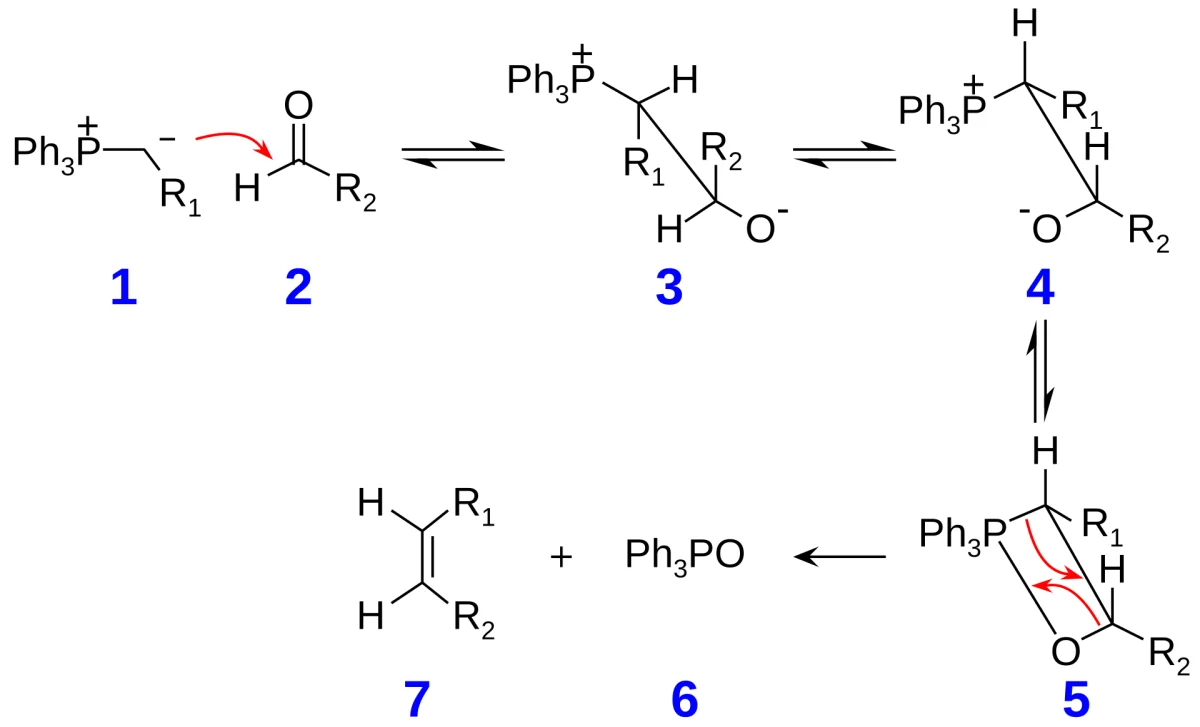
As a small segue: the Wittig reaction uses a phosphonium ylide (Ph₃P=CR₂) to convert a ketone or aldehyde directly into an alkene, with loss of phosphine oxide. The mechanism starts with nucleophilic addition of the ylide carbon to the carbonyl carbon, then a cyclic betaine intermediate decomposes to alkene + phosphine oxide. This is covered in Chapter 10 under Nitrogen- and Phosphorus-containing compounds.
Wittig reaction mechanism: the ylide's nucleophilic carbon attacks the carbonyl, forming a four-membered oxaphosphetane. The ring collapses to give a new C=C alkene and triphenylphosphine oxide byproduct. Geometry of the alkene depends on the ylide (stabilized vs unstabilized). Credit: Wikimedia Commons, CC BY-SA
Predict the product when acetone reacts with (a) methylamine (CH₃NH₂) and (b) dimethylamine ((CH₃)₂NH) under acid catalysis.
Click to reveal answer
(a) With methylamine (primary amine): forms N-methylpropan-2-imine (CH₃)₂C=N-CH₃, an imine with the methylamine's H removed. (b) With dimethylamine (secondary amine): forms an enamine, 1-(dimethylamino)prop-1-ene, (CH₃)₂N-CH=C-CH₃ (with the double bond shifted to an alpha-carbon because N has no H to lose). Primary → imine via N-H loss. Secondary → enamine via alpha-C-H loss.
Hydride (H⁻) is the simplest nucleophile that can reduce a carbonyl. But free H⁻ is too reactive to handle; instead, chemists use borohydride or aluminum hydride reagents that deliver hydride in a controlled way. The two workhorses are NaBH₄ (mild) and LiAlH₄ (strong). Their selectivity difference is one of the most important practical distinctions in synthesis - and a recurring MCAT topic.
NaBH₄: The Mild Reducing Agent
Sodium borohydride (NaBH₄) reduces:
Aldehydes → primary alcohols.
Ketones → secondary alcohols.
NaBH₄ does NOT reduce:
Esters, carboxylic acids, amides, nitriles (too unreactive for borohydride).
Alkenes, alkynes.
Why selective? The B-H bond in NaBH₄ is only moderately polarized - the hydride is not strongly nucleophilic. It can attack highly electrophilic aldehydes and ketones but fails on less-reactive carbonyls (esters, amides) where the electron-donating OR or NR₂ groups reduce electrophilicity.
NaBH₄ tolerates water and alcohols as solvents (it is slow to react with them at 0°C to room temperature). Protic solvents are actually useful for the mechanism because they supply the proton needed to convert the alkoxide intermediate to the alcohol product.
LiAlH₄: The Strong Reducing Agent
Lithium aluminum hydride (LiAlH₄) reduces:
Aldehydes → primary alcohols.
Ketones → secondary alcohols.
Carboxylic acids → primary alcohols.
Esters → primary alcohols (+ alcohol byproduct from the OR group).
Amides → amines (does NOT give alcohol; the amide nitrogen stays, gets a new C-H bond).
Nitriles → primary amines.
Alkyl halides → alkanes (rarely used for this).
Epoxides → alcohols.
LiAlH₄ does NOT reduce:
Alkenes (slowly, if at all).
Benzene rings (no).
LiAlH₄ is a much stronger reducing agent because Al-H bonds are more polarized than B-H bonds (Al is less electronegative than B, so the H is more hydride-like).
LiAlH₄ is extremely sensitive to water, alcohols, and any acidic proton. It reacts violently with these, producing H₂ gas and potentially fires. It must be used in dry anhydrous ether or THF. Workup with aqueous acid (or a controlled quench with ethyl acetate) is required at the end.
The Mechanism
Both reagents deliver hydride to the carbonyl carbon via the same basic mechanism:
Hydride attacks the carbonyl carbon. The nucleophilic hydride pushes into the electrophilic C. The pi bond breaks, electrons flow to oxygen. Tetrahedral alkoxide intermediate forms.
Workup. The alkoxide is protonated by water or acid during workup, giving the alcohol.
For NaBH₄: the mechanism is usually drawn with direct hydride delivery from borohydride, with the borate byproduct handling subsequent equivalents. NaBH₄ can deliver up to four hydrides per molecule (4 H per B).
For LiAlH₄: similar, with AlH₃, AlH₂⁻, AlH⁻, and Al intermediates as the hydrides are delivered one at a time. LiAlH₄ also delivers 4 H per Al.
Stereochemistry
Both NaBH₄ and LiAlH₄ attack the carbonyl from whichever face is more accessible. For most substrates, this gives a roughly random approach and racemic products (or the more stable diastereomer for chiral substrates).
For stereospecific reductions, asymmetric reducing agents (CBS catalyst, Corey-Bakshi-Shibata; BINAL-H) or chiral ligand systems are used. These are rarely on the MCAT.
Practical Selectivity Table
Substrate
NaBH₄ product
LiAlH₄ product
Aldehyde (RCHO)
1° alcohol (RCH₂OH)
1° alcohol (RCH₂OH)
Ketone (R₂CO)
2° alcohol (R₂CHOH)
2° alcohol (R₂CHOH)
Carboxylic acid (RCOOH)
no reaction
1° alcohol (RCH₂OH)
Ester (RCOOR’)
no reaction
1° alcohol (RCH₂OH) + R’OH
Amide (RCONR’₂)
no reaction
amine (RCH₂NR’₂)
Nitrile (RCN)
no reaction
primary amine (RCH₂NH₂)
Epoxide
slow, 2° alcohol (substituent-selective)
2° alcohol
Alkene
no reaction
no reaction
Choosing the Right Reagent
Need to reduce only aldehydes/ketones, leave esters/amides alone: NaBH₄.
Need to reduce an ester to a primary alcohol: LiAlH₄.
Need to reduce an amide to an amine: LiAlH₄.
Need to reduce a nitrile to a primary amine: LiAlH₄.
Need to reduce a ketone but protect a nearby ester: NaBH₄.
The MCAT almost always gives you the substrate and asks which product forms. If you recall the selectivity table, you win every time.
A substrate contains a ketone AND a methyl ester. You want to reduce only the ketone. Which reducing agent do you use?
Click to reveal answer
NaBH₄. Sodium borohydride is mild and selective - it reduces ketones and aldehydes but leaves esters, carboxylic acids, and amides untouched. LiAlH₄ would reduce both the ketone and the ester (to their respective alcohols), so it would not be selective. NaBH₄ gives the desired 2° alcohol while the ester is preserved.
Organometallic reagents (R-M, where M = Mg, Li, Cu) are the premier tool for making carbon-carbon bonds with carbonyls. The specifics depend on which metal you use. Grignards (R-MgX) attack aldehydes and ketones at the carbonyl carbon (1,2-addition). Gilman reagents (R₂CuLi) prefer the beta-carbon of enones (1,4-conjugate addition, a.k.a. Michael addition).
The Grignard story was introduced in Chapter 5 (alcohols); this section reviews and extends it to the broader alpha-beta unsaturated system.
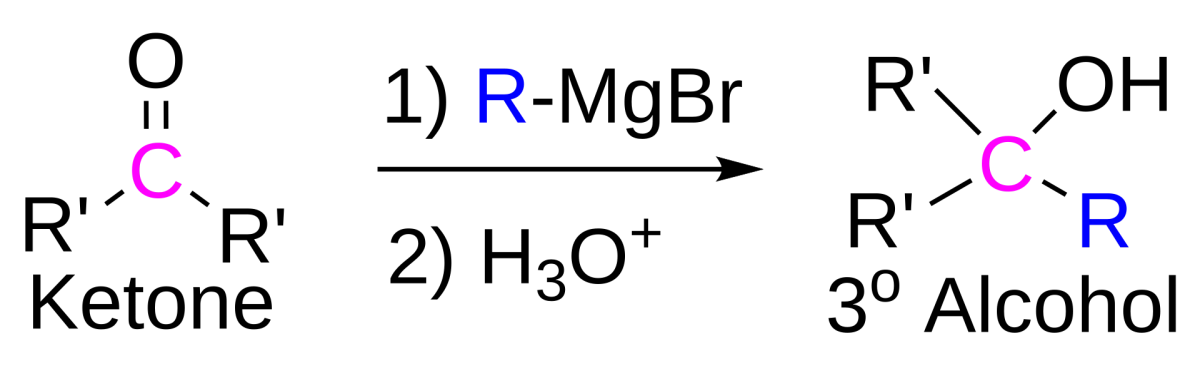
Grignard + ketone → 3° alcohol after aqueous workup. The Grignard's carbanionic carbon attacks the electrophilic carbonyl carbon, pushing pi electrons onto oxygen to form an alkoxide, then protonation gives the alcohol. Credit: Wikimedia Commons, CC BY-SA
Grignard Addition to Carbonyls (Review + Extension)
Grignard reagents (R-MgX) behave as carbanion equivalents. The Mg-C bond is highly polarized, so the R group acts as a nucleophile and attacks the electrophilic carbonyl carbon:
Carbonyl
Grignard product
Formaldehyde (HCHO)
1° alcohol (R-CH₂OH)
Aldehyde (R’CHO)
2° alcohol (R-CHOH-R’)
Ketone (R’COR”)
3° alcohol (R-COH-R’R”)
Ester (R’COOR”)
3° alcohol with 2 R groups added (double addition)
Nitrile (RCN)
Ketone after hydrolysis
CO₂
Carboxylic acid
Epoxide
Alcohol (ring opens at less substituted C)
The Grignard always forms a new C-C bond between its R group and the carbonyl/electrophilic carbon. This is the primary utility of Grignards in synthesis: extending carbon chains and building tertiary alcohols.
Why Grignards Give 1,2-Addition (Not 1,4)
For an alpha-beta unsaturated carbonyl (enone), two carbons are electrophilic: the carbonyl C and the beta-C (the one at the end of the conjugated C=C-C=O). Grignards attack at the carbonyl C (1,2-addition) rather than the beta-C (1,4-addition).
Reason: Grignards are HARD nucleophiles (small, high charge density, non-polarizable). They prefer to attack hard electrophiles (the carbonyl C, with its high charge density and localized positive character). The beta-C is a soft electrophile (diffuse positive character via resonance), which hard nucleophiles tend to avoid.
This is the HSAB principle in action (hard prefers hard, soft prefers soft).
Gilman Reagents (Organocuprates)
Gilman reagents have the formula R₂CuLi (two R groups on one copper, with lithium as counterion). They are prepared by reacting an organolithium with a copper(I) halide:
2 R-Li + CuI → R₂CuLi + LiI
Gilman reagents are SOFT nucleophiles - the C-Cu bond is much less polarized than C-Mg, and copper is a large, polarizable atom. So Gilman reagents prefer to attack SOFT electrophiles, especially the beta-C of enones.
Gilman 1,4-Addition (Michael Addition)
When R₂CuLi reacts with an enone:
The R group of the Gilman adds to the BETA-carbon (not the carbonyl C).
An enolate intermediate forms on the original alpha-C and carbonyl.
Aqueous workup protonates the enolate, giving a saturated ketone.
Net: enone + R₂CuLi → saturated ketone with R added at the beta-position.
Example: 2-cyclohexenone (a cyclic enone) + (CH₃)₂CuLi → 3-methylcyclohexanone (methyl added at C3, the beta-position of the original enone).
This is sometimes called conjugate addition, 1,4-addition, or Michael addition. Contrast with Grignard 1,2-addition where the R group goes to the carbonyl C and the carbonyl becomes a 3° alcohol.
Why This Distinction Matters in Synthesis
If you have an alpha-beta unsaturated ketone and want to decide where to add a new carbon:
Add to the carbonyl C: use a Grignard → product is an allylic alcohol (C=C still intact).
Add to the beta-C: use a Gilman → product is a saturated ketone with a new substituent at the beta-C.
These two options give completely different products from the same starting material. The MCAT loves this distinction - make sure you know which reagent gives which result.
Organolithium Reagents: More Grignard-Like
Organolithium reagents (R-Li) behave like Grignards but are even MORE reactive (C-Li bond is more polarized than C-Mg). They:
Attack carbonyls at the C=O carbon (1,2-addition, like Grignards).
Work with MORE sterically hindered substrates that Grignards might struggle with.
Are more basic and can deprotonate acidic C-H bonds (e.g., terminal alkynes, alpha-H’s).
Common organolithiums: methyllithium (MeLi), n-butyllithium (n-BuLi), sec-BuLi, tert-BuLi, phenyllithium.
Organozinc and Other Organometallics
Other organometallics have their own flavors:
Organozinc (R₂Zn): weakly nucleophilic; used in specialized reactions (Reformatsky, Negishi couplings).
Organotitanium (RTi): intermediate reactivity; used in stereoselective additions.
For the MCAT, focus on Grignards (1,2-addition) and Gilmans (1,4-addition); organolithiums as high-power Grignards.
2-cyclohexenone is treated with (a) methylmagnesium bromide (CH₃MgBr), or (b) lithium dimethylcuprate ((CH₃)₂CuLi). Predict the major product in each case.
Click to reveal answer
(a) With CH₃MgBr (hard Grignard): 1,2-addition to the carbonyl C. Product = 1-methylcyclohex-2-en-1-ol (3° allylic alcohol, with methyl on C1 and C=C preserved between C2 and C3). (b) With (CH₃)₂CuLi (soft Gilman): 1,4-addition to the beta-C. Product = 3-methylcyclohexanone (methyl on C3 of the saturated ring, carbonyl preserved). Same substrate, completely different products - the hard/soft choice of organometallic dictates which electrophilic carbon gets attacked.
Aldehydes are easily oxidized to carboxylic acids because the aldehyde carbon still has a C-H bond that can be abstracted. Ketones, in contrast, have no C-H on the carbonyl carbon and therefore cannot be oxidized at that position without breaking a C-C bond. This selectivity difference - aldehydes oxidize easily, ketones do not - is the basis of several classic laboratory tests.
The Aldehyde-to-Carboxylic Acid Conversion
Every aldehyde oxidation goes through the same intermediate: the hydrate (gem-diol, covered in Section 6.5). The gem-diol has a C-H bond that the oxidant can pull off, along with one of the hydroxyls, giving a carboxylic acid:
Because the gem-diol is the oxidation intermediate, any oxidant that works with alcohols will oxidize the aldehyde (via its hydrate). The exception: PCC operates in water-free conditions, so the hydrate does not form, and oxidation stops at the aldehyde. For all other oxidants with water present, the aldehyde is quickly oxidized further to the carboxylic acid.
Tollens’ Reagent: The Silver Mirror Test
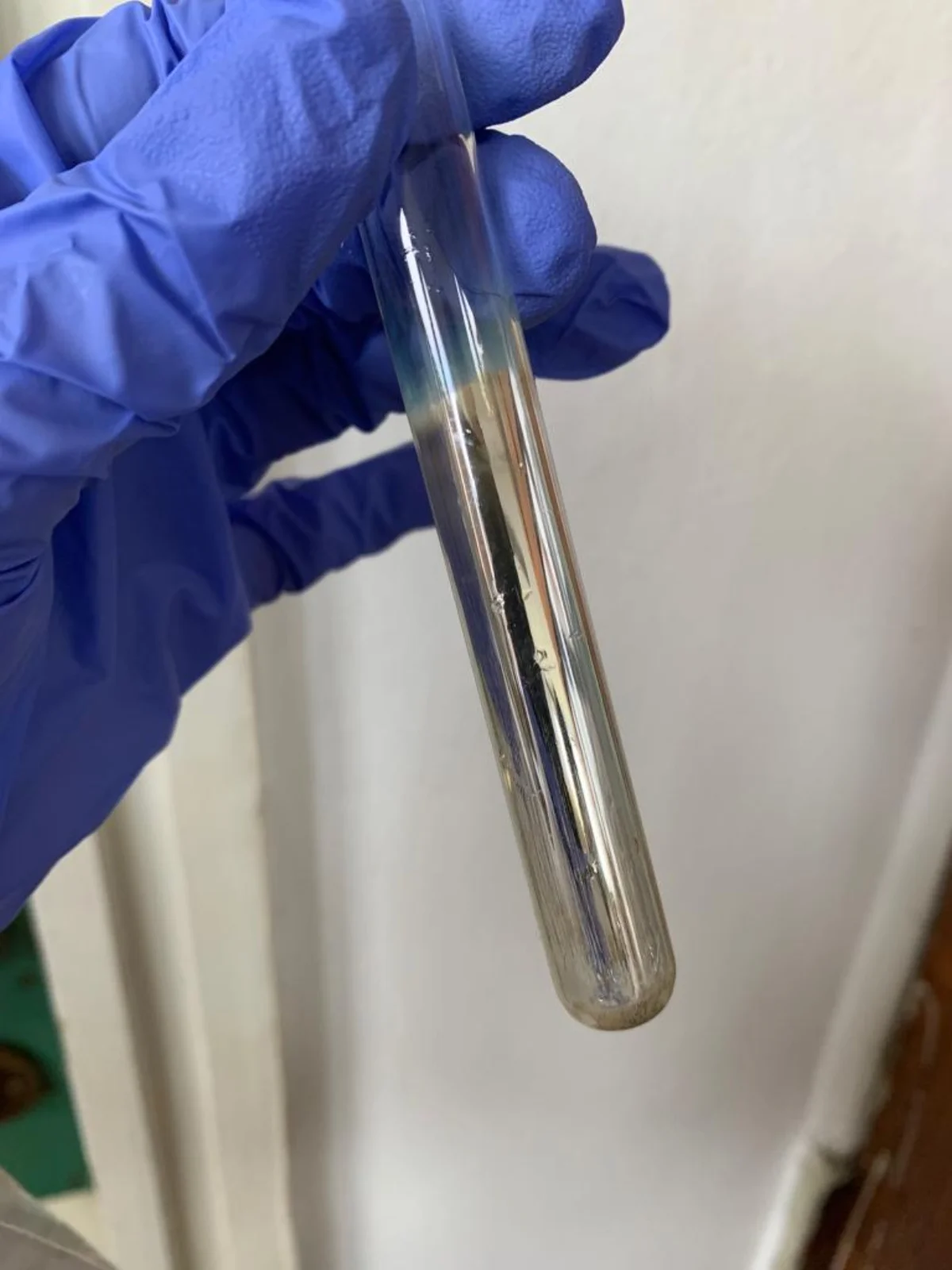
Tollens’ reagent is an ammoniacal silver solution: Ag(NH₃)₂⁺ OH⁻. Silver ion is the oxidant; aldehydes reduce Ag⁺ to metallic silver, which deposits as a shiny mirror on the inside of the test tube.
The test is specific for aldehydes. Ketones give NO reaction (no silver mirror). This makes Tollens’ the classic way to distinguish aldehyde from ketone in a blind sample.
A positive Tollens' test: aldehyde reduces Ag⁺ to metallic silver, which deposits as a shiny mirror on the test tube wall. Ketones give no reaction. Credit: Wikimedia Commons, CC BY-SA
Note: sugars with free anomeric hydroxyls (reducing sugars like glucose, maltose, fructose) also give a positive Tollens’ test because they are in equilibrium with their open-chain aldehyde form. Sucrose does not (both anomeric centers are tied up in the glycosidic bond), so sucrose is a non-reducing sugar.
Jones Reagent (H₂CrO₄ / H₂SO₄ / acetone)
Jones reagent is chromic acid in acidic aqueous acetone. It oxidizes:
Primary alcohols → carboxylic acids.
Secondary alcohols → ketones.
Aldehydes → carboxylic acids (via the hydrate).
Ketones do not react with Jones under normal conditions.
KMnO₄ (Potassium Permanganate)
Hot concentrated KMnO₄ is a very strong oxidant. It oxidizes:
Primary alcohols → carboxylic acids.
Secondary alcohols → ketones.
Aldehydes → carboxylic acids.
Alkenes → 1,2-diols (cold, dilute, basic) OR cleaves alkenes to carbonyls/carboxylic acids (hot, concentrated).
Toluene side chains → benzoic acid (via methyl group oxidation).
KMnO₄ is rarely a selective choice - it oxidizes almost everything. Used when you want aggressive oxidation to a carboxylic acid.
Peracid Oxidation (Baeyer-Villiger)
A specialized oxidation: ketones can be converted to esters via the Baeyer-Villiger oxidation using a peracid (like mCPBA, meta-chloroperoxybenzoic acid). The mechanism involves insertion of an oxygen between one of the alkyl groups and the carbonyl carbon. The migration preference is:
tertiary > secondary > phenyl > primary > methyl
Baeyer-Villiger is how you can convert a ketone into an ester directly - useful when other synthetic routes are blocked. It is occasionally on the MCAT but not a high-frequency topic.
Why Ketones Resist Oxidation
Ketones have no C-H bond on the carbonyl carbon (both alpha carbons have C-R bonds, not C-H, assuming the carbonyl is NOT at the end of a chain). Oxidation to a carboxylic acid would require breaking a C-C bond - which is much harder than breaking a C-H bond.
Harsh oxidants (hot concentrated KMnO₄, strong acid at high temperature) CAN eventually break C-C bonds and cleave ketones to two carboxylic acids, but this is not standard practice.
For MCAT purposes: aldehydes oxidize easily; ketones do not oxidize under ordinary conditions.
Biological Aldehyde Oxidation
In biology, aldehydes are oxidized by aldehyde dehydrogenase using NAD⁺ as the hydride acceptor:
Aldehyde + NAD⁺ + H₂O → Carboxylate + NADH + H⁺
This is essentially the biological version of Tollens’ or Jones (using a hydride-accepting cofactor instead of silver or chromium). The liver uses this enzyme in alcohol metabolism: ethanol → acetaldehyde (by alcohol dehydrogenase) → acetate (by aldehyde dehydrogenase).
People with a variant aldehyde dehydrogenase (ALDH2*2, common in East Asian populations) accumulate acetaldehyde after drinking alcohol, producing the characteristic flush, headache, and nausea. The enzymatic mechanism mirrors the chemistry of lab oxidation.
You have an unknown liquid that could be either butanal (aldehyde) or butan-2-one (ketone). Describe a simple chemical test to distinguish them.
Click to reveal answer
Add Tollens' reagent (Ag(NH₃)₂⁺ in ammonia solution) to a small sample and warm gently. If a silver mirror deposits on the inside of the test tube, the sample is butanal (aldehyde). If no mirror forms, the sample is butan-2-one (ketone). Aldehydes reduce Ag⁺ to metallic silver because their C-H bond on the carbonyl carbon allows oxidation to the carboxylate. Ketones cannot do this and give no reaction.
Regular hydride reductions (NaBH₄, LiAlH₄) convert a C=O to a C-OH - the oxygen stays, just becomes an alcohol. But sometimes you want to remove the oxygen entirely, converting the C=O to a -CH₂- methylene group. Two classic methods do this: Wolff-Kishner (basic conditions) and Clemmensen (acidic conditions). The choice depends on whether your substrate survives acid or base.
Wolff-Kishner Reduction: Basic Conditions
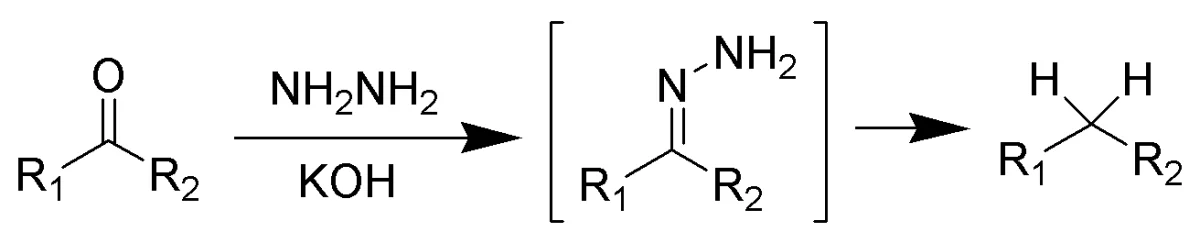
Wolff-Kishner uses hydrazine (H₂N-NH₂), strong base (KOH), and high temperature (often in a high-boiling solvent like triethylene glycol or diethylene glycol).
Sequence:
The carbonyl reacts with hydrazine to form a hydrazone (C=N-NH₂) - a type of imine with an extra NH₂ on the nitrogen.
Base deprotonates the hydrazone NH₂.
Heat drives a concerted elimination: the C=N bond breaks, N₂ gas escapes, and the resulting carbanion picks up a proton to give the CH₂ group.
The byproducts (N₂ gas and water) leave the reaction mixture easily, driving it forward.
Wolff-Kishner is ideal when:
The substrate contains acid-sensitive groups (esters, acetals) that would not survive Clemmensen’s HCl.
You need mild basic conditions.
Wolff-Kishner reduction: carbonyl → hydrazone (with H₂NNH₂) → alkane + N₂ (with KOH, heat). Basic conditions tolerate acid-sensitive groups that would die under Clemmensen's HCl. Credit: Wikimedia Commons, CC BY-SA
Clemmensen Reduction: Acidic Conditions
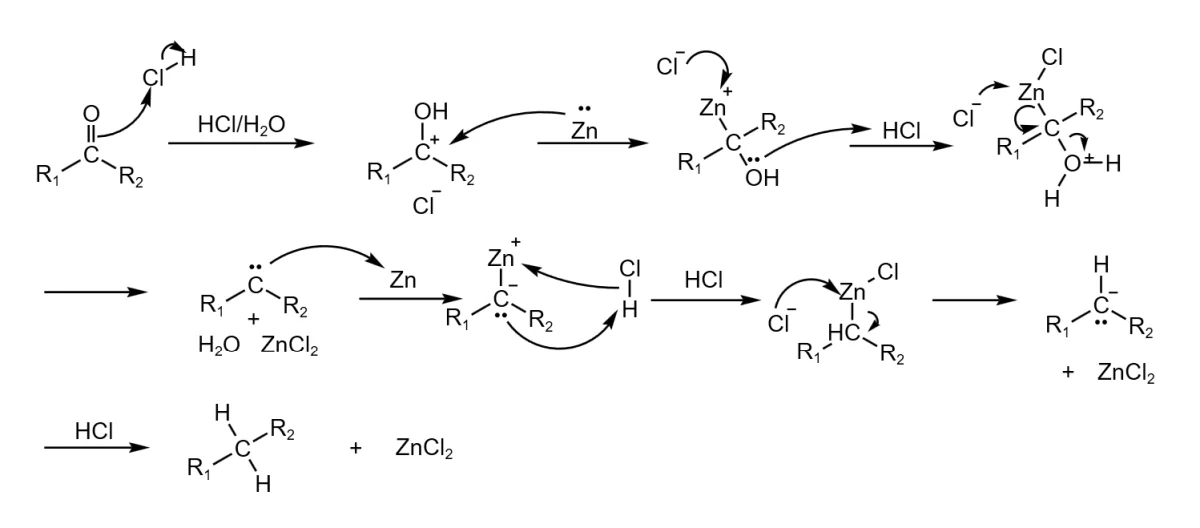
Clemmensen uses zinc amalgam (Zn-Hg alloy) and concentrated HCl at elevated temperature.
The exact mechanism is not fully understood (it involves Zn-carbenoid or carbanion intermediates), but the net effect is the same: C=O → CH₂.
Net: R₂C=O + Zn-Hg / HCl / heat → R₂CH₂.
Clemmensen is ideal when:
The substrate has base-sensitive groups (phenolic -OH, amine N-H) that would not survive Wolff-Kishner’s KOH.
You need acidic conditions.
Clemmensen reduction: Zn(Hg) + HCl + heat convert C=O to CH₂. Acidic conditions make it suitable for base-sensitive substrates where Wolff-Kishner's KOH would be destructive. Credit: Wikimedia Commons, CC BY-SA
Compared to Catalytic Hydrogenation (H₂ / Pd)
H₂/Pd does NOT reduce carbonyls cleanly to methylene. It reduces alkenes/alkynes to alkanes, reduces some nitriles, but simple ketones and aldehydes survive H₂/Pd at ordinary conditions.
For carbonyl-to-methylene, the two canonical methods are Wolff-Kishner and Clemmensen. On the MCAT, these are the only two reductions that give -CH₂- from -C(=O)-.
Why Remove the Oxygen at All?
Common scenarios where C=O to -CH₂- conversion matters:
Friedel-Crafts alkylation is messy, but Friedel-Crafts acylation is clean. So to put an alkyl chain on a benzene ring, you often do acylation first (which installs a -CO-R) then reduce the C=O to -CH₂- (giving the alkylated ring).
Synthesizing saturated hydrocarbons with a specific branching pattern that is easier to make via ketone intermediate.
Steroid and natural-product synthesis where a ketone was needed for an earlier step but must be removed in the final product.
Convert the carbonyl to a thioacetal using 1,3-propanedithiol (two -SH groups) under acid catalysis, removing water (analogous to acetal formation but with sulfur).
Reduce the thioacetal with Raney nickel, which desulfurizes the C-S bonds to give C-H bonds, resulting in -CH₂-.
This three-step sequence (ketone → thioacetal → alkane) is sometimes used when neither Wolff-Kishner nor Clemmensen conditions are tolerated. For MCAT purposes, it is not a high-frequency topic, but recognize it if a passage mentions “desulfurization” near a carbonyl.
Summary of Carbonyl Reduction Options
Reagent
Product from RCHO
Product from R₂CO
NaBH₄ (mild)
R-CH₂OH (1° alcohol)
R₂CHOH (2° alcohol)
LiAlH₄ (strong)
R-CH₂OH (1° alcohol)
R₂CHOH (2° alcohol)
H₂ / Pd (on alkene, not usual on C=O)
(no reaction usually)
(no reaction usually)
Wolff-Kishner (H₂NNH₂/KOH/heat)
R-CH₃ (methylene)
R₂CH₂ (methylene)
Clemmensen (Zn-Hg / HCl / heat)
R-CH₃ (methylene)
R₂CH₂ (methylene)
NaBH₃CN (with amine)
R-CH₂-NR’₂ (reductive amination)
R₂CHNR’₂ (reductive amination with ketone + amine)
Aromatic Substrates Specifically
For an aryl ketone (Ph-CO-R from Friedel-Crafts acylation), both Wolff-Kishner and Clemmensen work to reduce to Ph-CH₂-R. This is the standard workaround for Friedel-Crafts alkylation’s limitations, turning the acylated product into the alkylated one.
A chemist wants to convert acetophenone (PhCOCH₃) to ethylbenzene (PhCH₂CH₃). The substrate contains an acid-sensitive acetal elsewhere in the molecule. Which reduction should be used?
Click to reveal answer
Wolff-Kishner reduction (H₂NNH₂, KOH, heat). Both Wolff-Kishner and Clemmensen reduce the ketone C=O to CH₂. But Clemmensen uses HCl, which would hydrolyze the acetal (acetals are acid-sensitive). Wolff-Kishner uses basic conditions (KOH and hydrazine) - acetals are base-stable. So Wolff-Kishner preserves the acetal while reducing the ketone.