
Hemiacetals and Acetals
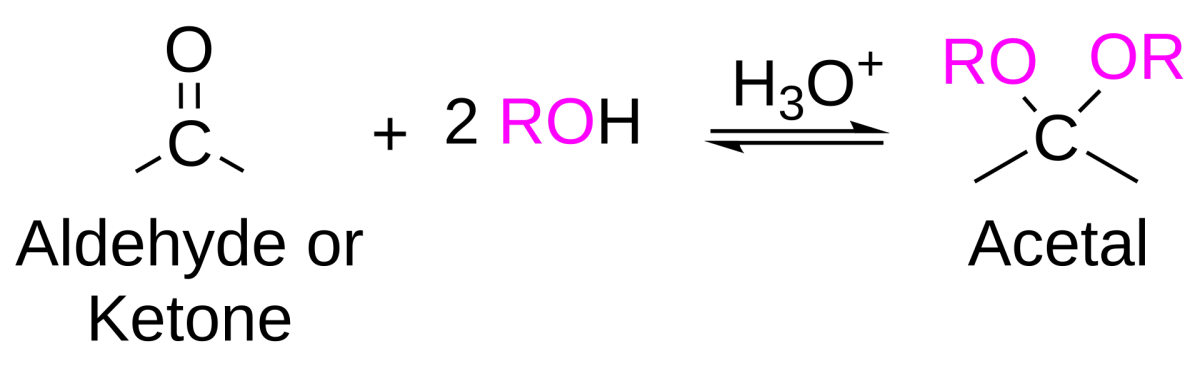
When an alcohol adds to an aldehyde or ketone, you get a hemiacetal (half-acetal: one OR and one OH on the same carbon). Add a second alcohol and you get an acetal (two OR groups on the same carbon, no free OH). These additions are acid-catalyzed, reversible, and critically important in both synthesis (as protecting groups) and biology (the cyclic forms of sugars are intramolecular hemiacetals).

Hemiacetal Formation (Step 1)
The mechanism is the standard acid-catalyzed addition:
- Protonation of carbonyl oxygen (H⁺ on carbonyl O).
- Alcohol’s lone pair attacks the activated carbonyl carbon.
- Deprotonation of the OR group on the tetrahedral intermediate.
Net: R-OH + R’-CO-R” → R’-C(OH)(OR)-R”. The carbon now has one -OH and one -OR.
Hemiacetals are usually UNSTABLE as isolated compounds - they exist in equilibrium with the open-chain carbonyl + alcohol. There are two important exceptions:
- Cyclic hemiacetals in sugars - when the alcohol and carbonyl are on the same molecule (intramolecular), the cyclic hemiacetal can be quite stable. This is why glucose is mostly in its pyranose (six-membered cyclic hemiacetal) form in solution.
- Lactols - cyclic hemiacetals of 4- or 5-ring size are isolable and sometimes useful.
Acetal Formation (Step 2)
In the presence of excess alcohol and acid, the hemiacetal loses water and reacts with a second alcohol to give an acetal:
- Protonation of the hemiacetal OH.
- Loss of water (the protonated OH leaves as water), giving an oxocarbenium ion (R’-C⁺(OR)-R”).
- Second alcohol attacks the oxocarbenium.
- Deprotonation gives the neutral acetal.
Net: hemiacetal + R-OH → acetal + H₂O.
The acetal has two OR groups on the same carbon, no free OH, and no carbonyl. It looks like a “diether” at that carbon.
Driving the Equilibrium
Acetal formation is reversible. To push the equilibrium toward the acetal, chemists use:
- Excess alcohol (Le Chatelier: more reactant drives forward).
- Water removal (Dean-Stark trap, molecular sieves) to prevent the reverse reaction.
- Cyclic diols (ethylene glycol, propane-1,3-diol) to form cyclic acetals, which are entropically favored (one molecule forms instead of two).
Conversely, to hydrolyze an acetal back to the carbonyl, you use excess water and catalytic acid - the reverse conditions.
Why Acetals Are Great Protecting Groups
Acetals are stable under basic conditions but cleave cleanly in acid. This selective stability makes them ideal protecting groups for carbonyls.
Typical use: you have a molecule with both an ester and a ketone. You want to reduce the ester to an alcohol using LiAlH₄, but LiAlH₄ also reduces ketones. Solution:
- Convert the ketone to a cyclic acetal (with ethylene glycol + acid catalyst + water removal).
- Run LiAlH₄ on the ester (the acetal is stable under these conditions - no water, no acid).
- Hydrolyze the acetal back to the ketone (aqueous acid).
This three-step sequence selectively reduces the ester while leaving the ketone intact.
Sugars as Intramolecular Hemiacetals
Glucose is drawn in organic chemistry textbooks as an open-chain aldehyde with five OH groups. But in water, glucose exists >99% as a six-membered cyclic hemiacetal (the pyranose form). The OH on C5 attacks the aldehyde carbonyl on C1 to form a new C-O bond, closing the ring.
The carbon bearing the new OH group (C1 in glucose) is called the anomeric carbon. It can be either alpha (OH axial, down) or beta (OH equatorial, up) depending on which face of the open aldehyde was attacked. These two anomers interconvert through the open-chain form - a process called mutarotation.
Fructose forms a furanose (5-membered) ring via intramolecular hemiacetal of its C2 ketone carbonyl with the C5 OH.
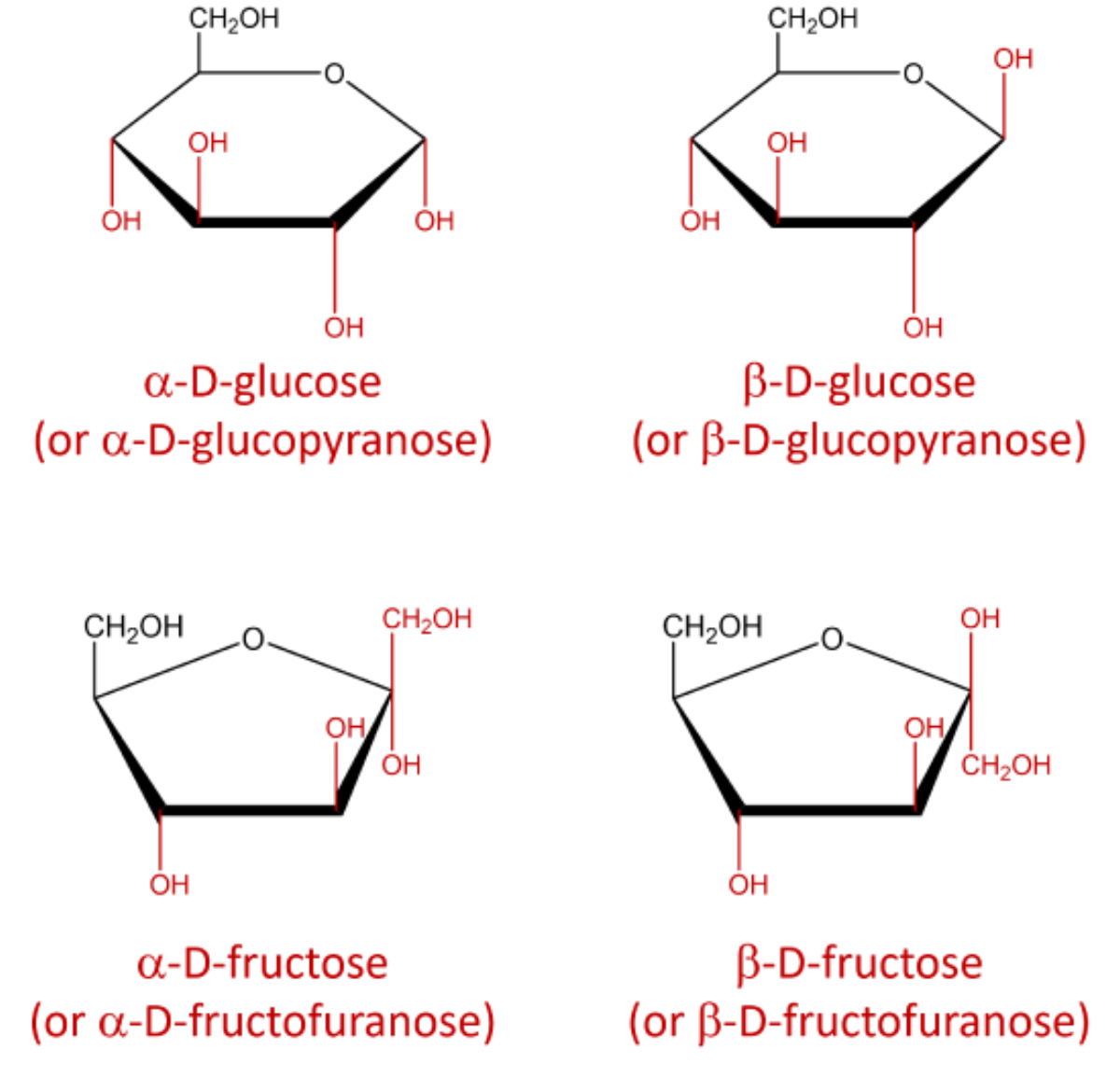
Disaccharides (like sucrose and lactose) contain a glycosidic bond - an acetal linkage between the anomeric carbon of one sugar and a hydroxyl of another. Sucrose, for example, has an acetal linkage because BOTH anomeric carbons are tied up in the bond.
The Acetal in Biochemistry
The glycosidic bonds that connect sugars in polysaccharides (starch, glycogen, cellulose) are acetals. They are stable enough to form the structural backbone of these biomolecules but can be hydrolyzed back to glucose by enzymes (amylase, cellulase). The same acid-labile, base-stable pattern from lab synthesis appears in biology.