
Cyanohydrin Formation
When cyanide (CN⁻) attacks an aldehyde or ketone, the product is a cyanohydrin - a molecule with both a hydroxyl group (-OH) and a nitrile group (-CN) on the same carbon. Cyanide is a classic small nucleophile that adds cleanly to most aldehydes and ketones, and cyanohydrins serve as versatile intermediates in synthesis because the nitrile can be hydrolyzed to a carboxylic acid or reduced to an amine.
The Mechanism
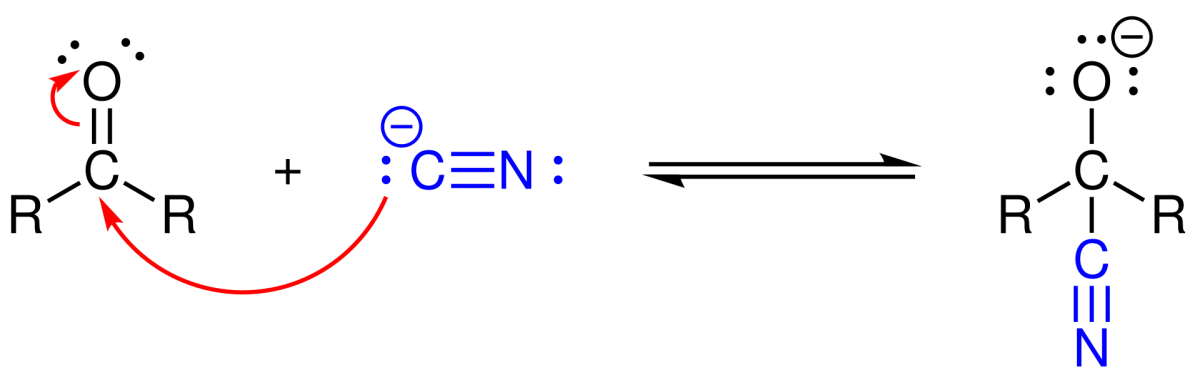
Cyanohydrin formation is a textbook base-catalyzed addition:
- Generation of cyanide. HCN is weakly acidic (pKa ~9.2), so a mild base (KCN, NaCN, or even K₂CO₃ + HCN) gives cyanide ion.
- Cyanide attacks the carbonyl carbon. The carbon of CN⁻ is the nucleophilic atom (not the nitrogen, because the sp-hybridized carbon has the exposed lone pair). Attack on the C of the aldehyde/ketone gives a tetrahedral alkoxide intermediate.
- Protonation. The alkoxide is protonated by HCN or by solvent to give the neutral cyanohydrin.
Net: R-CO-R’ + HCN → R-C(OH)(CN)-R’ (cyanohydrin).
Reversibility and Equilibrium
Cyanohydrin formation is reversible. Under basic conditions (or with excess HCN), the equilibrium favors the cyanohydrin. Under aqueous neutral conditions, the balance shifts depending on substrate:
- Aldehydes: equilibrium favors the cyanohydrin (aldehydes are reactive electrophiles).
- Ketones: equilibrium is less favorable, often roughly 50-50 for simple ketones.
- Sterically hindered ketones (di-tert-butyl ketone): equilibrium far to the left, cyanohydrin minimal.
- Aromatic ketones: equilibrium toward carbonyl (resonance stabilizes the starting material).
The same steric + electronic logic from carbonyl hydration (Section 6.5) applies here.
Why the C of Cyanide Attacks, Not the N
Cyanide has lone pairs on both carbon and nitrogen, but only the CARBON end has an sp hybrid orbital holding a free lone pair. The nitrogen’s lone pair is in the pi system of the triple bond and is not available for bonding (using it would disrupt the triple bond).
In effect, CN⁻ behaves as a carbon nucleophile with nitrogen as a spectator. The new C-C bond in the cyanohydrin is between the old carbonyl carbon and the cyanide carbon.
Strecker Synthesis of Amino Acids
Cyanide addition to aldehydes combined with ammonia (or an amine) is the Strecker synthesis of alpha-amino acids, a classic textbook reaction:
- Aldehyde + NH₃ → imine (Section 6.8).
- Imine + HCN → alpha-aminonitrile.
- Hydrolysis of the nitrile (with H₃O⁺) → alpha-amino acid.
Net: RCHO + NH₃ + HCN → R-CH(NH₂)-COOH.
Strecker synthesis is explicitly listed on the AAMC outline. It is one of the two main ways to make alpha-amino acids in the lab (the other is Gabriel synthesis via phthalimide; see Ch 10).
Downstream Chemistry: What Cyanohydrins Can Become
The nitrile group (-CN) in a cyanohydrin is a versatile functional group that can be transformed several ways:
- Acid hydrolysis (H₂O / H₂SO₄ / heat) → alpha-hydroxy carboxylic acid. The nitrile becomes a COOH.
- Reduction (LiAlH₄ or H₂/Pt) → alpha-hydroxy amine. The nitrile becomes a CH₂NH₂.
- Grignard-like alkylation on the nitrile → alpha-hydroxy ketone. The nitrile becomes a ketone.
So a cyanohydrin is effectively a three-way synthetic intermediate. Many MCAT passages will feature this conversion.
Biological Parallel: Cyanide Poisoning
Biologically, cyanide is a potent toxin because it binds tightly to the Fe(III) in cytochrome c oxidase (Complex IV of the ETC), blocking cellular respiration. This is unrelated to the cyanohydrin chemistry you just learned - but it is a common MCAT biology topic, and the underlying feature (cyanide’s small, potent nucleophilicity) is the same.
Stereochemistry
Cyanohydrin formation creates a new stereocenter at the carbon that was the carbonyl carbon. For an achiral aldehyde/ketone with achiral HCN, the product is racemic (50:50 mixture of enantiomers). Enzymes (like oxynitrilase in almonds) can produce enantiopure cyanohydrins - an example of asymmetric catalysis.