Imines and Enamines
Amines are excellent nucleophiles for carbonyl addition because nitrogen’s lone pair is highly available and basic. The product of the addition depends on whether the amine is primary (one R group on N) or secondary (two R groups on N):
- Primary amine (R-NH₂) + aldehyde/ketone → imine (C=N-R) + water. A new C=N double bond forms; the nitrogen keeps one H.
- Secondary amine (R₂NH) + aldehyde/ketone → enamine (C=C-NR₂) + water. A C=C double bond forms on the adjacent carbon; the nitrogen keeps both R groups.
Imines are also called Schiff bases in biochemistry and are critical in enzyme mechanisms (e.g., fructose-1,6-bisphosphate aldolase uses a lysine-derived Schiff base).
Imine Formation (from Primary Amines)
The mechanism is a multi-step acid-catalyzed sequence:
- Acid protonation of carbonyl. Standard activation.
- Amine attacks. Nitrogen’s lone pair attacks the carbonyl carbon, forming a protonated tetrahedral alcohol (hemiaminal intermediate).
- Deprotonation and protonation shuffle. The N-H is deprotonated, then the OH on the same carbon is protonated (an alcohol-like tautomer).
- Water loss. The now-protonated OH leaves as water, forming a new iminium cation (C=N⁺-H).
- Deprotonation. The iminium loses its N-H proton to give the neutral imine (C=N-R).
Net: R-CO-R’ + R”-NH₂ → R-C(=N-R”)-R’ + H₂O.

pH Dependence of Imine Formation
Imine formation is strongly pH-dependent with an optimum around pH 4-5:
- Too acidic (pH < 3): the amine is fully protonated to ammonium (R-NH₃⁺), which has no lone pair available to attack. Reaction is slow.
- Too basic (pH > 7): the carbonyl is not protonated enough to be activated, and water loss is also slow without acid catalysis.
- Optimal (pH 4-5): the amine is partially free (still basic pKa ~9-10, so some neutral NH₂), and acid is available to catalyze the water-loss step.
This “bell-shaped” pH profile is a classic MCAT topic, especially in biochemistry contexts where enzymes operate at specific pH.
Enamine Formation (from Secondary Amines)
When a secondary amine attacks, the same mechanism starts (amine attacks carbonyl, tetrahedral hemiaminal forms). But after water loss, there is no N-H proton to remove (both N substituents are R groups, not H). Instead, an ALPHA-HYDROGEN on the adjacent carbon is removed, and the C-C double bond forms.
Net: R-CH₂-CO-R’ + R”₂NH → R-CH=C(NR”₂)-R’ + H₂O.
The nitrogen lone pair is now in conjugation with the new C=C, giving an enamine. Enamines are important nucleophiles in their own right - they are used in the Stork enamine synthesis to alkylate ketones at the alpha-carbon (a preview of Chapter 7).
Schiff Bases in Biology
Lysine side chains in enzymes provide the NH₂ group that forms Schiff bases with aldehydes, ketones, and pyridoxal phosphate (vitamin B6). Examples:
- Aldolase (class I) forms a Schiff base between a lysine NH₂ and fructose-1,6-bisphosphate’s C2 ketone, facilitating the aldol cleavage.
- PLP (pyridoxal phosphate) forms a Schiff base with amino acid amines in transaminase reactions.
- Retinal in rhodopsin is a Schiff base with a lysine; cis-trans isomerization of retinal’s polyene under light starts the visual signaling cascade.
These biological Schiff bases are usually protonated (iminium ion, C=N⁺-H), which makes the adjacent alpha-carbon more acidic and the system more reactive.
Reductive Amination
Combining imine formation with a hydride reduction gives a powerful synthetic method: reductive amination. Steps:
- Aldehyde or ketone + primary amine → imine (in situ).
- Imine + NaBH₃CN (sodium cyanoborohydride) → amine.
NaBH₃CN is a mild hydride source that reduces imines (C=N) at low pH but does NOT reduce carbonyls (C=O) efficiently. This selectivity is key to reductive amination: the imine forms and gets reduced, while the starting carbonyl is not competitively reduced.
Reductive amination is the main lab method for converting carbonyls + amines into secondary or tertiary amines with one extra C-N bond. It is especially common in drug synthesis.

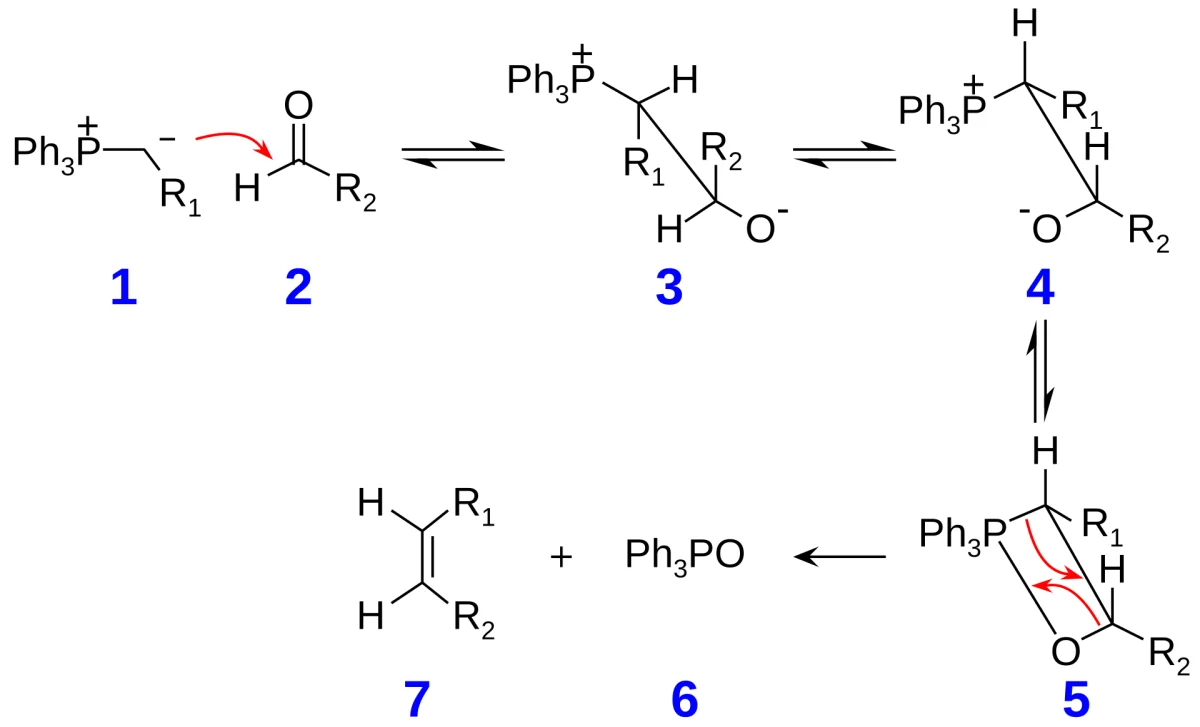
Wittig Precursor: Phosphonium Ylides
As a small segue: the Wittig reaction uses a phosphonium ylide (Ph₃P=CR₂) to convert a ketone or aldehyde directly into an alkene, with loss of phosphine oxide. The mechanism starts with nucleophilic addition of the ylide carbon to the carbonyl carbon, then a cyclic betaine intermediate decomposes to alkene + phosphine oxide. This is covered in Chapter 10 under Nitrogen- and Phosphorus-containing compounds.