
Carbonyl Group Structure
Every aldehyde and ketone begins with the same feature: a carbon double-bonded to an oxygen (C=O), called a carbonyl group. The entire chemistry of this chapter flows from one fact about that bond: oxygen is much more electronegative than carbon, so the bonding electrons are pulled toward oxygen, leaving carbon partially positive. That partial positive carbon is the target of every nucleophilic attack to come.

Geometry and Hybridization
The carbonyl carbon is sp² hybridized: three sp² orbitals form sigma bonds (two to neighbors, one to oxygen), and the remaining p orbital forms the pi bond with oxygen. The result is a trigonal planar geometry with 120° bond angles around the carbon.
Oxygen in the carbonyl is also sp² hybridized. Two of its sp² orbitals hold lone pairs; the third forms the sigma bond to carbon. The remaining p orbital forms the pi bond.
The C=O bond length is about 1.22 Å - shorter than a C-O single bond (1.43 Å) and consistent with a double bond that also has partial ionic character.
The Polarized C=O Bond
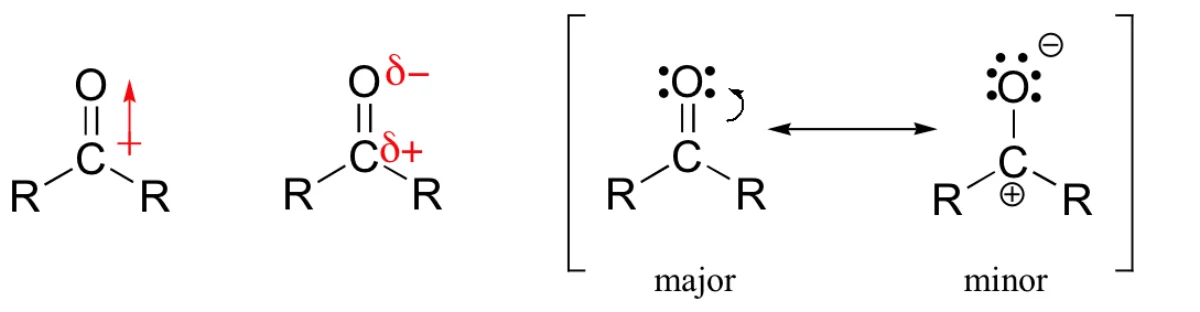
Oxygen’s electronegativity (3.44 on the Pauling scale) is significantly higher than carbon’s (2.55). In the C=O bond, both the sigma and pi electron densities are pulled toward oxygen. Resonance structures make this explicit:
- Major contributor: C=O neutral (double bond, no formal charges).
- Minor contributor: C⁺−O⁻ (single bond, positive on C, negative on O).
The minor contributor is what gives carbonyl carbons their electrophilic character. Nucleophiles see the carbon as being partially positive (δ⁺), and the oxygen as being partially negative (δ⁻).
Dipole Moment
The C=O bond has a large dipole moment - about 2.3 to 2.7 D for typical aldehydes and ketones, compared to about 1.7 D for a C-O single bond. This dipole:
- Makes carbonyls quite polar - they dissolve moderately in water and other polar solvents.
- Raises boiling points of aldehydes and ketones above those of comparable alkanes or ethers (but below alcohols, which can H-bond).
- Influences intermolecular interactions - carbonyls align partially in the pure liquid, with δ⁺ C aligning with δ⁻ O of a neighbor.
Why Aldehydes Are More Electrophilic Than Ketones
Recall from Chapter 4 that the electrophilicity of a carbonyl depends on what else is attached. Aldehydes have one alkyl group and one H. Ketones have two alkyl groups. Alkyl groups are weakly electron-donating (via induction and hyperconjugation), so they decrease the δ⁺ on the carbonyl carbon.
- Aldehyde: 1 alkyl donor → moderate δ⁺.
- Ketone: 2 alkyl donors → smaller δ⁺.
Consequence: aldehydes react faster than ketones with most nucleophiles. The same logic extends to the full reactivity ladder in Chapter 9 (acyl halides > anhydrides > aldehydes > ketones > esters > amides).
Steric Differences: Aldehyde vs. Ketone
Electronics aside, steric access to the carbonyl carbon also matters. Ketones have two bulky alkyl groups flanking the electrophilic carbon; aldehydes have one alkyl and one tiny H. Nucleophiles can approach an aldehyde’s carbonyl more easily, especially bulky nucleophiles like Grignards or hydride from LiAlH₄.
So aldehydes win on both counts - more electrophilic AND more accessible - and react faster than ketones in essentially every nucleophilic addition.
Acid Activation Amplifies Electrophilicity
Protonation of the carbonyl oxygen in acidic conditions dramatically increases the electrophilicity of the carbon. The protonated carbonyl (RR’C=OH⁺) has a full positive charge on oxygen, which pulls even more electron density off the carbon through the pi bond. The oxocarbenium-like resonance contributor becomes significant:
R₂C=O + H⁺ → R₂C=OH⁺ ↔ R₂C⁺−OH
Now the carbon is essentially a carbocation, and any weakly nucleophilic species (water, alcohol, amine) can attack it easily. This is why many carbonyl reactions are acid-catalyzed: the acid activates the electrophile.
The Universal Nucleophilic Addition Pattern
Every reaction in Chapter 6 follows the same three-step template:
- Nucleophile attacks the carbonyl carbon. Arrow: Nu lone pair → C. Pi bond breaks, electrons flow to oxygen. Result: tetrahedral alkoxide intermediate.
- Protonation of the alkoxide. The alkoxide oxygen picks up an H⁺ from solvent or added acid, giving a neutral alcohol or diol.
- In some cases, subsequent steps (like acetal formation, imine dehydration, or further oxidation). These are the reaction-specific extras.
Steps 1 and 2 are universal. That is why all of this chapter’s reactions share the same opening arrows - just the nucleophile and the follow-up chemistry changes.