
Organometallic Additions
Organometallic reagents (R-M, where M = Mg, Li, Cu) are the premier tool for making carbon-carbon bonds with carbonyls. The specifics depend on which metal you use. Grignards (R-MgX) attack aldehydes and ketones at the carbonyl carbon (1,2-addition). Gilman reagents (R₂CuLi) prefer the beta-carbon of enones (1,4-conjugate addition, a.k.a. Michael addition).
The Grignard story was introduced in Chapter 5 (alcohols); this section reviews and extends it to the broader alpha-beta unsaturated system.
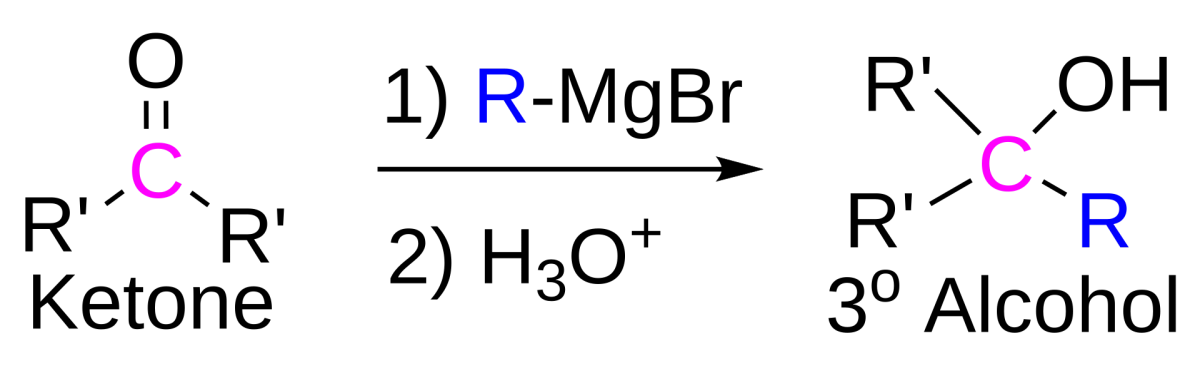
Grignard Addition to Carbonyls (Review + Extension)
Grignard reagents (R-MgX) behave as carbanion equivalents. The Mg-C bond is highly polarized, so the R group acts as a nucleophile and attacks the electrophilic carbonyl carbon:
| Carbonyl | Grignard product |
|---|---|
| Formaldehyde (HCHO) | 1° alcohol (R-CH₂OH) |
| Aldehyde (R’CHO) | 2° alcohol (R-CHOH-R’) |
| Ketone (R’COR”) | 3° alcohol (R-COH-R’R”) |
| Ester (R’COOR”) | 3° alcohol with 2 R groups added (double addition) |
| Nitrile (RCN) | Ketone after hydrolysis |
| CO₂ | Carboxylic acid |
| Epoxide | Alcohol (ring opens at less substituted C) |
The Grignard always forms a new C-C bond between its R group and the carbonyl/electrophilic carbon. This is the primary utility of Grignards in synthesis: extending carbon chains and building tertiary alcohols.
Why Grignards Give 1,2-Addition (Not 1,4)
For an alpha-beta unsaturated carbonyl (enone), two carbons are electrophilic: the carbonyl C and the beta-C (the one at the end of the conjugated C=C-C=O). Grignards attack at the carbonyl C (1,2-addition) rather than the beta-C (1,4-addition).
Reason: Grignards are HARD nucleophiles (small, high charge density, non-polarizable). They prefer to attack hard electrophiles (the carbonyl C, with its high charge density and localized positive character). The beta-C is a soft electrophile (diffuse positive character via resonance), which hard nucleophiles tend to avoid.
This is the HSAB principle in action (hard prefers hard, soft prefers soft).
Gilman Reagents (Organocuprates)
Gilman reagents have the formula R₂CuLi (two R groups on one copper, with lithium as counterion). They are prepared by reacting an organolithium with a copper(I) halide:
2 R-Li + CuI → R₂CuLi + LiI
Gilman reagents are SOFT nucleophiles - the C-Cu bond is much less polarized than C-Mg, and copper is a large, polarizable atom. So Gilman reagents prefer to attack SOFT electrophiles, especially the beta-C of enones.
Gilman 1,4-Addition (Michael Addition)
When R₂CuLi reacts with an enone:
- The R group of the Gilman adds to the BETA-carbon (not the carbonyl C).
- An enolate intermediate forms on the original alpha-C and carbonyl.
- Aqueous workup protonates the enolate, giving a saturated ketone.
Net: enone + R₂CuLi → saturated ketone with R added at the beta-position.
Example: 2-cyclohexenone (a cyclic enone) + (CH₃)₂CuLi → 3-methylcyclohexanone (methyl added at C3, the beta-position of the original enone).
This is sometimes called conjugate addition, 1,4-addition, or Michael addition. Contrast with Grignard 1,2-addition where the R group goes to the carbonyl C and the carbonyl becomes a 3° alcohol.
Why This Distinction Matters in Synthesis
If you have an alpha-beta unsaturated ketone and want to decide where to add a new carbon:
- Add to the carbonyl C: use a Grignard → product is an allylic alcohol (C=C still intact).
- Add to the beta-C: use a Gilman → product is a saturated ketone with a new substituent at the beta-C.
These two options give completely different products from the same starting material. The MCAT loves this distinction - make sure you know which reagent gives which result.
Organolithium Reagents: More Grignard-Like
Organolithium reagents (R-Li) behave like Grignards but are even MORE reactive (C-Li bond is more polarized than C-Mg). They:
- Attack carbonyls at the C=O carbon (1,2-addition, like Grignards).
- Work with MORE sterically hindered substrates that Grignards might struggle with.
- Are more basic and can deprotonate acidic C-H bonds (e.g., terminal alkynes, alpha-H’s).
Common organolithiums: methyllithium (MeLi), n-butyllithium (n-BuLi), sec-BuLi, tert-BuLi, phenyllithium.
Organozinc and Other Organometallics
Other organometallics have their own flavors:
- Organozinc (R₂Zn): weakly nucleophilic; used in specialized reactions (Reformatsky, Negishi couplings).
- Organotitanium (RTi): intermediate reactivity; used in stereoselective additions.
- Organopalladium: cross-coupling reactions (Suzuki, Heck, Stille - beyond MCAT scope).
For the MCAT, focus on Grignards (1,2-addition) and Gilmans (1,4-addition); organolithiums as high-power Grignards.