
Resonance Structures
A mule is not a horse that sometimes pretends to be a donkey. A mule is its own animal - a hybrid that has features of both parents, all the time. It does not flip between being a horse on Mondays and a donkey on Tuesdays. It is always a mule.
Resonance works exactly the same way. When a molecule can be drawn as two or more valid Lewis structures that differ only in where the electrons are (not where the atoms are), the real molecule is a blend of all those structures - a resonance hybrid. It is not flipping between structures. It is all of them at once, all the time.
The Rules for Drawing Resonance Structures
When you draw resonance structures, you must follow strict rules. Breaking any of these rules means you have drawn something that is not a resonance structure - it is a different molecule entirely.
Rule 1: Only electrons move. Atoms stay put.
This is the most important rule. Curved arrows in resonance show electron movement only. If you move an atom, you have drawn a structural isomer, not a resonance contributor.
Rule 2: The total number of electrons does not change.
Every resonance structure has the same total number of valence electrons. You are not adding or removing electrons - just rearranging them.
Rule 3: The connectivity of atoms does not change.
The same atoms are bonded to the same atoms in every resonance structure. Only the locations of double bonds, lone pairs, and formal charges shift.
Rule 4: All structures must be valid Lewis structures.
Each resonance contributor must obey the rules of Lewis structures. Do not exceed the octet for second-row elements (C, N, O, F). Third-row elements (S, P) can exceed the octet because they have d orbitals.
How to Draw Resonance Structures
Use curved arrows to show electron movement. There are three common patterns:
Pattern 1: Pi bond to adjacent atom.
Move a pi bond to the next position, shifting the double bond along the chain. Common in conjugated systems.
Pattern 2: Lone pair to pi bond.
A lone pair on an atom adjacent to a double bond moves into a pi bond with the next atom. The original double bond breaks and becomes a lone pair on the far atom. Common with atoms bearing lone pairs next to pi systems (nitrogen in amides, oxygen in carboxylates).
Pattern 3: Pi bond to adjacent atom with charge.
A pi bond adjacent to a positive charge can move to create a new pi bond at the positive center, shifting the charge to the other end. Common in allylic and benzylic carbocations.
The Resonance Hybrid
The resonance hybrid is the true structure of the molecule - a weighted average of all resonance contributors. In the hybrid:
- Bonds that are single in some structures and double in others have an intermediate bond order
- Charges that appear in some structures but not others are partially present, spread over multiple atoms
- Bond lengths reflect the averaged bond order
For the carboxylate ion (RCOO-), two resonance structures each show a double bond to one oxygen and a single bond to the other. The hybrid has two identical C-O bonds, each with bond order 1.5, and the negative charge is equally distributed over both oxygen atoms.
Evaluating Resonance Contributors - Which One Matters More?
Not all resonance structures contribute equally to the hybrid. The most stable contributors have the greatest weight. Use these criteria to rank them:
1. More complete octets = better. Structures where every atom (especially carbon, nitrogen, oxygen) has a full octet are more important contributors than structures with incomplete octets.
2. Fewer formal charges = better. A structure with no formal charges is a better contributor than one with separated charges (e.g., one atom positive and another negative).
3. Negative charges on electronegative atoms = better. If a structure must have a negative formal charge, place it on the most electronegative atom (oxygen better than nitrogen, nitrogen better than carbon).
4. Positive charges on electropositive atoms = better. If a structure must have a positive formal charge, place it on the least electronegative atom.
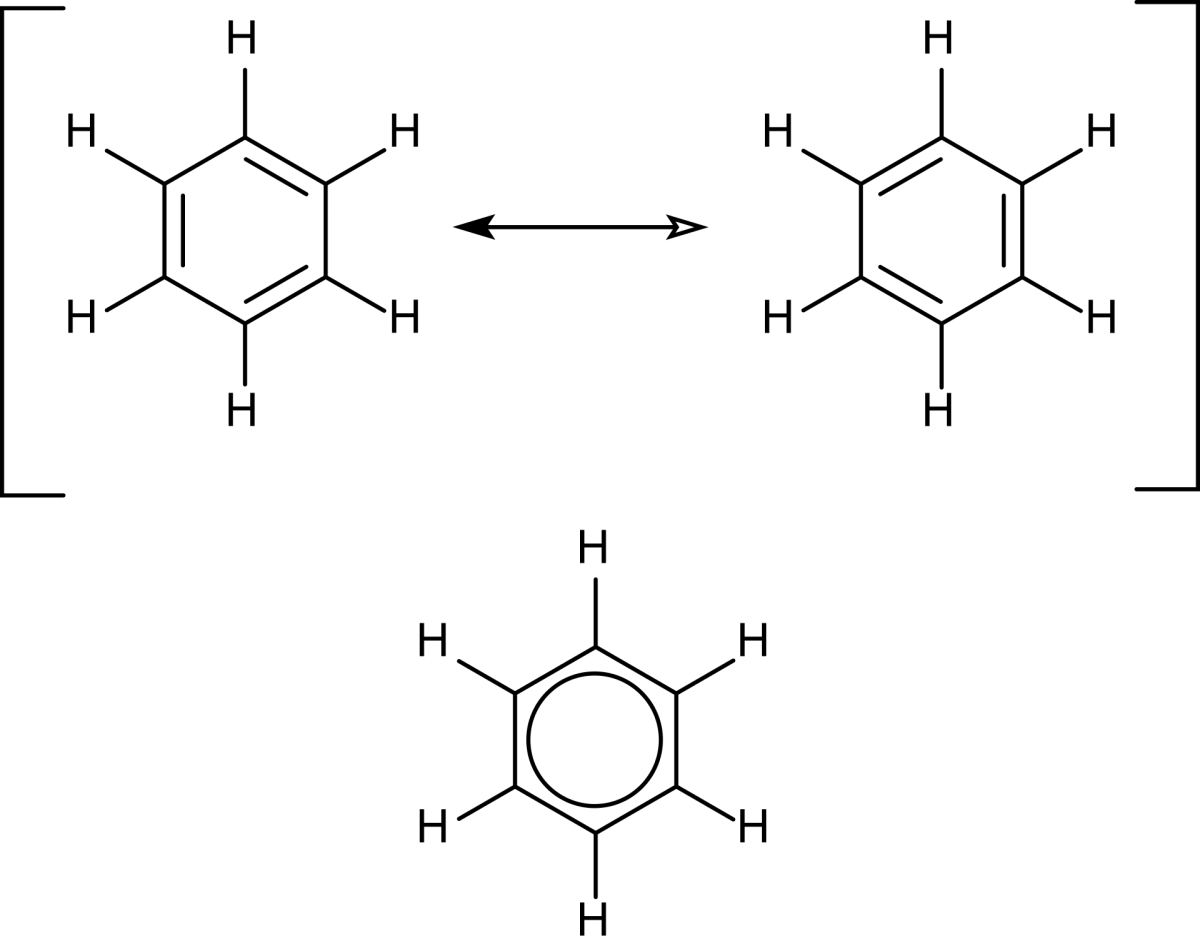
5. Equivalent structures contribute equally. If two structures are mirror images of each other (like benzene’s two Kekule structures), they contribute equally to the hybrid.
Common Resonance Situations in Organic Chemistry
Carboxylic acids and carboxylates: The C=O and C-O bonds can exchange through resonance. In the carboxylate anion, this creates two equivalent structures and equal charge distribution.
Amides: The nitrogen lone pair can delocalize into the carbonyl, giving the C-N bond partial double-bond character. This is why peptide bonds are planar and rigid.
Enolates: Deprotonation alpha to a carbonyl creates a system where negative charge is shared between carbon and oxygen.
Aromatic rings: Benzene has two equivalent Kekule structures. Substituted aromatics can have additional resonance structures involving substituents that donate or withdraw electrons.
Allylic systems: Carbocations, carbanions, or radicals adjacent to a double bond are stabilized by resonance with the pi system.
Resonance vs. Equilibrium
The double-headed arrow between resonance structures (a double-headed arrow with two heads) is NOT the same as the equilibrium arrow (two opposing single-headed arrows). Equilibrium implies two distinct species interconverting over time. Resonance structures are not distinct species - they are partial descriptions of a single, unchanging molecule.
| Feature | Resonance | Equilibrium |
|---|---|---|
| Arrow symbol | Double-headed single arrow | Two opposing arrows |
| Number of species | One (the hybrid) | Two or more |
| Interconversion | None - the hybrid is constant | Species convert back and forth |
| Atoms move? | No - only electrons shift | Yes - atoms may rearrange |
Resonance Stabilization Energy
The energy difference between a molecule’s actual energy (the resonance hybrid) and the energy predicted for a single, non-delocalized structure is the resonance stabilization energy. The greater the resonance stabilization, the more stable the molecule.
Benzene’s resonance stabilization energy is approximately 150 kJ/mol - a massive amount that explains why benzene undergoes substitution reactions (preserving the ring) rather than addition reactions (destroying the ring).