
Conductivity and Meters
This section covers two AAMC-listed topics that often share the same MCAT passage: how materials conduct electricity, and how we measure current and voltage without messing up the very circuit we’re trying to study.
The conductivity material connects physics to general chemistry (electrolytes), and the meter material connects to lab-skills questions. Both are bite-sized topics with high test-yield-per-page-of-prep.
Conductivity
Conductivity is the inverse of resistivity. Where resistivity tells you how much a material opposes current, conductivity tells you how easily current flows.
Two Types of Conduction
The MCAT distinguishes between two fundamentally different ways charge can move through a material.
Metallic Conduction
In metals like copper or silver, the charge carriers are free electrons — a “sea” of delocalized electrons that aren’t tied to specific atoms. When a voltage is applied, those electrons drift toward the positive terminal.
Key features:
- Charge carriers: electrons.
- Conductivity decreases as temperature rises (more atomic vibrations means more collisions with the drifting electrons).
- No chemical change in the conductor — it’s a physical process.
Electrolytic Conduction
In ionic solutions (NaCl in water, sulfuric acid, biological fluids), the charge carriers are ions — both positive cations moving one way and negative anions moving the other.
Key features:
- Charge carriers: dissolved ions.
- Conductivity increases as temperature rises (ions move faster, may dissociate more).
- Conductivity increases with ion concentration.
- Chemical changes can occur at electrodes (this is electrolysis — the basis of car batteries, electroplating, electrolytic cells in chemistry).
Ammeters and Voltmeters
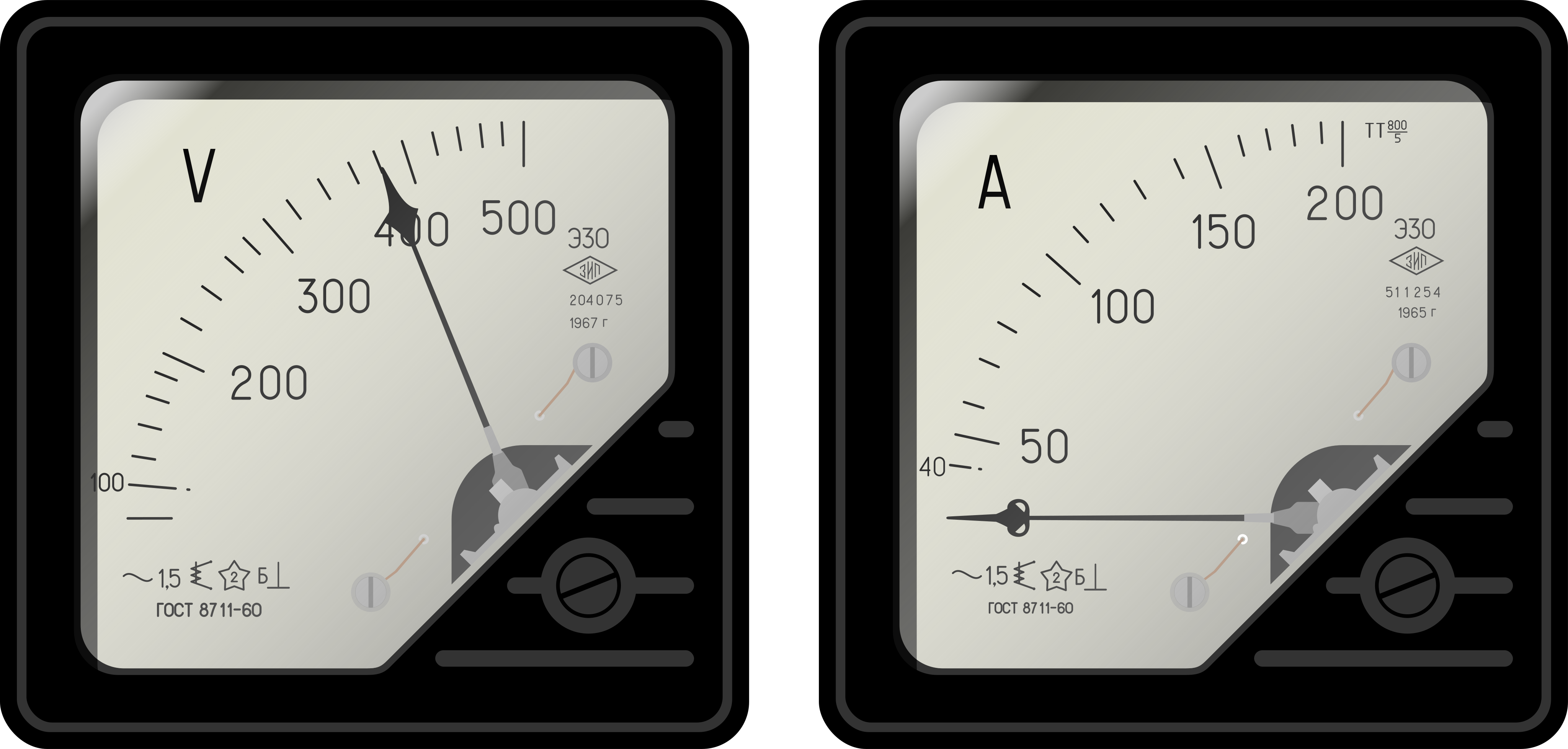
Ammeters: Measuring Current
An ammeter measures current and must be placed in series with the component you’re measuring. All the current you’re measuring has to flow through the ammeter.
For an ammeter to avoid disturbing the circuit, it must have very low internal resistance (ideally zero). If the ammeter had high resistance, it would behave like an extra resistor in series, reducing the very current you were trying to measure.
Voltmeters: Measuring Voltage
A voltmeter measures the potential difference between two points and must be placed in parallel with the component you’re measuring.
For a voltmeter to avoid disturbing the circuit, it must have very high internal resistance (ideally infinite). If the voltmeter had low resistance, it would provide an alternate current path through itself, changing the circuit’s behavior.
| Meter | Connection | Ideal resistance | Why |
|---|---|---|---|
| Ammeter | Series | ≈ 0 Ω | Doesn’t add resistance to the loop |
| Voltmeter | Parallel | ≈ ∞ Ω | Doesn’t draw current from the circuit |
What Happens with Non-Ideal Meters?
- A real ammeter has some small resistance (not zero). It reduces the current in the circuit slightly. The measured current is lower than the true value would be without the ammeter present.
- A real voltmeter has finite (not infinite) resistance. It draws a tiny bit of current through itself, which slightly changes the voltage distribution in the circuit. The measured voltage is lower than the true value would be.
In practice, both effects are usually negligible because modern meters approach ideal behavior closely enough — but the MCAT may test the concept.