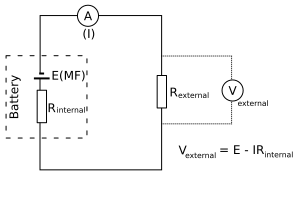
There’s no such thing as an ideal battery. Every real battery has some internal resistance — a small but real opposition to current inside the battery itself. That resistance steals a portion of the EMF before any current reaches the external circuit, which is why your phone charger feels warm and why old batteries can no longer power what they once could.
The MCAT requires you to understand this concept and the formula that goes with it. Without internal resistance, every battery would deliver its full rated voltage forever — but then we couldn’t explain why an old AA can’t run a toy any longer despite having “almost full” voltage when measured.
Terminal Voltage
A real battery modeled as an ideal EMF source (ε) in series with internal resistance r. The terminal voltage available to the external circuit is V=ε−Ir. As current grows, more voltage is lost inside the battery. Credit: Wikimedia Commons, CC BY-SA
Think of a real battery as a tiny circuit inside itself: an ideal EMF source in series with a small internal resistance r. When current flows, some voltage gets “lost” inside the battery — converted to heat by the internal resistance. The voltage you actually measure at the battery’s terminals is less than the EMF.
When no current flows (open circuit), the terminal voltage equals the EMF exactly — because the Ir drop is zero. This is why a voltmeter reading across an unused battery shows the full EMF (a voltmeter draws negligible current).
Why Batteries “Die”
As a battery ages, its internal resistance increases due to chemical degradation inside the cell. The Ir drop gets bigger and bigger, leaving less voltage for the external circuit. The battery’s EMF may still be close to its rated value — but so much voltage gets lost internally that the device can’t function any more.
This is why an “old” AA battery often shows nearly full voltage on a multimeter (where almost no current is drawn) but can’t power a flashlight (which needs to draw real current). Multimeter sees ~1.5 V open-circuit; flashlight sees, say, 0.6 V because Ir has eaten the rest.
The Complete Circuit Equation
For a simple circuit with a battery (EMF ε, internal resistance r) and an external resistance R:
So the terminal voltage across the external resistor is:
Vterminal=IR=R+rεR
When R≫r (external resistance much larger than internal): nearly all the EMF appears across the external resistor (negligible internal loss). When R≪r (small external resistor): most of the EMF gets dropped inside the battery.
Short Circuits
A short circuit is when the external resistance approaches zero — a bare wire connects the battery terminals directly, with no load in between. In that case:
Ishort=rε
This is the maximum possible current the battery can deliver. All the EMF drops across the internal resistance, dumping massive power into the battery as heat. In real life, short circuits are dangerous — batteries can rupture or catch fire, lithium-ion cells in particular can vent flames. (Hence safety circuits in modern devices.)
A battery has EMF 9 V and internal resistance 0.5 Ω. It's connected to a 4 Ω external resistor. What is the terminal voltage?
Click to reveal answer
Vterminal=8 V. Current: I=ε/(R+r)=9/4.5=2 A. Terminal: V=ε−Ir=9−2(0.5)=8 V (or directly: V=IR=2×4=8 V).
A 12 V battery with internal resistance 2 Ω is short-circuited. What is the current?
Click to reveal answer
I=6 A. In a short, R=0, so I=ε/r=12/2=6 A. All 12 V drops across the internal resistance, dumping P=εI=72 W of heat into the battery — which is exactly why shorts are dangerous.
An old AA battery shows 1.5 V on a multimeter (open circuit) but only 0.5 V when connected across a small flashlight bulb that draws 0.5 A. What is the internal resistance?
Click to reveal answer
r=2 Ω. Voltage drop inside the battery: ε−Vterminal=1.5−0.5=1 V. This drop equals Ir, so r=(1 V)/(0.5 A)=2 Ω. (A new AA usually has r≈0.1–0.3 Ω. This battery has aged and degraded — the bigger r is what makes it "dead.")