
Kirchhoff's Laws
Series and parallel rules handle simple circuits beautifully. But what about messier ones — circuits with multiple batteries, branching paths, or components that don’t fit neatly into “series” or “parallel” boxes? That’s where Kirchhoff’s two laws come in.
These aren’t new physics. They’re just conservation of charge and conservation of energy applied specifically to circuits — dressed up in slightly intimidating names. Understand the analogies and the laws become almost obvious.
Kirchhoff’s Current Law (KCL) — The Junction Rule
This is just conservation of charge. Charges can’t pile up at a junction or disappear — whatever flows in has to flow out.
Think of a river fork: if 10 m³/s flows into the fork and 6 m³/s goes left, then 4 m³/s must go right. The water didn’t vanish, and it didn’t accumulate at the split.
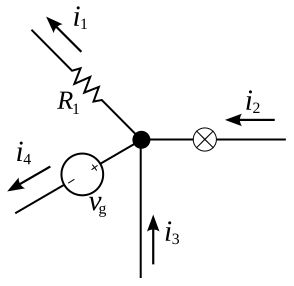
Example. If 5 A flows into a junction and splits into three branches with 2 A in the first branch and 1 A in the second, the third branch carries A out.
Kirchhoff’s Voltage Law (KVL) — The Loop Rule
This is conservation of energy. A charge that travels around a complete loop and returns to its starting point ends up with the same potential energy it started with — so the energy gained from batteries must exactly equal the energy lost across resistors. Net change: zero.
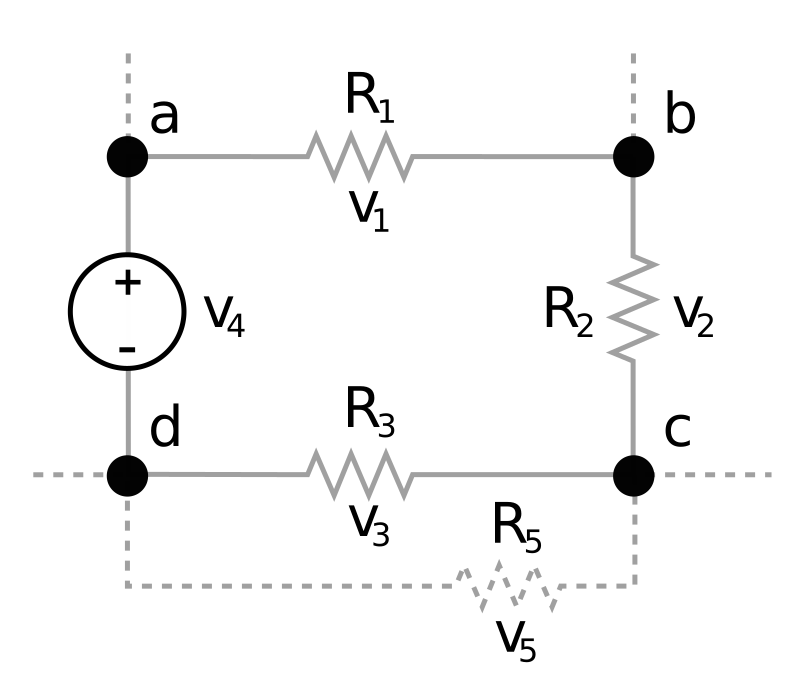
Sign Conventions for KVL
When you “walk” around a loop in a chosen direction, here’s how to tally up voltage changes:
| Element | Walking direction | Voltage change |
|---|---|---|
| Battery | − to + (through the battery) | (gain) |
| Battery | + to − (through the battery) | (drop) |
| Resistor | Same direction as current | (drop) |
| Resistor | Against direction of current | (gain) |
The choice of loop direction doesn’t matter — pick one, stay consistent, and the math works out.
Applying Kirchhoff’s Laws — A Strategy
- Label all currents with assumed directions. If you guess wrong, the math returns a negative value — that just means the current actually flows opposite your guess. No need to redo the diagram.
- Apply KCL at each junction to relate the branch currents.
- Apply KVL around enough independent loops to solve for all unknowns.
- Solve the system of equations.
For the MCAT, you rarely need more than one junction equation and one or two loop equations. The exam favors conceptual understanding over algebraic complexity.
Quick Example
A simple loop has a 10 V battery and two series resistors: Ω and Ω. Apply KVL clockwise starting at the battery:
A. Then V, V. They add to 10 V — the battery’s EMF. KVL satisfied. ✓
This tiny example shows the recipe: walk around the loop, write down each voltage change with the correct sign, set the sum to zero, solve.