
RC Circuits and Problem Solving
An RC circuit contains a resistor (R) and a capacitor (C). When you flip a switch, the capacitor doesn’t charge or discharge instantly — it does so gradually, following an exponential curve. The resistor sets the pace; the capacitor sets the size of the storage.
The MCAT doesn’t ask you to derive the exponential equations, but you must know the qualitative behavior and the time constant . RC circuits show up everywhere: camera flashes, defibrillators, audio filters, the timing circuits in just about every electronic device.
This section also wraps up the chapter with a general circuit-problem-solving strategy that you can apply to anything from simple series/parallel questions to multi-loop monsters.
Charging an RC Circuit
When a battery is connected to a resistor and an uncharged capacitor in series, charge flows onto the capacitor plates. At first the capacitor is empty, so nothing opposes the current — initial current is high. As charge builds up on the plates, the voltage across the capacitor grows, opposing further current flow. Current gradually decreases until the capacitor is fully charged and current stops entirely.
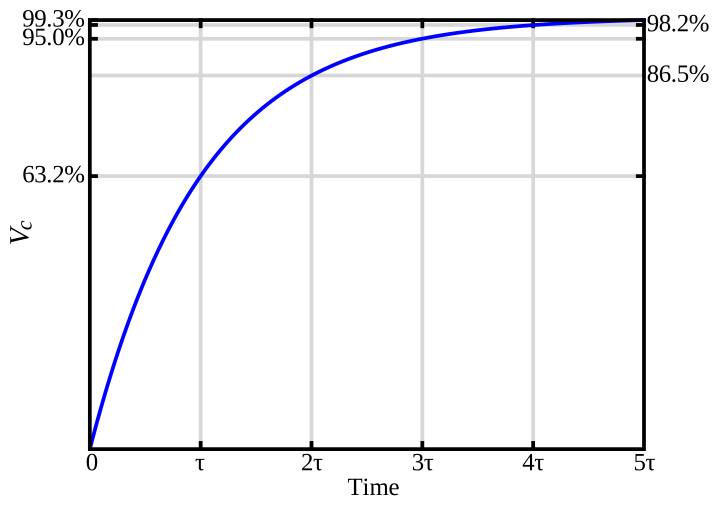
During charging:
- Charge starts at 0 and grows exponentially toward .
- Current starts at and decays exponentially toward 0.
- Capacitor voltage starts at 0 and grows toward .
Discharging an RC Circuit
When a fully charged capacitor is disconnected from the battery and connected through a resistor, the stored charge flows back out through the resistor. Current starts high (large across the capacitor) and decays toward zero as the capacitor drains.
During discharging, all three quantities (, , ) start at their initial values and decay exponentially toward zero — same time constant.
The Time Constant
The time constant is just a number with units of seconds — and the percentages of completion at each multiple of are the same for every RC circuit:
| Time elapsed | Charging (% of max) | Discharging (% remaining) |
|---|---|---|
| 1 τ | 63% | 37% |
| 2 τ | 86% | 14% |
| 3 τ | 95% | 5% |
| 5 τ | ~99% | ~1% |
Why 63% and 37%?
These come from the exponential function. After one time constant, (37%). For charging, the capacitor reaches (63%) of its maximum. You don’t need to work with on the MCAT — just memorize the split at 1 τ, and the “essentially done at 5 τ” rule.
How R and C Affect the Time Constant
- Larger → larger τ → slower charging/discharging (current is more restricted).
- Larger → larger τ → slower charging/discharging (more charge to move on/off the plates).
- Smaller or → smaller τ → faster response.
Practical consequence: if you want a fast camera flash (rapid discharge), you use a small resistor and a moderate capacitor. If you want a slow circuit (a windshield-wiper delay), you use a big resistor.
Circuit Problem-Solving Strategy
Here’s a general game plan for any MCAT circuit problem:
- Simplify. Identify resistors and capacitors that are in series or parallel. Combine them into equivalent values. Redraw the simplified circuit.
- Apply the big rules. Ohm’s law (), Kirchhoff’s junction rule (current in = current out), Kirchhoff’s loop rule (voltage gains = voltage drops around any loop).
- Identify what’s constant. In series: current is the same. In parallel: voltage is the same. For capacitors with battery connected: is constant. For isolated capacitors: is constant.
- Use the right power formula. , , or — pick the one that matches the variables you already know.
- Check your answer. Does total resistance look reasonable (parallel < smallest)? Do voltage drops sum to the EMF (KVL)? Do currents balance at junctions (KCL)?