A dielectric is an insulating material placed between the plates of a capacitor. Glass, plastic, ceramic, paper, even air — all are dielectrics. They’re called “insulators” in everyday speech (because they don’t conduct), but in capacitor land they have a special name and a specific job.
Inserting a dielectric always increases capacitance. But the downstream effects — what happens to voltage, charge, and energy — depend on whether the battery is still connected. This distinction is one of the highest-yield topics in MCAT circuit physics. The exam loves writing both versions of the question and watching students get one right and the other wrong.
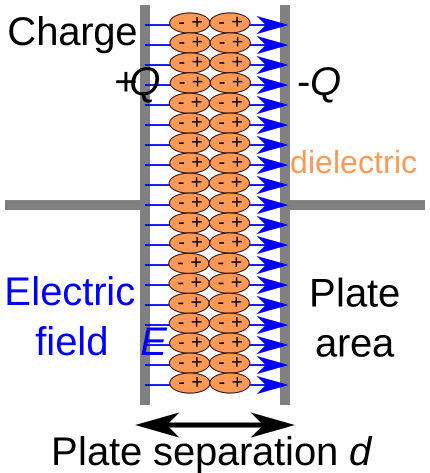
A capacitor with a dielectric inserted. The dielectric molecules polarize in the electric field, partially canceling the internal field — which lets the capacitor store more charge at the same voltage. Credit: Wikimedia Commons, CC BY-SA
How Dielectrics Increase Capacitance
Why Does This Happen?
The dielectric molecules can polarize — their positive and negative ends shift slightly in response to the electric field between the plates. The polarized molecules create their own small internal electric field that points opposite to the original field. The two fields partially cancel, leaving a weaker net field.
A weaker field means less voltage is needed to support a given amount of charge — equivalently, more charge can be stored at the same voltage. That’s exactly what “higher capacitance” means.
The Two Scenarios: Battery Connected vs. Disconnected
This is where the MCAT gets sneaky. You have to know what stays constant in each scenario.
Scenario 1: Battery Stays Connected
The battery enforces constant voltage across the capacitor.
Quantity
What happens
Why
Capacitance (C)
× κ
C=κC0
Voltage (V)
Stays the same
Battery holds it
Charge (Q)
× κ
Q=CV, V constant, C bigger
Electric field (E)
Stays the same
E=V/d, V and d unchanged
Energy (U)
× κ
U=21CV2, V constant, C bigger
Scenario 2: Battery Disconnected, Then Dielectric Inserted
The charge is trapped on the plates — no battery to add or remove any.
Quantity
What happens
Why
Capacitance (C)
× κ
C=κC0
Charge (Q)
Stays the same
No battery to change it
Voltage (V)
÷ κ
V=Q/C, Q constant, C bigger
Electric field (E)
÷ κ
E=V/d, V smaller
Energy (U)
÷ κ
U=Q2/(2C), Q constant, C bigger
Dielectric Breakdown
Every dielectric has a maximum electric field strength it can withstand. Push above this limit (called the dielectric strength) and the material suddenly starts conducting — the capacitor discharges all at once, often destructively.
The most familiar example: lightning. The atmosphere is normally a great insulator (air’s dielectric strength is ~3 MV/m). But during a storm, charge separation builds up such enormous voltages between cloud and ground that the field exceeds air’s breakdown strength. Air abruptly becomes conducting along a path → boom, lightning bolt.
The same principle limits how small modern electronics can be: as components shrink, fields get bigger (E=V/d), and engineers have to choose dielectrics with very high breakdown strengths to avoid catastrophic failure.
A parallel plate capacitor is connected to a 100 V battery. A dielectric with κ=4 is inserted. What happens to the charge on the plates?
Click to reveal answer
Charge increases by a factor of 4. Battery stays connected, so V is constant. C increases to 4C0. Q=CV, so Q increases to 4Q0. The battery pushes additional charge onto the plates to maintain the same voltage.
A charged capacitor is disconnected from the battery. A dielectric (κ=3) is then inserted. What happens to the voltage and the energy stored?
Click to reveal answer
Voltage drops to V0/3; energy drops to U0/3. Battery disconnected, so Q is constant. C increases to 3C0. V=Q/C → V drops by 3. U=Q2/(2C) → U drops by 3. The "missing" energy went into pulling the dielectric into the gap (the field literally pulls the dielectric in — work that energy did).
Why does inserting a dielectric *always* increase capacitance, regardless of which scenario you're in?
Click to reveal answer
Because C depends only on geometry and material — not on V or Q. The dielectric polarizes in the field, partially canceling the field inside the gap. That allows more charge to be stored per volt — a higher C. The increase happens whether or not a battery is present, because C is a property of the capacitor itself, not of the circuit it's in.