A diamond sparkles with an almost supernatural brilliance. Light enters the gem — but instead of just passing through, it bounces around inside, reflecting off the internal facets multiple times before finally escaping out the top.
The diamond essentially traps light. The phenomenon is called total internal reflection (TIR), and it only happens under very specific conditions. It’s also the trick behind fiber-optic cables (which carry the entire global internet) and medical endoscopes (which let doctors see inside the body without cutting it open).
When Does Total Internal Reflection Occur?
TIR happens when two conditions are both met:
Light is traveling from a higher-n medium to a lower-n medium (denser → less dense).
The angle of incidence is greater than the critical angle.
If either condition fails, TIR doesn’t happen. Light going from air into glass (low → high) can never undergo TIR, no matter the angle.
The Critical Angle
Total internal reflection. Below the critical angle: light refracts through. At the critical angle: refracted ray grazes the surface at 90°. Above the critical angle: all light reflects back into the denser medium. Credit: Wikimedia Commons, CC BY-SA
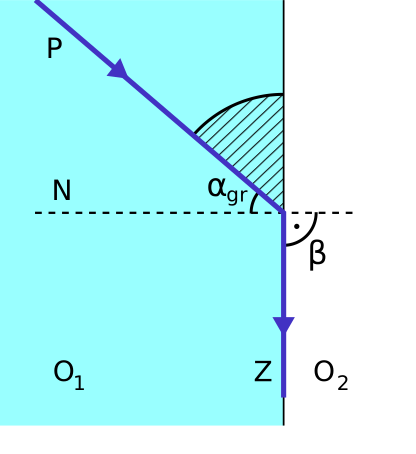
The critical angle (θc) is the angle of incidence at which the refracted ray just barely skims along the boundary surface (θ2=90°). Above this angle of incidence, no light is transmitted — all of it reflects.
This formula falls right out of Snell’s law with θ2=90°:
n1sinθc=n2sin90°=n2⇒sinθc=n2/n1.
Why the Ratio Matters
A small critical angle means light gets trapped easily — even at modest angles, TIR kicks in. A large critical angle means light can escape across most angles and only gets trapped at very steep approaches.
Interface
n1
n2
Critical angle
Glass → Air
1.50
1.00
41.8°
Water → Air
1.33
1.00
48.8°
Diamond → Air
2.42
1.00
24.4°
Fiber Optics
Fiber optic cables are arguably the most important application of TIR. A thin glass or plastic fiber (the core) is surrounded by a coating (cladding) with a lower refractive index. Light enters one end of the fiber and hits the core-cladding boundary at a steep angle — well above the critical angle. The light bounces along the length of the fiber via TIR, never escaping, even around gentle curves.
This is how the modern internet is built — undersea fiber-optic cables carry data at near light-speed across oceans. It’s also how endoscopes let doctors see inside organs (bundles of fibers carry images out from the body), and how a laparoscopic surgeon can operate through tiny incisions.
What Happens at Each Angle?
θ<θc: Most light refracts through (some reflects). Normal refraction.
θ=θc: Refracted ray grazes the surface at 90°. The boundary case.
θ>θc: All light reflects back into the original medium. Zero transmission. TIR.
Calculate the critical angle for light traveling from glass (n=1.50) into water (n=1.33).
Click to reveal answer
~62.5°.sinθc=n2/n1=1.33/1.50≈0.887⇒θc≈62.5°. Since n1>n2 (glass is denser than water), TIR is possible. Any angle of incidence > 62.5° → all light reflects back into the glass.
Can TIR occur when light travels from air (n=1.00) into diamond (n=2.42)? Why or why not?
Click to reveal answer
No. TIR only happens when going from higher n to lower n. Air (n=1) is *less* dense than diamond (n=2.42), so this is a low-to-high transition. Light going from air into diamond always partially transmits — TIR is impossible at this interface.
Why can a fiber-optic cable transmit light around gentle curves without losing signal?
Click to reveal answer
Because every reflection inside the fiber is a total internal reflection. The core has higher n than the cladding, and light hits the boundary at angles steeper than the critical angle. So 100% of the light reflects back into the core every time — no transmission losses, no leakage. Even with curves, as long as the angle stays above θc, TIR keeps the light bouncing forward.